

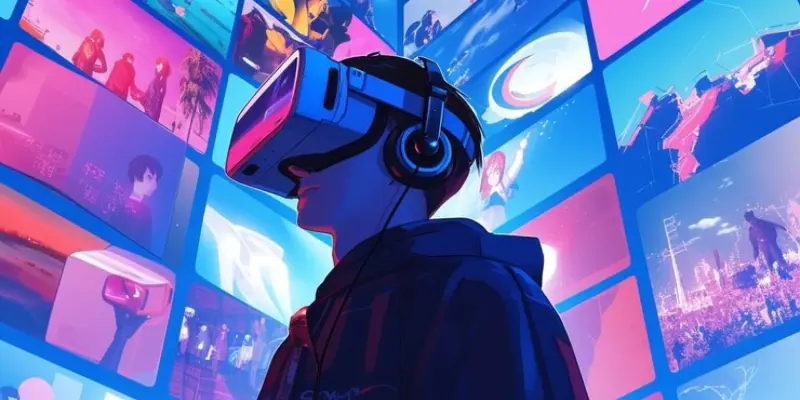
The immersive content creation market is experiencing rapid growth driven by technological advancements and demand for enhanced digital experiences. Valued at USD 12.57 billion in 2023, it is estimated to reach USD 87.12 billion by 2032, growing at a compound annual growth rate of 24% from 2024 to 2032. The surge in demand for sophisticated 3D and virtual reality content, along with technological innovations propelling user engagement, are key factors fueling this expansion. Immersive technologies are now integral across various sectors, redefining how users interact with digital content and paving the path toward a new era of digital transformation.
Technological Advancements Driving Growth
Virtual Reality as a Market Leader
Virtual reality (VR) has emerged as a dominant force in the immersive content market, commanding a significant share of the revenue in 2023. At the forefront of this transformation, VR spans multiple applications including gaming, simulations, and training, offering users immersive three-dimensional environments that replicate real-world scenarios. These capabilities are particularly beneficial for educational and defense sectors, where realistic simulations provide considerable advantages for training purposes. The educational sector utilizes VR to offer students an interactive and engaging learning experience, while the defense sector leverages VR simulations for safe and effective training environments.
The Rise of Augmented Reality
Augmented reality (AR) is rapidly gaining traction and is projected to witness the fastest growth in the forecasted period. Expanding into industries such as retail, healthcare, and education, AR enhances real-world experiences by seamlessly integrating computer-generated graphics and sounds. The use of affordable and user-friendly devices, like smartphones and AR glasses, allows AR applications to revolutionize various sectors by bringing interactive and engaging experiences to everyday activities. In retail, AR is transforming customer experiences by providing virtual fitting rooms and interactive product displays, while in healthcare, AR aids in complex surgeries through enhanced visualization tools.
Market Dynamics and Regional Insights
North America’s Market Stronghold
North America stands as a powerhouse in the immersive content market, contributing 32% of the total revenue. The region’s stronghold is underpinned by prominent technology companies, high consumer adoption rates, and substantial investments in immersive technologies. The presence of major tech enterprises facilitates innovation and growth, while consumer readiness for adopting new technologies ensures a promising market growth trajectory. The region’s infrastructure and favorable climate for technological exploration further bolster its position, as companies continually strive to advance immersive experiences for wide-ranging applications.
Asia-Pacific’s Fastest Growing Market
The Asia-Pacific region is set to experience the fastest compound annual growth rate by 2032, driven by extensive investments in digital infrastructure and a tech-savvy population. The government’s initiatives to promote AR/VR technologies and the region’s cultural inclinations toward technological advancements make this growth possible. Countries like China, India, and Japan lead this surge, playing crucial roles in regional market evolution. Their efforts in nurturing startups and fostering technological collaborations further enhance an innovative ecosystem conducive to immersive technologies. The large population eager to embrace digital transformation sets the stage for robust market development.
Key Drivers and Innovations
Hardware’s Pivotal Role
In 2023, hardware accounted for a significant share of market revenue, with VR headsets and AR glasses being central to delivering high-quality immersive experiences. These essential devices are critical in enveloping users into engaging digital environments, significantly influencing the immersive content landscape. As technology continues to evolve, the software segment is predicted to grow quickly, offering developers powerful platforms for efficient content creation, editing, and distribution. Software innovations not only complement hardware capabilities but also expand possibilities, enabling creators to craft immersive content across various genres and industries effectively.
Industry-Specific Applications
The gaming industry leads the immersive content market, fueled by the voracious demand for interactive and visually captivating content. With continuous enhancements in VR and AR platforms, developers are crafting inventive gaming experiences enriched with haptic feedback and multi-sensory environments. These innovations allow players to experience games in ways that have never been imagined before, creating unparalleled engagement and immersion. Similarly, the entertainment and media sectors are increasingly adopting immersive technologies, enhancing viewer experiences through virtual concerts, interactive films, and other creative applications that deliver emotionally and experientially rich content.
Noteworthy Developments
Corporate Collaborations and Ventures
Corporate alliances have emerged as pivotal strategies in advancing mixed reality content, exemplified by Meta Platforms collaborating with James Cameron’s Lightstorm Vision. This partnership aims to enhance the Meta Quest headset, focusing extensively on high-quality 3D entertainment content, including live sports and concerts. Specialized companies like Cosm are also contributing significantly by securing over $250 million in funding, thereby elevating their valuation beyond $1 billion. These collaborations and investments enable the acceleration of immersive technology innovation, breaking new ground in transforming content consumption and user interaction.
Investment Surge
The immersive content creation sector is experiencing significant growth, spurred by technological advancements and the demand for enriched digital experiences. In 2023, the market was valued at USD 12.57 billion and is projected to skyrocket to USD 87.12 billion by 2032, with a compound annual growth rate of 24% from 2024 to 2032. This expansion is largely driven by the increasing need for advanced 3D and virtual reality content alongside innovations that enhance user engagement. Immersive technologies are becoming essential across multiple industries, transforming user interaction with digital content and heralding a new era in digital transformation. As these technologies evolve, they redefine the boundaries of digital engagement, offering unprecedented ways for consumers to experience media, entertainment, education, and even healthcare. This shift is setting the stage for the future, where digital interactions are not just seen but felt, reshaping consumer expectations and industry standards.