

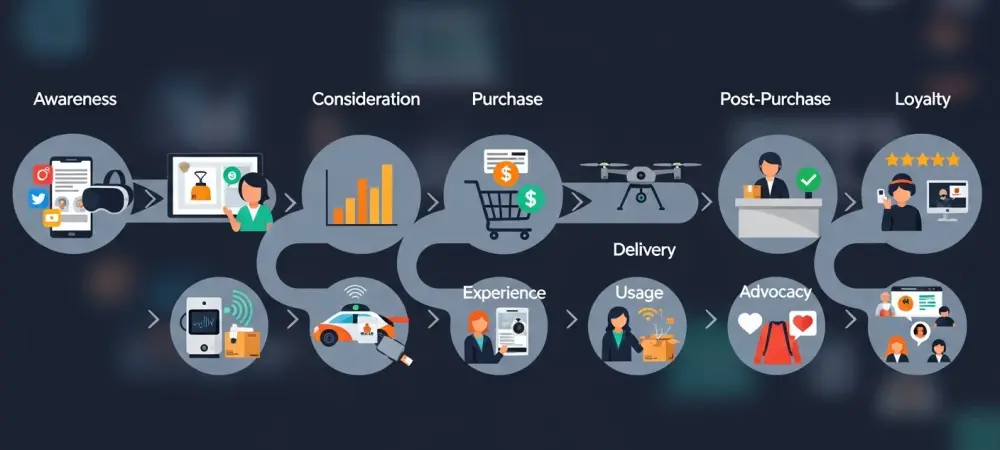
High-growth retail environments are currently defined by the seamless fusion of spatial computing, automated logistics, and personalized AI assistants that guide every purchasing decision. Today’s consumers no longer view their shopping habits as a series of disconnected events occurring separately on a smartphone screen or inside a brick-and-mortar storefront. Instead, they expect a fluid narrative where a product discovered via an augmented reality advertisement in a transit hub can be seamlessly reviewed on a tablet and eventually purchased through a biometric-enabled kiosk. This shift has rendered traditional, linear sales funnels obsolete, forcing retailers to adopt more sophisticated methods for visualizing the path to purchase. A modern journey map serves as the primary blueprint for understanding these multidimensional interactions, allowing businesses to pinpoint exactly where they are losing momentum or where they have successfully captured a shopper’s imagination. By meticulously documenting every micro-interaction, brands can transition from reactive service models to proactive experience design, ensuring that every touchpoint adds tangible value to the consumer’s life rather than just creating digital noise.
1. Understanding the Core Phases of Modern Retail
The initial stage of the retail journey revolves around awareness and consideration, where the consumer first encounters a brand and begins evaluating its offerings. Awareness often occurs in a fragmented landscape, ranging from algorithmic social media discovery to physical interactions with interactive storefront displays. Once a brand captures interest, the shopper moves into the consideration phase, which has become increasingly data-intensive. In this stage, consumers utilize high-speed research tools to compare technical specifications, read peer reviews across decentralized platforms, and view high-definition product demonstrations. Retailers must ensure that information is not only accurate but also consistent across all channels, as any discrepancy during this research phase can lead to a total loss of trust. The goal here is to provide enough value and clarity that the shopper feels confident moving toward a formal engagement with the product.
The journey culminates in the acquisition and loyalty phases, where the focus shifts from persuasion to execution and long-term relationship building. Acquisition is no longer just about the point of sale; it encompasses the entire checkout experience, whether it involves a one-click digital payment or a frictionless in-store mobile checkout. Speed and security are the primary drivers at this juncture, as any technical hurdle can cause immediate cart abandonment. Following a successful purchase, the loyalty phase begins, which is perhaps the most critical component for sustainable growth. This stage involves post-purchase engagement through automated replenishment reminders, exclusive access to brand communities, and rewards programs that offer genuine utility. By maintaining a continuous dialogue after the transaction, retailers can transform a one-time buyer into a brand advocate who provides a recurring revenue stream and valuable word-of-mouth marketing.
2. Step 1: Determining the Strategic Purpose of the Map
Before any data is collected or diagrams are drawn, the organization must achieve total alignment regarding the specific objectives of the journey mapping initiative. Mapping an entire end-to-end retail experience is a massive undertaking, and in many cases, it is more effective to focus on a particular segment of the journey that is currently underperforming. For example, a team might decide to map only the returns and exchange process if data suggests that customers are frustrated after a purchase. Alternatively, the goal could be to optimize the onboarding process for a new subscription service. By narrowing the scope, the resulting map becomes a much more precise diagnostic tool rather than a vague overview. It is essential to define exactly what the business hopes to learn and which specific metrics, such as conversion rates or customer satisfaction scores, will be used to measure the success of the improvements.
Once the scope is established, the leadership team must identify the internal stakeholders who will use the map and how the findings will be integrated into the company’s operations. A journey map is not merely a marketing asset; it is a cross-functional document that should influence product development, logistics, customer support, and physical store design. Determining who will have access to the data and how it will be shared ensures that the insights do not remain siloed within a single department. For instance, if the map reveals that customers frequently struggle with a mobile app’s navigation, the software engineering team needs to be involved in the mapping process from the beginning. Defining these roles and communication channels early on prevents the mapping exercise from becoming a purely academic pursuit and ensures that the final visual story leads to tangible operational changes.
3. Step 2: Accumulating and Organizing Reliable Data
Building an accurate map requires a sophisticated approach to data collection, starting with the first-party data that the organization already possesses. This category includes granular information such as individual purchase histories, precise website navigation paths, and interactions within loyalty programs. In the current retail climate, this also extends to data from point-of-sale systems that can track how physical store visitors move through different departments. By synthesizing these diverse data points, a retailer can construct a high-fidelity profile of how customers are actually behaving, rather than how the company thinks they should behave. This internal data acts as the factual foundation of the journey map, highlighting clear patterns in behavior, such as specific times of day when mobile traffic peaks or the average number of visits a shopper makes before committing to a high-ticket item.
To complement internal findings, businesses must also look outward at third-party data and broader market intelligence to contextualize their customers’ actions. This external perspective involves analyzing industry reports, general consumer spending trends, and competitor benchmarking data to see how the brand stacks up within the wider ecosystem. Understanding that a sudden drop in online engagement might be due to a regional network issue or a shift in general economic sentiment prevents the team from making incorrect assumptions based on internal data alone. Third-party data provides the necessary environmental context, allowing retailers to see the bigger picture and anticipate shifts in consumer expectations before they become mainstream. Combining these two data streams ensures that the journey map is both deeply personal to the brand’s own customers and strategically aligned with the broader realities of the modern retail market.
4. Step 3: Incorporating Direct Qualitative Customer Feedback
While quantitative data provides a clear picture of what is happening, qualitative feedback is the only way to truly understand why consumers make specific choices. Numbers might show that a high percentage of shoppers exit the website at the shipping information page, but only direct feedback can reveal if they were confused by the layout or put off by the delivery timelines. Engaging in structured interviews or facilitating casual conversations within the physical store environment allows retailers to capture the nuance of the human experience. These conversations often reveal hidden pain points that are invisible to tracking software, such as a customer’s emotional hesitation or a subtle preference for a competitor’s packaging. This layer of “human data” is essential for building empathy and ensuring that the final journey map reflects the authentic feelings of the people it is meant to serve.
Validating statistical findings with real-world testimonials ensures that the journey map remains grounded in reality and is not skewed by technical anomalies. For example, a retailer might find that their loyalty program has high enrollment numbers, which looks like a success on a spreadsheet, but customer interviews might reveal that people only sign up for a one-time discount and never intend to engage again. By digging deeper into the motivations behind the actions, the mapping team can identify the difference between superficial engagement and genuine brand affinity. This qualitative insight allows the business to refine its incentives and communication strategies to better align with what customers actually value. Ultimately, incorporating the voice of the customer ensures that every step of the journey is designed to solve real problems and provide meaningful benefits, rather than just hitting internal performance targets.
5. Step 4: Cataloging All Digital and Physical Touchpoints
In a fragmented retail landscape, identifying every point of contact between the customer and the brand is a complex but necessary task. These touchpoints include obvious interactions like television advertisements and physical store visits, but they also encompass more subtle moments such as automated text message updates, email receipts, and third-party review sites. To ensure a comprehensive list, it is helpful to bring together representatives from marketing, sales, customer service, and logistics for a collaborative brainstorming session. Each department interacts with the customer in different ways and can provide insights into touchpoints that others might overlook. For instance, the logistics team might highlight the importance of the delivery driver’s interaction, while the customer service team might point out the frequency of inquiries coming through social media direct messages.
Once all touchpoints are listed, the team must analyze how these different channels interact with one another to form a cohesive experience. A customer might see an ad on their smart watch, research the product on a laptop, and then use a mobile app to check in-store availability before finally making a purchase in person. Mapping these cross-channel transitions is vital for identifying where the experience might break down. If the transition from a digital ad to a product page is slow or if the in-store inventory reflected on the app is inaccurate, the customer journey is interrupted, often leading to frustration. By documenting the entire ecosystem of contact points, retailers can ensure that the brand voice and service quality remain consistent regardless of how or where the customer chooses to engage. This holistic view is what allows a business to provide a truly seamless omnichannel experience.
6. Step 5: Pinpointing Emotional Drivers and Challenges
Understanding the psychological state of the shopper at each stage of the journey is the key to moving them from consideration to acquisition. Every interaction is driven by a specific motivation, whether it is the excitement of a new purchase, the urgency of a needed replacement, or the desire for a personalized reward. By putting themselves in the customer’s shoes, retailers can identify what a person is trying to achieve at any given moment and what emotional hurdles might be standing in their way. For instance, during the consideration phase, a customer might feel overwhelmed by too many choices, leading to decision paralysis. Identifying these emotional “low points” allows the business to intervene with helpful tools, such as curated product recommendations or simplified comparison charts, that alleviate stress and provide a clear path forward.
Beyond identifying frustrations, the mapping process must also highlight the incentives that successfully motivate a customer to take the next step. These incentives are not always financial; they can include things like the peace of mind provided by a transparent return policy or the social validation found in a community forum. Conversely, it is equally important to recognize the specific triggers that cause a customer to give up and leave the journey entirely. This could be something as simple as a required account creation during checkout or a lack of clear contact information for customer support. Addressing these psychological barriers transforms the journey from a series of hurdles into a smooth and rewarding progression that respects the customer’s time and emotional energy.
7. Step 6: Visualizing the Complete Shopper Experience
The final step in the mapping process is to synthesize all collected data, touchpoints, and emotional insights into a clear and accessible visual diagram. This visualization does not need to be an overly complex work of art; its primary goal is to tell a coherent story that is easy for any employee to understand at a glance. A well-designed map typically uses a horizontal axis to represent time or the phases of the journey and a vertical axis to show different categories of information, such as customer actions, emotional states, and technical touchpoints. By layering these elements together, the map reveals the correlations between specific brand actions and customer reactions. It serves as a single source of truth that aligns the entire company around the customer’s perspective, making it much easier to identify where improvements are needed and why they matter.
Once the visual map is completed, it must be treated as a living document that is integrated into the daily operations and training of the staff. Providing employees with access to the journey map helps them understand how their individual roles contribute to the overall customer experience. For a warehouse worker, seeing how a delayed shipping notification impacts the “loyalty” phase of the map can provide a new sense of purpose and urgency. For a software developer, seeing the “frustration” peaks during mobile navigation can prioritize specific bug fixes. The map should be displayed in common areas or shared through digital internal portals to keep the customer’s journey at the forefront of everyone’s mind. Regularly updating the map as consumer behaviors evolve ensures that the business stays agile and continues to meet the high standards of the modern retail environment.
8. Strategic Application and Implementation for Retail Growth
A completed journey map is a powerful tool for refining marketing tactics and ensuring that advertising spend is directed toward the most effective channels. By analyzing the map, a retailer can see exactly which touchpoints are driving the most significant movements in the customer journey and which ones are failing to provide a return on investment. This allows for a more surgical approach to messaging, where content can be tailored to match the specific emotional state of the consumer at a given time. For example, if the map shows that customers in the awareness phase are primarily looking for inspiration, the brand can focus on high-quality visual storytelling. If those in the consideration phase are seeking technical details, the marketing spend can be shifted toward informative webinars or detailed white papers. This targeted approach reduces customer acquisition costs and increases the overall efficiency of the marketing department.
Beyond marketing, the journey map is essential for building a truly seamless experience that bridges the gap between online and offline shopping. One of the most common points of friction identified in retail mapping is the inconsistency between different platforms, such as a price listed online not matching the price found in the physical store. Using the map to identify these gaps allows the organization to implement synchronized pricing and inventory systems that eliminate confusion and build long-term trust. Additionally, the map can highlight opportunities to boost support services by identifying exactly where customers are likely to experience anxiety, such as during the period between a purchase and the final delivery. Providing automated updates or live chat options at these high-stress moments can preemptively solve problems and turn a potentially negative experience into a highlight of the customer’s journey.
9. Long-Term Evolution of Experience Design
The development of the retail journey map provided a clear roadmap for navigating the complexities of modern consumer expectations and informed every major strategic decision. By looking back at the data gathered and the emotional insights captured, the organization was able to identify the specific moments where customer trust was earned or lost. Actionable steps were taken to eliminate technical bottlenecks, such as streamlining the checkout process and ensuring that all digital touchpoints were optimized for rapid interaction. These improvements were not just superficial changes; they represented a fundamental shift in how the business viewed its relationship with the shopper. The map transformed the company culture from one that was focused on internal processes to one that was obsessed with the customer’s success, leading to a measurable increase in both satisfaction and retention.
As the retail landscape continued to evolve, the journey map served as a foundational tool for ongoing innovation and proactive problem-solving. It allowed the team to anticipate future shifts in behavior by identifying the underlying motivations that remained constant even as technology changed. The insights gained from direct customer feedback proved to be the most valuable asset, as they provided a human context that quantitative metrics could never replicate. By maintaining the map as a dynamic and frequently updated resource, the organization ensured that it never lost touch with the reality of the shopper’s experience. The transition from a reactive service model to a design-led approach was fully realized, proving that a deep understanding of the customer journey is the most reliable driver of sustainable growth and brand loyalty in a competitive market.