

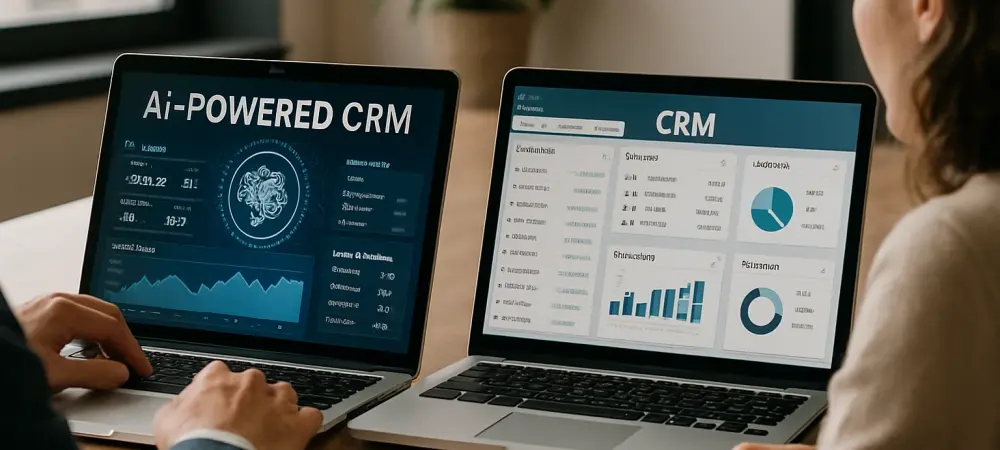
For countless businesses, the digital storefront never closes, yet the sales team inevitably clocks out, leaving a significant gap where potential revenue from after-hours inquiries often disappears into the night. This growing disconnect between customer expectations and business operations has become a critical battleground, forcing a fundamental reevaluation of the tools used to manage customer relationships. The choice is no longer just about which software to use, but which philosophy to adopt: the established reliability of a traditional system or the proactive intelligence of an AI-driven platform.
The Evolution of Customer Relationship Management
Traditional Customer Relationship Management (CRM) systems have long been the backbone of sales and marketing operations. At their core, these platforms function as digital rolodexes and activity logs, designed to centralize customer data, track interactions, and manage sales pipelines. Their primary role has been to serve as a system of record, relying heavily on manual data entry by sales teams to keep information current. Automation within this framework is typically rule-based, executing simple, pre-programmed tasks like sending a follow-up email three days after a call. While revolutionary in their time, these systems were built for a business world that operated on a 9-to-5 schedule.
In response to a new reality defined by data overload and the 24/7 consumer, the AI-Powered CRM emerged as an intelligent evolution. This new breed of CRM was not designed merely to store information but to actively interpret it and act upon it. Faced with challenges like the 60% of leads that arrive outside of business hours, companies needed a solution that could think and respond autonomously. AI-Powered CRMs fill this gap by leveraging artificial intelligence to understand, engage, and nurture leads around the clock, transforming the CRM from a passive database into an active, automated member of the sales team.
Head-to-Head Comparison: Key Functional Differences
Lead Response and Initial Engagement
The most significant divergence between the two systems appears at the first point of contact with a potential customer. With a traditional CRM, a lead that arrives at 8 p.m. on a Friday sits idle until a salesperson can manually follow up on Monday morning. In today’s fast-paced market, this delay is often fatal; the prospect has likely already engaged with a more responsive competitor. This manual limitation, restricted to standard business hours, translates directly into lost opportunities, with some businesses losing an average of 50 deals per month simply due to slow response times.
In stark contrast, an AI-Powered CRM eliminates the concept of “after-hours” abandonment entirely. By integrating intelligent automation, these platforms provide instant, personalized responses to every inquiry, 24/7, across any channel the customer chooses—be it SMS, web chat, email, or even voice. This ensures that no lead is ever left waiting. The impact is immediate and measurable, with businesses reporting the capture of hundreds of otherwise lost leads and the conversion of dozens into sales within the first month, effectively turning a significant revenue leak into a new stream of growth.
System Integration and Workflow Efficiency
Many businesses operating with traditional CRM setups find their workflows fragmented across multiple, disconnected platforms. A salesperson might use the CRM to view lead information, a separate application for texting, another for email, and yet another for managing calls. This patchwork of tools not only creates inefficiency by requiring multiple logins and constant switching between windows but also drives up operational costs and creates data silos where valuable customer insights can get lost. AI-Powered CRMs are architected to solve this exact problem by offering a unified, single-system solution. They consolidate all communication and CRM functionalities into one seamless platform, streamlining operations from lead capture to final sale. By integrating every tool into a single interface, these systems dramatically improve workflow efficiency and can reduce operational costs by thousands of dollars. This consolidated approach allows sales teams to manage all interactions from one place, giving them a holistic view of the customer journey without the friction of a disjointed tech stack.
Data Analysis and Proactive Nurturing
Data analysis in a traditional CRM is largely a reactive and historical exercise. It excels at generating reports that show what happened in the past—how many calls were made, how many deals were closed last quarter, and which email campaigns had the highest open rates. While this information is valuable for review, it offers little in the way of predictive insight or proactive guidance, leaving sales teams to manually interpret data and decide on the next best steps. Conversely, AI-Powered CRMs transform data into a tool for proactive engagement. They employ predictive analytics to score leads intelligently, identifying which prospects are most likely to convert and prioritizing them for the sales team. Furthermore, these systems use AI to monitor customer behavior and trigger automated, personalized nurturing campaigns. For instance, if a prospect showed interest in a particular product that was out of stock, the AI can automatically re-engage them with a tailored message the moment it becomes available, ensuring opportunities are capitalized on with precision and timing that a manual process could never match.
Adoption Challenges and Strategic Considerations
Implementing a traditional CRM has historically been a resource-intensive process, often plagued by significant hurdles. Lengthy setup times, which can stretch for weeks or months, are common, and user adoption frequently meets resistance from sales teams who view the system as an administrative burden rather than a helpful tool. The siloed nature of these platforms can also perpetuate the very data fragmentation they are meant to solve, limiting their overall effectiveness.
While AI-Powered CRMs offer a solution to many of these issues, their adoption comes with its own set of strategic considerations. The initial investment can be a factor, although many unified platforms are now offered at a lower total cost than a collection of disparate traditional tools. More importantly, the success of the AI is heavily dependent on the quality and volume of data used for its training. Businesses must ensure their data is clean and comprehensive to maximize the system’s potential. Crucially, the strategy should be to position the AI as a force multiplier that complements the human sales team—handling repetitive, time-consuming tasks so that sales professionals can focus on what they do best: building relationships and closing complex deals.
Conclusion: Choosing the Right CRM for Future Growth
The fundamental difference between these two approaches was made clear. The traditional CRM was designed as a system of record, a digital filing cabinet for organizing customer information. The AI-Powered CRM, however, was built as an engine for proactive engagement, designed not just to store data but to use it to drive action, efficiency, and revenue around the clock. Its ability to automate initial engagement and intelligently nurture leads allowed businesses to transform their follow-up rates from a mere fraction to a perfect 100%.
For organizations looking to not only survive but thrive, the choice became a strategic imperative. Businesses content with a simple data repository found that a traditional system sufficed. However, for companies seeking to scale aggressively, maximize lead conversion in a 24/7 marketplace, and gain a decisive competitive edge, the adoption of an AI-powered solution provided the necessary leverage. It equipped them to meet modern customer expectations head-on, ensuring no opportunity was left behind.