

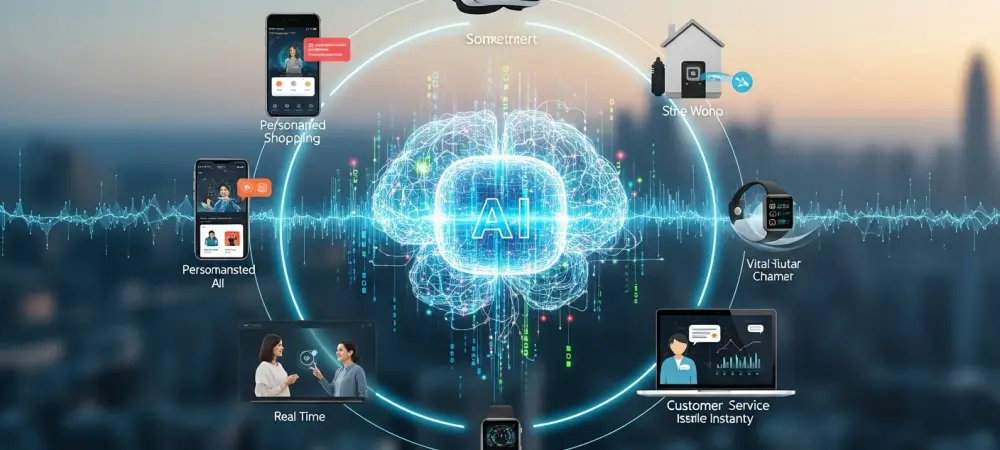
A retail shopper walking through a physical store today experiences a level of digital orchestration that was once confined to science fiction novels or high-end laboratory simulations. The convergence of high-velocity streaming data and sophisticated generative artificial intelligence has fundamentally altered how brands perceive and interact with their audiences in every single micro-moment of the journey. Gone are the days when customer service was defined by a reactive response to a filed complaint or a static recommendation based on purchases made three months prior to the current session. Instead, organizations are leveraging complex neural networks that ingest live telemetry from mobile devices, wearable sensors, and internet-of-things peripherals to anticipate a need before the consumer has even articulated it to themselves. This shift represents a move toward a frictionless economy where the boundary between physical presence and digital assistance has effectively vanished into a singular cohesive reality.
The Infrastructure of Instant Response: How Edge Computing Powers Personalization
The foundational layer of this new paradigm rests upon the deployment of edge computing frameworks that process information closer to the source rather than relying on distant data centers. When a customer interacts with a smart kiosk or a mobile application, the latency involved in sending that request to a central server and back can disrupt the flow of the user experience. By utilizing decentralized processing units, brands now execute complex AI models in milliseconds, allowing for dynamic pricing updates or inventory notifications that reflect the exact state of the world at that precise instant. For instance, high-end hospitality groups are using localized sensor data to adjust room environments and offer personalized concierge suggestions based on the guest’s physical location and current activity level. This technical agility ensures that the digital layer remains helpful without being intrusive, providing a seamless transition between various touchpoints in a complex omnichannel ecosystem. Moreover, the integration of real-time sentiment analysis into live communication channels has redefined the standard for automated support and high-stakes negotiation. Modern language models are no longer limited to scripted responses but can detect subtle shifts in a user’s tone, pacing, and vocabulary to adjust their own communication style accordingly. If a traveler encounters a flight delay, the system does not merely offer a generic apology; it analyzes the context of the delay, the traveler’s history, and current available alternatives to present a tailored resolution within seconds. This capability transforms a potentially negative interaction into a moment of brand loyalty by demonstrating an acute awareness of the individual’s specific circumstances and time constraints. As these systems become more autonomous, they are increasingly capable of making complex decisions, such as offering a refund or a premium upgrade, without requiring the intervention of a human supervisor or a lengthy escalation process.
Strategic Imperatives for Future Systems: Actionable Paths Toward Maturity
The integration of sophisticated artificial intelligence and real-time data streams successfully transitioned from a specialized competitive advantage to a baseline requirement for market relevance. Organizations that prioritized the development of elastic data infrastructures and autonomous decision-making engines realized significant gains in both operational efficiency and long-term customer lifetime value. It became clear that the goal was not simply to collect more information, but to cultivate the ability to act on that information with surgical precision and human-like empathy. Leaders focused on breaking down internal silos, ensuring that the insights generated by the marketing department were immediately accessible to the logistics and product development teams. This holistic view of the customer journey allowed for the creation of truly unified experiences that felt consistent across every possible medium. This shift necessitated a cultural change moving away from rigid hierarchies toward agile, cross-functional squads.
Strategic investments shifted toward the refinement of multi-modal AI systems that could interpret visual, auditory, and textual data simultaneously to create a comprehensive view of the user. Businesses implemented advanced feedback loops where every automated interaction served as a training data point for further system optimization, ensuring that the technology improved with every single transaction. To maintain a competitive edge, it was necessary to audit these systems regularly for algorithmic bias and to ensure that the drive for efficiency did not come at the expense of genuine human connection. Future-proofing the customer experience required a commitment to ethical AI development and the cultivation of a workforce that could effectively manage the intersection of data science and creative strategy. By focusing on the augmentation of human capabilities rather than simple replacement, companies established a sustainable model for growth that leveraged the strengths of both biological and digital intelligence.