

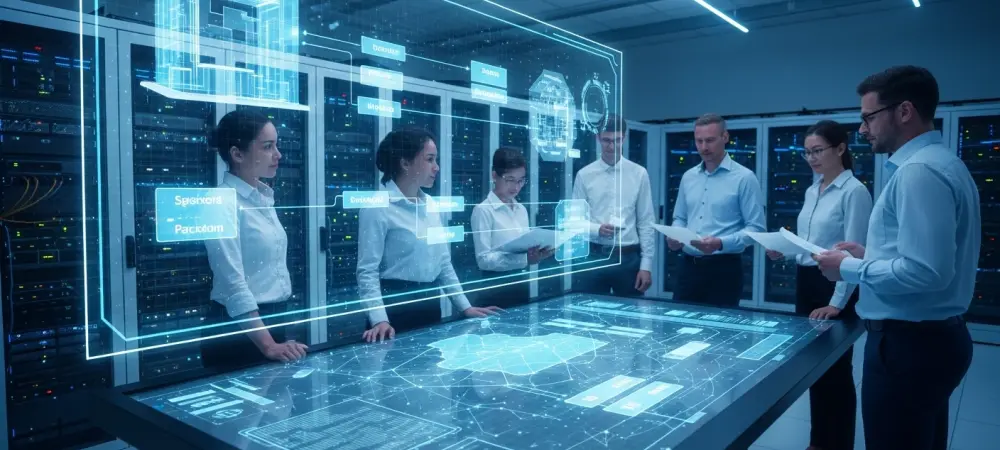
The Shift Toward Invisible Infrastructure and Autonomous Delivery
Software engineering departments across the globe are rapidly transitioning away from the traditional “you build it, you run it” mandate toward a more sophisticated, autonomous framework known as ZeroOps. While the original DevOps movement successfully dismantled the long-standing silos between development and operations through cultural integration, it still demanded significant human intervention to manage the resulting complexity. ZeroOps represents the terminal destination of this evolutionary journey, creating a state where infrastructure management, configuration, and maintenance are so thoroughly abstracted that they become invisible to the creator of the code. By leveraging continuous intelligence and advanced machine learning, this ecosystem allows engineers to focus exclusively on product innovation rather than system stability, effectively creating a “build and let it run” reality for the modern enterprise.
Tracking the Journey from Manual Oversight to Full Abstraction
To understand the current significance of ZeroOps, it is essential to trace the historical trajectory of software operations. For decades, the industry moved from the manual racking of physical servers to virtualized environments, and eventually to the cloud-native revolution that defined the early part of this decade. Each of these steps aimed to reduce the friction of deployment, yet the “operational tax”—the significant portion of time developers spend managing environments—remained stubbornly high. DevOps introduced a necessary bridge between code and production, but as systems scaled to global proportions, the cognitive load on human operators became unsustainable. This context makes ZeroOps the logical successor; it is the culmination of years of effort to treat infrastructure as a programmable, self-sustaining utility rather than a manual chore.
The Pillars of the ZeroOps Ecosystem
Predictive Monitoring and the Power of Continuous Intelligence
The first critical aspect of this evolution involves moving beyond reactive, threshold-based monitoring that defined previous operational eras. Traditional systems were designed to alert engineers only after a failure had already occurred, causing a cycle of constant firefighting. In contrast, ZeroOps systems anticipate failures before they manifest by applying advanced machine learning models, such as isolation forests for anomaly detection and Long Short-Term Memory models for time-series forecasting. These systems analyze a vast spectrum of data points simultaneously, including CPU usage, network latency, and business KPIs, to identify subtle patterns that human observers might miss. Recent industry data suggests that this proactive approach allows teams to predict network failures with roughly 94% accuracy up to six hours in advance.
Autonomous Self-Healing and the Reduction of Mean Time to Resolution
Building upon these predictive insights, the second pillar focuses on the system’s ability to remediate its own errors without human intervention. Self-healing now goes beyond simple auto-scaling to include complex tasks like database optimization and application-level troubleshooting. This theme emphasizes the use of historical data-driven learning and knowledge graphs to correlate past incidents with successful resolutions. By building automated decision trees, these systems can resolve issues in real-time, which has drastically reduced the Mean Time to Resolution. In practical applications, organizations have seen this metric drop from nearly an hour to approximately 12 minutes, resulting in millions of dollars in annual savings by minimizing downtime and incident-related costs.
Self-Evolving Architectures and the Integration of Generative AI
The most advanced aspect of the ZeroOps landscape is the emergence of architectures that essentially redesign themselves to meet changing demands. Unlike static cloud setups that require manual reconfiguration for growth, self-evolving architectures use generative AI and advanced algorithms to modify their own compute and network topologies. This allows the system to respond dynamically to changing business goals or shifting usage patterns without the need for a human architect to intervene. This level of adaptability ensures that the infrastructure is always optimized for the current workload, effectively morphing to meet demand. While this introduces new complexities regarding governance and cost control, it represents a disruptive innovation that removes the final bottleneck in the software delivery lifecycle.
Anticipating the Next Wave of Operational Innovation
The movement toward ZeroOps is backed by significant market momentum and a clear consensus among technological analysts. Current trends suggest that AI-driven operations have become the standard, with the vast majority of enterprises now integrating generative AI-enabled applications into their production environments. The industry is witnessing a shift toward “hyper-automation,” where even regulatory compliance and security patching are handled by autonomous agents. As Kubernetes and cloud-native principles continue to mature, the programmability of infrastructure has reached a point where manual configuration is becoming a legacy practice. This is being replaced by intent-based systems that translate high-level business requirements directly into operational states without any human scripting.
Strategic Implementation and the Path to Efficiency
The transition to a ZeroOps model requires a logical, phased progression to ensure organizational stability while maximizing efficiency gains. Organizations typically begin by establishing foundational automation and comprehensive monitoring to gain the necessary visibility into their stacks. The second phase involves integrating predictive analytics to move from a reactive to a proactive stance. Finally, the third phase focuses on realizing full self-evolving capabilities where the infrastructure manages its own lifecycle. By following this roadmap, businesses have reported up to a 67% reduction in costs associated with system incidents. Beyond the financial benefits, the primary recommendation for leadership is to focus on the qualitative improvement in developer productivity that occurs when the operational tax is removed.
Closing the Loop on the DevOps Journey
The shift toward ZeroOps emerged as an inevitable progression in the software delivery lifecycle, transforming infrastructure from a managed asset into a silent, self-sustaining utility. As the industry moved through the final stages of this evolution, the distinction between building and running software blurred until the operational layer became virtually invisible. For the modern enterprise, adopting these autonomous principles proved to be a competitive necessity rather than a mere optimization strategy. Organizations that prioritized self-healing architectures and predictive intelligence successfully reclaimed thousands of engineering hours, redirected those resources toward core product innovation, and ultimately fulfilled the original, long-standing promise of the DevOps movement.