

Dominic Jainy is a seasoned IT professional whose career spans the transformative landscapes of high-performance computing and infrastructure. His deep understanding of how physical hardware supports digital innovation makes him a leading voice on the future of hyperscale developments in Europe. In this discussion, we explore the ambitious Engrida project in Philippsburg, focusing on its massive 707MW energy requirement, its role in community sustainability through waste heat recycling, and the strategic push for digital sovereignty within the German industrial park.
Securing a 707MW grid connection capacity is a massive milestone for a project of this scale, so how does this power availability fundamentally change the landscape for data center development in the region?
This capacity is truly staggering when you consider that the town of Philippsburg previously fueled the region’s electricity for four decades through its nuclear plant. By reclaiming this 707MW through a landmark agreement with TransnetBW, the Wirth Group is reviving a dormant giant of the power grid to serve a new purpose. You can almost feel the historical weight of the site, transitioning from traditional energy production to the silent, high-speed processing of the modern digital age. This level of power is a massive magnet for hyperscale operations that require immense, reliable energy loads to drive the next generation of cloud services and sovereign data storage.
The project spans a massive 260,000 square meters and includes a plan to return waste heat to local households, so what are the technical and community-level benefits of such a massive circular energy model?
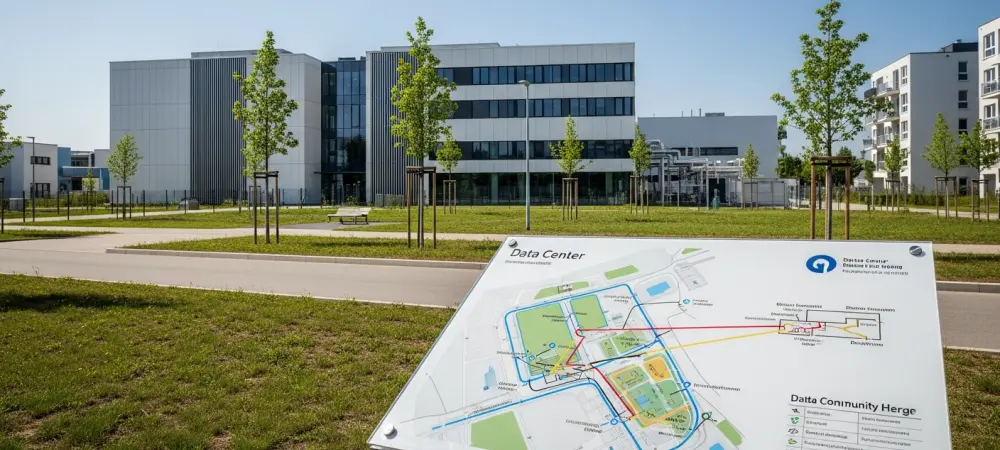
Developing 26 hectares of the Philippsburg Industrial Park allows for a scale that comfortably accommodates the footprint of a former tire factory and a decommissioned nuclear plant. The heart of this project is the district heating system that will siphon waste heat from the server racks directly into local homes. It is a sensory shift for the community, seeing a massive industrial site not as an eyesore, but as a literal furnace that keeps families warm during the cold German winters. This circularity proves that hyperscale facilities can be good neighbors, turning the byproduct of data processing into a tangible, local utility that benefits every citizen.
Given the emphasis on digital sovereignty and the preference for European investors, how does the financial structure of the Engrida project reflect the strategic priorities of the DACH region?
Mayor Stefan Martus has been quite vocal about the desire to attract German or European partners, which signals a strong push for regional autonomy in data management. By insisting that investors pay taxes domestically, the municipality ensures that the economic benefits of this hyperscale facility remain within the borders of Baden-Württemberg. There is a palpable sense of pride in reclaiming this infrastructure for digital sovereignty, ensuring that the data of European citizens is housed in a facility that contributes to the local treasury. Even though the Wirth Group remains open to global partners, the underlying mission remains rooted in building a robust and independent European digital backbone.
With no current data centers in Philippsburg but seven in nearby Karlsruhe, why do you think the specific infrastructure of this town makes it such a strategic choice for the Wirth Group?
The decision to build in Philippsburg is a masterstroke of infrastructure-led planning rather than simply following existing tech hubs. The town already possesses the substantial electricity transmission lines necessary to handle a 707MW load, something most cities simply cannot offer without decades of upgrades. When you add the planned 800MWh battery energy storage system by EnBW, which should be online by 2027, you create a level of grid stability that is incredibly rare in the industry. This combination of legacy transmission capacity and modern battery backup provides a fail-safe environment that hyperscalers crave to ensure 100% uptime for their critical operations.
What is your forecast for the evolution of the data center market in Germany over the next decade?
I expect we will see a dramatic shift toward these energy-legacy sites, where old industrial or power-generating hubs are reborn as sustainable digital centers. The success of the Engrida project will likely serve as a blueprint for how to integrate massive 800MWh storage systems and district heating into the very fabric of regional infrastructure. We are moving away from isolated data silos and toward integrated energy ecosystems that provide both digital power and physical warmth to the surrounding population. Over the next ten years, the DACH region will lead the way in proving that hyperscale growth and environmental responsibility are actually synergistic goals.