

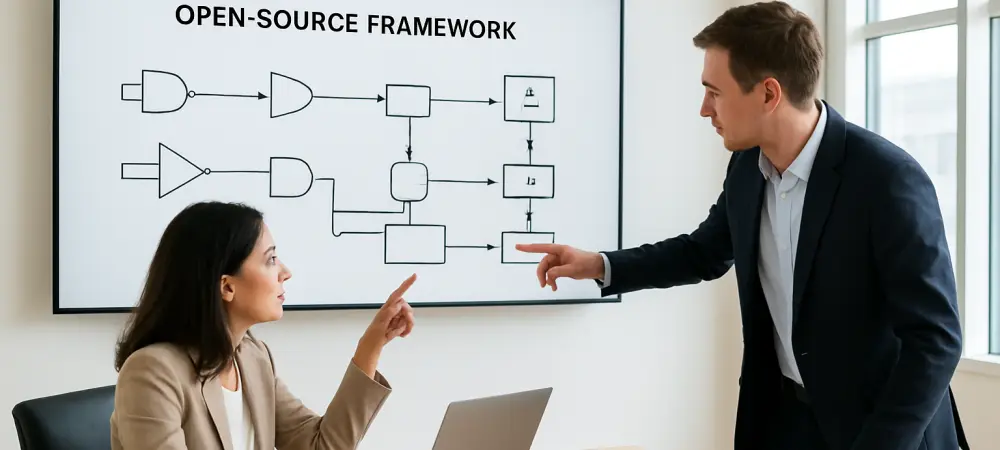
Modern corporate strategy has evolved far beyond simply licensing the most powerful reasoning engine; the real battleground for digital sovereignty in 2026 is the control over the agent runtime that executes complex business logic within secure environments. While the industry spent the previous cycle debating the merits of various large language models, the focus has shifted toward the “harness”—the specialized software layer that enables these models to perform actions, manage memory, and interact with external databases. This runtime acts as the vital connective tissue that transforms a passive predictor of text into an active participant in corporate workflows. The emergence of TrueForge marks a significant milestone in this evolution, offering an open-source alternative to the proprietary, managed environments that have dominated the early agentic landscape. By providing an MIT-licensed framework for self-hosting these capabilities, it presents a compelling case for enterprises to reclaim ownership of their operational intelligence. As organizations move from experimental chatbots to fully autonomous agents, the question of who controls the execution layer has become a matter of both economic efficiency and fundamental security.
The Invisible Architecture Governing the Future of Corporate Intelligence
The current obsession with selecting the “best” large language model often overlooks the critical software layer that actually puts those models to work in a production environment. While a model provides the raw reasoning capacity, it is the agent runtime that provides the hands, the memory, and the safety protocols required for complex execution. This invisible architecture is responsible for deconstructing a high-level goal into a sequence of actionable steps, managing long-running session states, and ensuring that every interaction remains within the bounds of corporate policy.
As organizations transition from simple information retrieval to autonomous task execution, the limitations of basic model interfaces have become increasingly apparent. A standalone model lacks the inherent ability to interact with a company’s internal tools or maintain a persistent awareness of a project’s history without external orchestration. The runtime fills this gap, serving as a sophisticated manager that oversees the model’s access to external resources and handles the heavy lifting of context optimization. This ensures that the agent remains grounded in real-world data rather than hallucinating sequences in a vacuum.
This shift toward agentic AI represents a fundamental change in how corporate intelligence is deployed across various departments. Instead of human workers acting as the bridge between different software platforms, the agent runtime orchestrates these connections directly, significantly reducing latency and error rates. The true value of an enterprise AI strategy now lies in how effectively this runtime can be integrated into existing infrastructure, making the selection of a robust execution harness just as important as the choice of the underlying intelligence.
Why the “Agent Harness” Is the New Frontier of AI Strategy
Relying on proprietary, hosted runtimes like the managed agent platforms offered by major providers creates a new form of vendor lock-in where a company’s operational logic is tethered to a specific ecosystem. When an enterprise builds its workflows on a closed platform, it surrenders control over the execution traces and the specific logic that governs how its agents think. This dependency trap can lead to spiraling costs and a lack of flexibility if the provider changes their pricing model or feature set, leaving the enterprise with few options for migration. Data sovereignty and compliance remain the primary drivers for moving away from these managed services toward self-hosted alternatives. In highly regulated sectors like finance or healthcare, the ability to host the agentic “brain” within a private VPC or an on-premises environment is no longer a luxury but a non-negotiable requirement. TrueForge enters the market at this pivotal moment, identifying the runtime as the vital infrastructure layer that manages context optimization and secure sandboxing—capabilities that models alone cannot provide.
Furthermore, the emergence of the agent harness as a strategic frontier highlights the need for a unified execution layer that can span across multiple cloud providers. A self-hosted runtime allows a company to maintain a consistent logic layer while utilizing different models for different tasks, effectively future-proofing the AI stack. By owning the harness, an organization ensures that its investment in agentic workflows remains portable and protected from the shifting alliances and rivalries of the major model developers.
Breaking Down TrueForge: Technical Innovations and Strategic Flexibility
One of the most notable technical innovations in the TrueForge architecture is the implementation of deferred tool loading for high-complexity tasks. Rather than overloading a model’s context window with thousands of tool definitions at the start of a session, the system pulls in only the specific resources required for the current sub-task. This approach significantly improves performance by reducing the noise within the model’s attention mechanism and drastically lowers the token costs associated with maintaining large context windows in long-running agents.
Strategic flexibility is further enhanced by the platform’s ability to balance probabilistic reasoning with deterministic logic. While the AI is given the freedom to navigate complex reasoning paths, the high-level application graphs and business rules remain under the control of the developers. This ensures that the agent follows a predictable path for critical operations, providing a level of reliability that is often missing from purely model-driven approaches. Enterprises can define exactly where they want the AI to show creativity and where they require rigid adherence to established protocols. Support for over 20 different models, including those from OpenAI, Anthropic, and Google, ensures that enterprises are never locked into a single reasoning engine. This model-agnostic approach allows developers to swap the underlying model based on real-time cost-to-performance metrics or specific task requirements. When paired with efficient open-weight models, the economics of self-hosting become highly attractive, with some organizations reporting a reduction in total operating costs of up to 50% compared to managed session-based services.
Expert Perspectives on the Shift Toward Modular AI Stacks
Industry analysts suggest that the “black box” era of AI is quickly giving way to more transparent, enterprise-owned architectures where every step of a decision can be audited. The modularity of the modern AI stack allows companies to treat the reasoning engine, the memory layer, and the tool-calling harness as separate, interchangeable components. Technical experts highlight the Kubernetes-optional nature of modern runtimes, noting that the ability to run on standard cloud instances or local hardware using SQLite and Postgres reduces the barrier to entry for smaller IT departments.
The ownership argument is gaining traction among proponents of digital autonomy who believe that enterprises should not depend on third parties to maintain the software that effectively “writes itself” within their corporate walls. Centralized governance through an AI gateway has become the standard method for enforcing budgetary caps and role-based access controls across these autonomous systems. This integration provides the unified execution traces necessary for legal and financial auditing, ensuring that every action taken by an AI agent can be traced back to a specific instruction and permission set.
Infrastructure adaptability is another key theme, as the move toward modular stacks allows for a more granular approach to resource allocation. Organizations can now deploy lightweight agents for simple tasks while reserving high-power reasoning engines for complex strategic work, all managed within the same self-hosted harness. This shift toward local control also mitigates the risks associated with API downtime or service outages from major providers, ensuring that internal business processes remain operational even if external connections are interrupted.
Strategies for Transitioning to an Enterprise-Owned Agentic Runtime
The most successful firms transitioned to self-hosted environments by first identifying high-stakes workflows that handled sensitive data where third-party hosting presented a risk. They recognized that starting with processes requiring human-in-the-loop approvals provided a safety net while they calibrated the autonomy of their systems. These organizations prioritized the migration of long-running sessions that were previously incurring significant hourly fees on managed platforms, immediately realizing the economic benefits of a self-owned runtime. Leaders leveraged Model Context Protocol standards to ensure their tool definitions and server integrations remained portable across different execution harnesses. This standardized approach minimized the friction of moving away from proprietary ecosystems and allowed for a more seamless integration with existing internal databases and APIs. By adopting a centralized gateway, they enforced standardized guardrails that logged every interaction, which became a foundational requirement for satisfying the demands of internal audit and compliance teams during the transition period.
The evaluation of total cost of ownership became a more transparent process as the reliance on per-session fees vanished. Although maintaining a self-hosted runtime required dedicated internal staffing and infrastructure orchestration, the reduction in operational expenditures and the increase in data security provided a clear return on investment. Ultimately, the shift toward platforms that prioritized modularity and control enabled a more resilient corporate intelligence strategy that remained independent of any single model provider’s roadmap.