

The Great Data Center Migration: How AI is Redrawing the Map
The digital world is built on a physical foundation of servers, cables, and cooling systems housed in massive, power-hungry buildings known as data centers. For years, this critical infrastructure has been concentrated in a few key hubs, with Northern Virginia reigning as the undisputed global capital. However, a seismic shift, driven by the explosive growth of artificial intelligence and hyperscale cloud computing, is underway. This insatiable demand for data processing is creating an unprecedented need for electrical power, overwhelming traditional markets and forcing a geographic realignment of the entire industry. This article explores this structural transformation, examining whether Texas, with its unique energy advantages and vast development pipeline, is poised to overtake Virginia and claim the title of the new data center capital of the world.
From Ashburn’s Reign to a New Frontier: The Shifting Tides of Data Infrastructure
To understand the magnitude of the current shift, one must appreciate the historical landscape. Markets like Northern Virginia’s “Data Center Alley” in Ashburn and Silicon Valley rose to prominence due to a perfect storm of fiber optic connectivity, a skilled workforce, and favorable business climates. They became the nerve centers of the internet, attracting colossal investment from the world’s leading tech companies. This model of geographic concentration worked for decades. Today, however, that paradigm is being tested. The sheer scale of modern AI workloads requires power on a gigawatt scale, a demand that the congested and aging grids of established hubs are struggling to meet. This has fundamentally changed the site selection calculus, transforming the availability of reliable, scalable power from a key consideration into the single most critical factor, setting the stage for the rise of new frontier markets.
The Power Play: Unpacking Texas’s Unprecedented Ascent
The AI-Fueled Boom: A Market Straining at Its Seams
The North American data center market is in a period of historic, almost frantic, expansion. For two consecutive years, vacancy rates have hovered at a startlingly low 1%, signaling that supply cannot keep pace with the voracious demand. The market currently supports 39 gigawatts (GW) of active capacity, but an astonishing 35 GW—nearly a full duplication of the existing infrastructure—is already under construction. This growth is not a broad-based trend; it is a direct consequence of the AI revolution. The top five hyperscale cloud providers are spending $710 billion in capital expenditures this year alone, while dedicated AI firms like OpenAI and Anthropic are planning an additional 10 GW of capacity. This has led to the emergence of mammoth developments, with over 10 active projects each designed to exceed 1 GW, a scale previously unimaginable.
Chasing Kilowatts: Why Power Availability Is the New Prime Real Estate
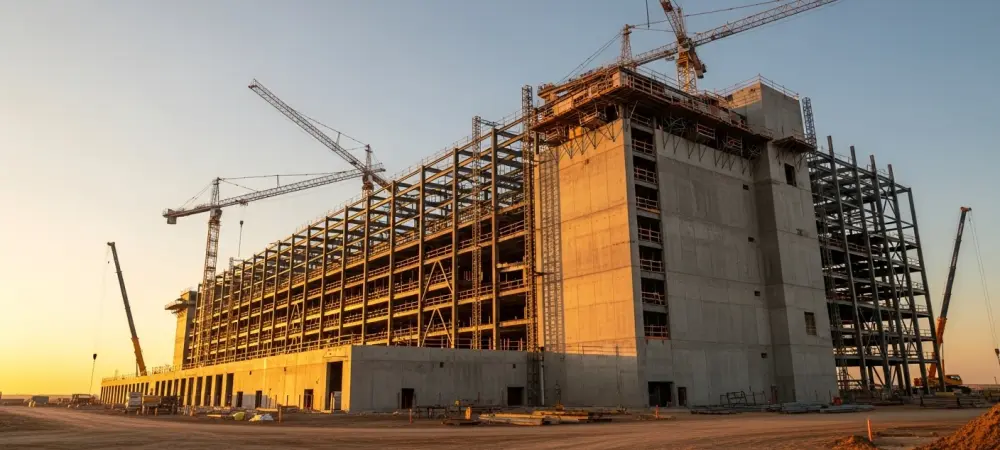
This unprecedented demand for power has triggered a critical decentralization of data center development. With established markets like Northern Virginia facing grid connection timelines stretching four years or more, developers are forced to look elsewhere. Consequently, nearly two-thirds of the new capacity under construction is located outside of traditional hubs. Texas has emerged as the primary beneficiary of this geographic exodus. With an incredible 6.5 GW of data center capacity currently being built, the state is on a clear trajectory to challenge, and potentially surpass, Northern Virginia’s dominance by 2030. Industry experts agree that the market is now unequivocally “chasing power capacity.” Texas, with its diverse energy sources—including abundant solar, wind, and natural gas—and the flexible ERCOT grid, is uniquely positioned to deliver the “fuel” needed for these power-intensive projects, making it the most attractive new destination for hyperscale and AI infrastructure.
The High Cost of Capacity: Economic Pressures in a Red-Hot Market
The severe imbalance between supply and demand has created intense economic pressure across the industry. Data center rental rates are surging, having risen an estimated 9% in 2025 and accumulating a staggering 60% increase since 2020. This inflation is even more pronounced for large-scale deployments, with leases over 1 megawatt seeing price hikes of up to 13%. In response to this volatile market, new lease agreements now commonly include annual rent escalation clauses of at least 3%. The scarcity of available space and power is also forcing tenants to plan further into the future than ever before, with major companies now securing capacity for delivery as far out as 2027 and beyond simply to guarantee their ability to grow.
The New Development Playbook: Adapting to an Energy-First World
The power bottleneck is forcing the entire industry to rethink its development strategies. As confirmed by industry leaders, developers are “increasingly following power,” and site selection is now defined by energy availability and grid interconnection timelines. This reality is giving rise to several new trends. First, large users are embracing long-term planning, accepting delayed delivery timelines for projects targeting late 2028 or 2029 to secure access to future power. Second, there is a renewed interest in “behind-the-meter” solutions, where operators build their own on-site power generation to bypass grid delays and meet aggressive deployment schedules. Finally, these constraints are influencing facility design itself, leading to more phased campus deployments, modular construction, and the use of microgrids to bring capacity online incrementally.
Navigating the New Paradigm: Integrating Energy and Infrastructure Strategy
The primary takeaway from this market upheaval is clear: data center strategy and energy strategy have become one and the same. For companies looking to build or lease new capacity, success is no longer just about location and connectivity; it is about securing a reliable, long-term power source. This requires a proactive and deeply integrated approach. Businesses must now engage with utility providers and local governments at the earliest stages of planning to understand grid capacity and transmission upgrade timelines. In some cases, operators may need to consider co-investing in energy infrastructure to ensure their needs can be met. The old model of simply requesting power from a utility is obsolete; the new model demands true partnership.
The Dawn of a New ErIs Texas the Future of Digital Infrastructure?
The convergence of AI’s immense computational needs and widespread power constraints has catalyzed a pivotal moment for the data center industry. The era of concentrating digital infrastructure in a handful of legacy markets is over, replaced by a new phase of geographic diversification dictated by energy availability. Texas, with its robust energy grid, vast land resources, and 6.5 GW construction pipeline, is capitalizing on this shift more effectively than any other region. While Northern Virginia will remain a critical hub, the trends in motion strongly suggest that Texas is not just a viable challenger but is on a clear path to redefine the global data center map. The future of our digital world is inextricably linked to our energy infrastructure, and in this new reality, the Lone Star State shines the brightest.