

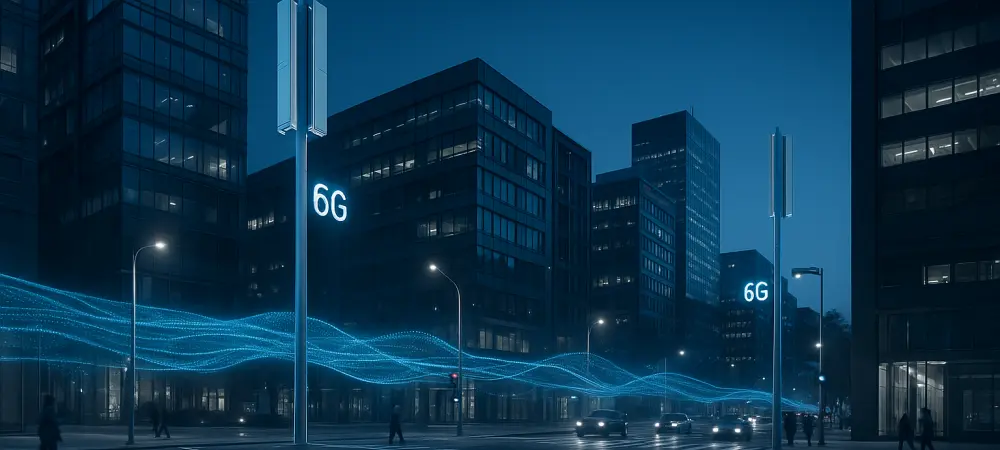
The subtle vibration of a smartphone in a pocket is no longer just a signal of an incoming text but a heartbeat in a vast, invisible web that is beginning to map every physical nuance of the urban landscape. As 2026 unfolds, the wireless communication industry is moving beyond the high-speed benchmarks of 5G toward a future where connectivity is synonymous with perception. Qualcomm’s recent advocacy for 6G technology marks a departure from mere data transmission, introducing a world where the network itself acts as a distributed sensor. This evolution represents a significant technological leap that promises unprecedented efficiency while simultaneously raising alarms about the potential for total surveillance. The move toward 6G is not merely a faster version of the current standard; it is the birth of the sensing network. This shift, headlined by the concept of Integrated Sensing and Communication (ISAC), suggests that infrastructure will soon be capable of “seeing” the physical environment through radio waves. As the industry pushes for these capabilities, the line between helpful utility and invasive monitoring becomes increasingly blurred. The core objective is to move into a realm where the network does more than just transmit data—it perceives the world. Every cell tower essentially acts as a high-frequency radar, potentially turning every street corner into a massive, distributed sensor.
This transition highlights a fundamental change in the relationship between public infrastructure and the private citizen. While 5G continues to find its footing through fixed wireless access, the drive for 6G prioritizes capabilities that allow for a comprehensive, real-time view of physical reality. Without a federal privacy law in the United States, the deployment of this always-sensing technology creates a vacuum where corporate interests and public anonymity are destined to collide. The conversation is no longer just about download speeds; it is about the fundamental architecture of the modern city and whether it will serve as a communication tool or a sophisticated surveillance apparatus.
The Invisible Grid: Why Your Movement Is the New Data Currency
While previous cellular generations focused on connecting people and devices, the industry is already pivoting toward a future where human movement becomes a primary data asset. Qualcomm’s strategic vision for 6G signaled a shift from simple connectivity to a paradigm where radio waves double as spatial detectors. In this environment, the network uses signals to bounce off objects, creating a real-time digital twin of the physical world. This transformation means that the presence of a person in a room or a vehicle on a road is no longer just a physical fact but a digital data point recorded by the nearest base station.
The technical implications of this sensing capability are profound, as every cell tower effectively becomes an observer. This creates a persistent grid that tracks the flow of life with a level of granularity that was previously impossible. Such a system does not require a user to “check in” or even have their phone screen active; the network itself identifies the physical presence. This evolution raises a piercing question about whether society is building a more efficient communication system or inadvertently constructing the most sophisticated surveillance apparatus in human history. The digital reflection of physical reality is becoming a currency that companies and governments may find too valuable to ignore.
This perception-based network is marketed as a way to enhance safety and automation, yet the scale of data collection is unprecedented. Unlike the targeted tracking of the past, 6G sensing is ambient and ubiquitous. It operates in the background of daily life, recording the movement of crowds and individuals alike. As these capabilities become integrated into the very airwaves people breathe, the concept of a private walk in a public park may become a thing of the past. The invisible grid is being built one tower at a time, and the data it generates is set to become the most sought-after commodity in the tech industry.
The 6G Crossroads: Why This Technological Leap Is Different
The transition to 6G is not a mere incremental update; it represents a fundamental change in how digital infrastructure interacts with the public. Unlike the switch from 4G to 5G, which primarily focused on larger bandwidth and lower latency, 6G seeks to bridge the gap between digital signals and physical reality. This matters because it gives the network a “God’s-eye view” of its surroundings. The infrastructure is being designed to understand the context of the physical world, which allows it to predict and react to human behavior in ways that previous generations could not imagine.
This technological leap is occurring during a period of significant regulatory ambiguity. In the United States, the lack of a comprehensive federal privacy law means that the deployment of always-sensing technology happens in a legal vacuum. Corporate interests are moving faster than the legislative processes designed to protect public anonymity. When a network is designed to be “always-sensing,” it challenges the traditional legal definitions of data collection and consent. If the airwaves themselves are sensing your presence, there is no simple “opt-out” button for someone walking down a public sidewalk.
Furthermore, the 6G crossroads is defined by a shift in how value is extracted from the network. In the 5G era, value was derived from the volume of data transmitted. In the 6G era, value will likely be derived from the insights gained through integrated sensing. This fundamental change in the business model of telecommunications means that carriers will have a massive incentive to maximize the “perceptive” power of their grids. As digital signals and physical reality merge, the potential for corporate interests and public privacy to collide becomes an inevitability rather than a possibility.
The Pillars of the 6G Ecosystem: Sensing, Efficiency, and Intelligence
Qualcomm’s vision for Integrated Sensing and Communication (ISAC) involves using radio-frequency signals to detect, classify, and map physical objects in real-time. This pillar of the 6G ecosystem allows the network to function like a camera without a lens, using the reflection of waves to identify the shape and movement of people and objects. While this could help first responders locate individuals in emergencies, it also creates a surveillance feedback loop. By combining radio-wave mapping with high-definition cameras already present at base stations, operators could enable tracking on a national scale. This provides a centralized view of movement within a city, creating a persistent record of activity that moves beyond the limitations of individual vehicle sensors. The user experience in a 6G world is expected to be dominated by AI-equipped wearables, such as smart glasses that are designed to be “always-sensing.” These devices record and analyze everything a wearer sees, creating what has been termed an AI Recall database. Much like the controversial features seen in recent computer operating systems, this technology builds a searchable history of a person’s life, from where they left their keys to the identity of every individual they encountered. The linguistic shift in the corporate world from “always-on” to “always-sensing” is a strategic move to mask the reality of continuous data ingestion and edge-computing analysis, making the technology feel more like a helpful assistant and less like a constant observer.
Beyond the challenges of privacy, 6G aims to solve the historical failures of earlier networks regarding power consumption and spectrum waste through intelligent management. Granular network slicing will allow individual applications to negotiate for the exact bandwidth they need, reducing the stutter and congestion often seen in 5G deployments. This ensures that the network is “polite,” only consuming the resources necessary for a specific task. Additionally, 6G focuses on sustainability goals by using AI to dynamically power down cell site components when they are not in use. This addresses the high carbon footprint of current wireless infrastructure and moves the industry toward a more green and efficient future.
Expert Perspectives on the Regulatory and Privacy Vacuum
The ambition of 6G is currently outpacing the legal frameworks intended to govern it, leading to significant concern among privacy advocates. Former FCC Chairman Ajit Pai has noted that without a federal privacy law, the realm of bulk data collection remains a “Wild West.” This is a particularly sharp concern given the history of wireless carriers, who have frequently faced litigation for selling granular location data to third-party brokers. If 6G allows for the classification of every object in a network’s view, the reasonable expectation of privacy in public spaces may effectively vanish. The technology provides the means for a total loss of anonymity, even for those who do not own a mobile device.
Industry experts warn that the capability to identify and categorize objects through radio waves could lead to a permanent record of human behavior. If a network can distinguish between a person carrying a bag and a person carrying a tool, the potential for profiling becomes immense. Without clear regulations, there is nothing to stop this data from being analyzed by AI to predict future actions or to assign risk scores to individuals. The vacuum in the legal landscape means that the protections for citizens are currently being written by the same corporations that stand to profit from the data collection. This lack of oversight creates a dangerous precedent for the deployment of 6G.
Moreover, the historical track record of the telecommunications industry suggests that data minimization is rarely a priority unless it is legally mandated. The shift to 6G requires a new type of regulatory thinking that addresses the sensory nature of the network. Experts are calling for a framework that treats environmental sensing data with the same level of protection as private medical records. As 6G prepares for a broader rollout, the pressure on policymakers to create clear boundaries is mounting. The goal is to ensure that the technological benefits of a smarter network do not come at the cost of the fundamental right to exist in a public space without being tracked and analyzed.
Navigating the 6G Future: Strategies for Balanced Innovation
As the industry targets a 2029 launch for the first 6G specifications, stakeholders are beginning to look for ways to balance innovation with public trust. One of the primary strategies involves establishing a privacy-by-design framework. This approach requires engineers to bake data minimization directly into the 6G protocol. Instead of sending all sensing data to a central server, the information should be processed locally at the “edge” and discarded immediately after its specific task is completed. By ensuring that the network does not store bulk records of physical movement, the industry can reduce the risk of massive data breaches or systemic surveillance.
Another critical challenge involves the ongoing “Spectrum War” over the 4GHz and 7GHz bands. Policymakers must create clear pathways for relocating military and satellite incumbents to make room for 6G’s massive bandwidth requirements. Relocating these users is a complex task that requires international cooperation and significant investment in new hardware for the affected government agencies. However, without access to these contiguous blocks of spectrum, the sensing and efficiency promises of 6G will remain unfulfilled. Navigating this logistical hurdle is essential for the global standardization of the technology and for preventing a fragmented wireless landscape.
Finally, demanding corporate accountability remains a central pillar for a balanced 6G future. Users and advocacy groups are pushing for “Opt-In” sensing features, ensuring that the pervasive mapping of the physical world cannot be activated without clear public consent and oversight. This includes transparent reporting on how sensing data is used and giving individuals the right to know what information the network has collected about them. By prioritizing transparency and security, the industry can foster an environment where 6G serves as a tool for progress rather than a mechanism for control. This balanced approach is the only way to ensure that the vision of a perceptive network is welcomed by the society it intends to connect.
The transition toward a sensing infrastructure was marked by a shift in focus from the user’s screen to the user’s environment. Industry leaders recognized that the success of 6G depended on their ability to integrate artificial intelligence into the core of the network, which allowed for a more efficient distribution of resources. Engineers developed protocols that prioritized local processing, which helped mitigate some of the early fears regarding mass surveillance. Policymakers eventually moved to provide the necessary spectrum while also introducing the first significant updates to privacy laws in decades. These steps ensured that the new generation of wireless technology acted as a transparent utility. The focus on sustainability and “polite” network behavior also reduced the environmental impact that had hindered previous deployments. By the time the first 6G modems reached the market, the framework for a more secure and efficient digital future had been established. This evolution demonstrated that technological progress could be achieved without sacrificing the fundamental rights of the public.