

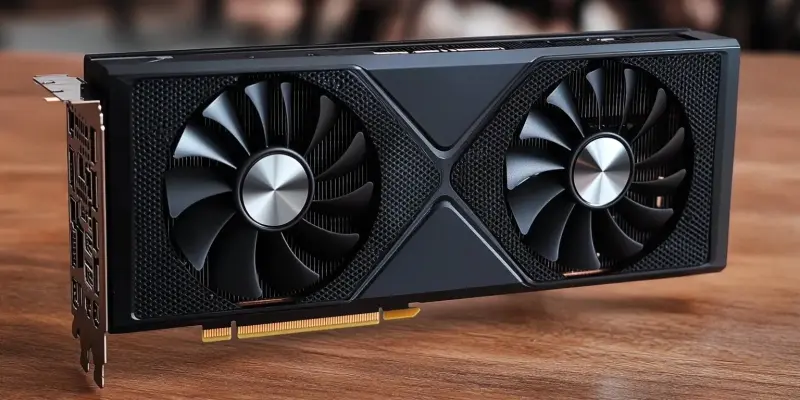
NVIDIA’s upcoming GeForce RTX 5070 graphics card is generating considerable excitement within the tech community. As part of the next-generation Blackwell consumer GPU series, the RTX 5070 promises to make a significant impact in the mid-range graphics card market. This new GPU is strategically designed to offer enhanced performance at a competitive price point, aiming to outshine its predecessors and rival offerings from AMD and Intel. With technological advancements and appealing features, the RTX 5070 aims to attract budget-conscious gamers and enthusiasts seeking high-performance GPUs without breaking the bank.
Market Positioning and Strategy
The GeForce RTX 5070 is positioned strategically in the middle of NVIDIA’s Blackwell consumer GPU lineup, a placement that is crucial for capturing the competitive mid-range segment. This market segment is increasingly crowded, with major players like AMD and Intel also vying for dominance. NVIDIA aims to secure a stronghold in this market by offering a robust price-performance ratio, ensuring that the RTX 5070 appeals to consumers who are looking for high performance without the premium price tag. By targeting this demographic, NVIDIA hopes to strengthen its presence and outmaneuver its rivals in a key market segment.
NVIDIA’s strategy includes leveraging advanced technologies such as DLSS 4 (Deep Learning Super Sampling) and Ray Tracing to secure a competitive edge. These innovations have the potential to set the RTX 5070 apart from its competitors by delivering superior performance in gaming and other graphically intensive applications. By focusing on these cutting-edge features, NVIDIA aims to differentiate the RTX 5070 and establish it as the go-to choice for mid-range GPU consumers, offering both exceptional performance and value for money.
Specifications and Architecture
The RTX 5070 boasts impressive specifications that promise to deliver substantial performance improvements over its predecessors. It utilizes the GB205-300-A1 silicon die, featuring 6144 CUDA cores, which play a critical role in enhancing processing power. Additionally, the card comes equipped with a 192-bit bus interface and 12 GB of GDDR7 memory, providing a total bandwidth of 672 GB/s. With memory speeds expected to reach an impressive 28 Gbps, the RTX 5070 is set to offer a significant uplift in data throughput. The GPU has a Total Board Power (TBP) of 250W, reflecting a 14% increase over its predecessor, the RTX 4070 SUPER. These specifications indicate a strong focus on delivering enhanced performance and efficiency.
The architectural advancements in the RTX 5070 highlight the significant strides NVIDIA has made in GPU design. The increased memory speed and bandwidth, coupled with a higher CUDA core count, suggest that the RTX 5070 will offer a notable performance boost compared to previous generations. These enhancements are designed to handle demanding gaming and professional workloads, making the RTX 5070 a formidable contender in the mid-range GPU market.
Performance Expectations
NVIDIA claims that the RTX 5070 will deliver a 20% performance improvement in native Ray Tracing gaming scenarios compared to the RTX 4070. This enhancement is particularly appealing to gamers who prioritize high-quality graphics and immersive experiences. The RTX 5070 is specifically designed for 1440p gaming, catering to a broad audience looking for high performance but not necessarily the extreme capabilities required for 4K gaming. While higher-end models like the RTX 5090 and RTX 5080 target the 4K gaming segment, the RTX 5070 aims to strike a balance between performance and cost, making it an attractive option for many gamers.
Focusing on 1440p gaming ensures that the RTX 5070 remains accessible to a wide range of consumers. This resolution is increasingly popular among gamers who seek an optimal blend of detailed visuals and smooth gameplay without the demanding hardware requirements of 4K gaming. By offering a significant performance boost over its predecessor, the RTX 5070 aims to provide a compelling proposition for gamers seeking to upgrade their systems and achieve a superior gaming experience.
Price and Availability
NVIDIA has set the MSRP for the RTX 5070 at $549 US, positioning it as a competitively priced option in the mid-range market. Scheduled for release on March 5th, this GPU aims to capitalize on key market windows and attract early adopters. The competitive pricing is a strategic move by NVIDIA to appeal to budget-conscious gamers and consumers looking for high performance without the premium price tag typically associated with top-tier GPUs. By offering a high-performance GPU at a reasonable price, NVIDIA demonstrates its commitment to delivering value and strengthening its position in the mid-range segment.
The strategic release date further underscores NVIDIA’s aggressive approach to capturing market share. By aligning the launch with key market windows, NVIDIA aims to maximize visibility and consumer interest in the RTX 5070. This timing is particularly crucial for attracting early adopters who are keen to experience the latest advancements in GPU technology. Overall, the combination of competitive pricing and well-timed availability positions the RTX 5070 as a strong contender in the mid-range GPU market.
Comparative Performance Analysis
NVIDIA’s upcoming GeForce RTX 5070 graphics card is stirring up significant excitement within the tech community. This card is part of the highly anticipated next-generation Blackwell consumer GPU series. The RTX 5070 is poised to make a big splash in the mid-range graphics card market, delivering enhanced performance at a competitive price. It aims to surpass its predecessors and challenge rival offerings from AMD and Intel. With cutting-edge technology and attractive features, the RTX 5070 is designed to appeal to budget-conscious gamers and tech enthusiasts who want high-performance GPUs without a hefty price tag. Its advanced architecture and efficiency aim to provide a robust gaming experience, making it an attractive option for those looking to upgrade their systems. The RTX 5070’s potential for superior performance and affordability could set a new standard in the mid-range segment, making it a popular choice among users who demand both quality and value in a graphics card.