

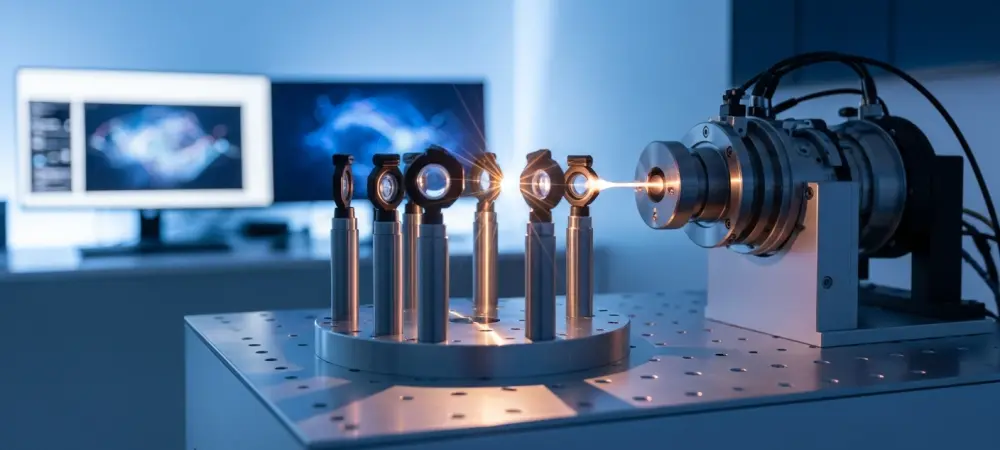
A piercing beam of concentrated white light cutting through the atmosphere recently carried a stream of data across a distance of twelve hundred meters, redefining the potential of optical communication. This experimental milestone represents a pivotal departure from the radio-frequency foundations that have dictated wireless connectivity for nearly a century. While the current infrastructure struggles to maintain high-speed integrity over even modest distances, this record-breaking transmission suggests that the future of the internet may be illuminated by lasers rather than broadcast through traditional antennas. The implications for the next decade of digital growth are profound, offering a glimpse into a world where high-capacity data is as ubiquitous as street lighting.
At the heart of this transformation is the transition to 6G, a standard that promises to do more than just increase download speeds for consumer devices. The telecommunications industry is moving toward a model where the network itself acts as a massive, distributed sensor. To realize this vision, engineers have sought new ways to bypass the congestion of the radio spectrum. The successful 1.2-kilometer leap using a specialized ceramic photonic engine provides the first real-world evidence that visible light can serve as a long-range backbone for these intelligent networks. This breakthrough addresses the primary bottleneck of optical communication: the rapid degradation of signals over distance and the thermal instability of high-powered light sources.
A 1.2-Kilometer Leap: The Achievement That Challenges the Limits of Wireless Data
The recent demonstration of data transmission over a distance of 1.2 kilometers using nothing but a beam of white light has effectively shattered the perceived limitations of visible light communication. In the past, this technology was relegated to short-range, indoor environments, often limited to a few meters within a single room. The success of this long-range experiment indicates that light-based systems can compete with, and eventually surpass, the reliability of current microwave and millimeter-wave technologies. By utilizing the visible spectrum, researchers are tapping into a vast, unlicensed resource that is thousands of times larger than the radio bands currently utilized by 5G providers.
The shift toward laser-powered engines marks a significant evolution in hardware design. Traditional wireless standards rely on spreading energy across a wide area, which leads to interference and signal drop-off. In contrast, the laser-driven approach focuses energy into a tight, coherent beam that can carry massive amounts of information with minimal leakage. This precision allows for the creation of point-to-point links that are nearly impossible to intercept or jam, adding a layer of physical security that radio frequencies cannot match. As the demand for secure, high-bandwidth data continues to climb, the ability to project information across a kilometer-long path via light becomes a critical asset for urban infrastructure.
Furthermore, this technological leap challenges the existing paradigm of base station density. One of the most significant criticisms of next-generation networks has been the need for a massive increase in the number of small cells to maintain signal strength. If a single photonic engine can reliably transmit data over a kilometer, the industry can rethink how coverage is distributed across a city. This capability suggests a future where high-speed nodes are spaced much further apart, reducing the aesthetic and environmental impact of telecommunications hardware on the urban landscape.
Moving Beyond 5G: The Path Toward an All-Encompassing Intelligent Ecosystem
The transition to 6G represents a fundamental shift from a network that simply connects devices to one that perceives its environment. While 5G was designed to create high-speed highways for mobile data, 6G is envisioned as an intelligent ecosystem where communication and sensing are inextricably linked. This “integrated sensing and communication” allows base stations to use their signals to “see” and “hear” their surroundings, detecting the movement of pedestrians, the flow of traffic, and even the structural health of buildings. Laser-powered photonic engines are uniquely suited for this task because light waves provide the high resolution necessary for precise environmental mapping.
To achieve total global coverage, 6G must bridge the gap between urban centers and the most remote locations on Earth. This includes providing connectivity to deep-sea research vessels, remote desert outposts, and aircraft in flight. The development of long-range optical engines is a key component of this “space-air-ground integrated” network. By combining these photonic systems with low-Earth orbit satellites, providers can create a seamless web of connectivity that does not rely solely on terrestrial cables. This ensures that the intelligence of the 6G network is not confined to wealthy cities but is accessible across the entire globe, fostering a truly universal digital society.
However, the ambition of 6G brings with it immense infrastructure challenges. Building a network that is both sensing-capable and globally pervasive requires a hardware foundation that is both robust and cost-effective. The industry is currently grappling with how to scale these technologies without incurring astronomical costs that would be passed on to the consumer. Using streetlamps as data nodes, for example, allows for the rapid deployment of 6G capabilities without the need for entirely new, single-use structures.
The Technological Shift: Moving From Silicone Resins to Quasi-Transparent Ceramics
The primary obstacle to long-range laser communication has always been heat. Traditional optical systems utilize silicone resins to house light-emitting materials, but these resins are prone to “thermal quenching” when exposed to the intense energy of a high-powered laser. Under high temperatures, the silicone degrades, causing the light output to dim and the data signal to fail. To solve this, researchers turned to material science, developing a quasi-transparent ceramic engine that remains stable even under extreme conditions.
This new ceramic material is a game-changer for the industry because it transfers heat approximately 20 times more efficiently than the silicone resins used in current LED and laser technologies. This thermal conductivity allows the engine to handle the massive energy required to project a data-carrying beam over a kilometer without losing efficiency. By maintaining its structural and optical integrity at high temperatures, the ceramic engine ensures that the white light produced is of the highest quality. This stability is the key to turning a simple light source into a robust vehicle for long-distance wireless communication.
Beyond heat management, the quasi-transparent nature of the ceramic allows for better light extraction and color consistency. In traditional systems, the housing material often absorbs or scatters a portion of the light, leading to wasted energy and a weaker signal. The ceramic engine, however, allows the light to pass through with minimal resistance, maximizing the output of the laser. This efficiency not only extends the range of the transmission but also reduces the power consumption of the base station. As the world moves toward more sustainable technology, the energy efficiency of these ceramic engines provides a clear path forward for “green” telecommunications.
Key Findings: Insights From the South China University of Technology Research Team
The research team led by Zhiguo Xia has demonstrated that high-performance wireless light communication can be both affordable and scalable for mass adoption. One of their most significant findings involves the manufacturing process for the ceramic engines. Unlike previous high-tech materials that required expensive high-pressure equipment and rare-earth elements, this new ceramic can be produced using a low-cost method. By combining calcium ions with standard glass compounds, the team created a material that is both high-performing and easy to manufacture. This discovery lowers the economic barrier to entry for 6G deployment, making it feasible for a wider range of industries.
The study published in the journal Matter also highlighted the versatility of these photonic engines. During the 1.2-kilometer test, the engine maintained a consistent data rate despite the natural fluctuations of the outdoor environment. The researchers found that by integrating these engines into existing urban infrastructure, such as streetlamps or drone docking stations, providers could significantly reduce the density of base stations required for 6G. This efficiency is critical for the rapid rollout of next-generation networks in densely populated cities where space is at a premium.
Furthermore, the team’s research into fluorescence lifetimes has provided a roadmap for increasing data speeds in the coming years. While the current ceramic engine is already faster than many traditional wireless solutions, the team identified specific material modifications that can further reduce the time it takes for the light to switch between states. This switching speed is directly proportional to the amount of data that can be transmitted per second. By optimizing these properties, the team believes that future iterations of the photonic engine will be able to rival the speeds currently reserved for high-end fiber optic connections, all without the need for physical cables.
Strategic Resilience: Overcoming Environmental Obstacles Through Hybrid Networks and AI Adaptation
The transition from a controlled laboratory setting to the unpredictable real world requires a sophisticated strategy for handling atmospheric interference. Unlike radio waves, which can pass through many physical objects, light beams are susceptible to blockage by rain, thick fog, or even a passing bird. To address this vulnerability, the proposed framework for 6G deployment involves a “network of networks” approach. In this hybrid model, laser-powered photonic systems work in tandem with traditional radio frequencies. This ensures that the network remains functional even when the optical link is temporarily obscured by weather or physical obstacles.
Central to this strategy is the use of AI-driven software to perform real-time “link adaptation.” This software constantly monitors the environmental conditions and the quality of the signal. If the system detects a sudden drop in light integrity due to heavy rain, the AI automatically shifts the data load to the radio-frequency spectrum. Simultaneously, it can adjust the data rates and the power of the laser to maintain the best possible connection. This seamless switching happens in milliseconds, ensuring that the user never experiences a loss of connectivity. This hybrid approach maximizes the massive bandwidth of laser communication during clear conditions while maintaining a reliable fail-safe for constant uptime.
The research team finalized their assessment by demonstrating that the integration of these photonic engines was economically viable for global infrastructure. Industry stakeholders recognized the potential of this technology to provide green connectivity, significantly reducing the carbon footprint of massive data centers and urban networks. Future development efforts shifted toward optimizing the spectral output to include more red-light components, ensuring that the dual-use streetlamps provided natural-looking light for pedestrians. The academic community also prioritized the standardization of ceramic manufacturing protocols, which paved the way for the first commercial deployments of long-range optical 6G nodes in major metropolitan areas. By blending material science with artificial intelligence, the groundwork was laid for a world where the speed of light finally became the standard for wireless connection.