

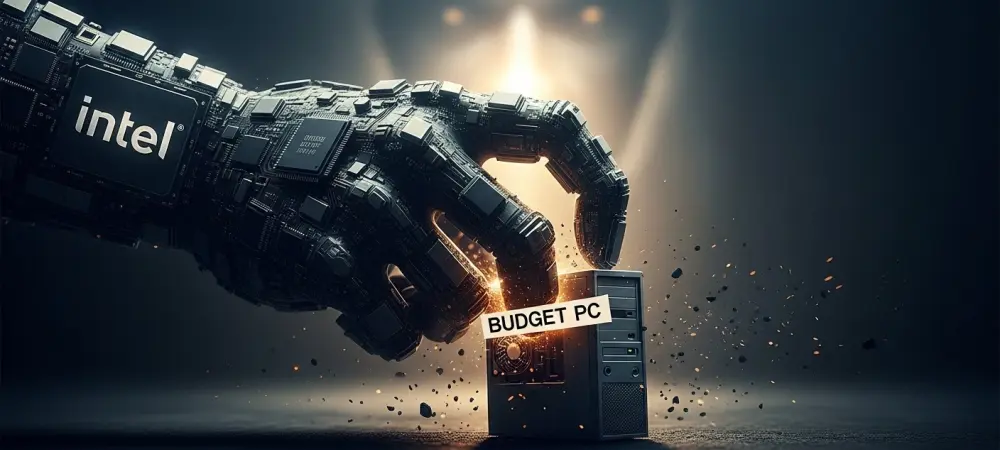
Building a reliable home office or a student workstation for under five hundred dollars was once a rite of passage for the budget-conscious consumer, but that affordable reality is rapidly dissolving into hardware history. A recent surge in component costs, led by Intel’s strategic decision to raise prices across its entire processor lineup, has signaled a permanent shift in the economics of personal computing. This adjustment is not merely a reaction to inflation; it is a calculated pivot by the world’s most influential chipmaker toward a future where high-margin silicon takes precedence over the needs of the entry-level market.
The Death of the Triple-Digit Desktop
The era of the “triple-digit” desktop is fading as the fundamental math of PC manufacturing undergoes a radical transformation. For years, the sub-$500 category relied on thin margins and high-volume production to remain viable for vendors and accessible to the public. However, as Intel notifies global manufacturers of impending price hikes, those narrow profit margins are being squeezed into non-existence, forcing brands to abandon the low-end segment. This trend suggests that the entry-level floor is being pushed toward the seven-hundred-dollar mark, fundamentally changing how students and small businesses approach technology. What used to be a commodity is becoming a significant investment, as the silicon originally destined for affordable laptops is redirected toward more lucrative sectors. The result is a market where the “budget” label no longer equates to “cheap,” but rather to “less expensive than the extreme.”
Why the Silicon Squeeze Matters Today
The current hardware landscape is defined by a fierce competition for limited production capacity, where the average consumer is no longer the primary focus. Intel is currently balancing a delicate act of allocating its finite manufacturing resources between traditional consumer chips and the high-performance hardware required for the global AI infrastructure. With demand for machine learning capabilities reaching an all-time high, the company has prioritized the production of enterprise-grade processors that command premium prices.
This shift in priority means that the silicon wafers used to create an i3 or i5 processor are now seen as more valuable when converted into a Xeon server chip. For the typical buyer, this results in a supply vacuum where low-cost options are intentionally throttled to satisfy the “AI boom.” This redirection of resources treats the traditional PC market as a secondary concern, leaving retail shelves with fewer affordable choices and higher price tags.
The Factors Driving the 10% Surge
- The Shift to AI Inference: As AI workloads move from massive training centers to localized inference, the demand for CPU-driven performance has reached a fever pitch. Intel is prioritizing its 4th Gen Xeon chips to service hyperscalers, leaving the consumer sector with a significant supply deficit.
- Production Capacity Bottlenecks: Manufacturing constraints have forced a choice between high-volume budget chips and low-volume, high-margin enterprise silicon, with the latter currently winning the internal resource war.
- The Component Compound Effect: This CPU hike hits an industry already struggling with inflated costs for DRAM and graphics units, creating a perfect storm of rising prices across the entire bill of materials.
- The Eroding Bill of Materials: An extra $50 on a processor might seem manageable in isolation, but for a manufacturer, it often represents the entire profit margin of a budget system, making such builds economically impossible.
Expert Perspectives on the Vanishing Entry-Level Market
Analysts are increasingly concerned that the “AI tax” is creating a digital divide, where the cost of entry for modern computing is becoming prohibitive for many. Industry insiders observe that the trickle-down effect of technology, which usually makes hardware cheaper over time, has effectively been reversed by the demand for corporate infrastructure. They argue that high-grade silicon is now a luxury good, and its value in a data center far outweighs its value in a student’s laptop.
Furthermore, market researchers suggest that we are entering a sustained period of higher entry prices where the concept of “value” is being redefined. As manufacturers pivot toward the enterprise, the hardware available to the general public will likely become more expensive and less diverse. This environment favors those with the capital to invest in premium machines, while those on a budget are left to navigate a market with dwindling options.
How to Navigate the Rising Cost of Hardware
To mitigate the impact of these rising costs, consumers should focus on extending the lifecycle of their current devices through targeted upgrades. Adding more memory or replacing a mechanical drive with a modern SSD can provide a significant performance boost for a fraction of the cost of a new system. This approach allows users to bypass the inflated prices of new entry-level hardware while maintaining a functional workspace. Alternatively, the secondary market has become a goldmine for those seeking performance-per-dollar. Refurbished enterprise workstations and last-generation stock often offer superior builds compared to the new, price-inflated budget models currently hitting the shelves. Additionally, cloud-based computing and virtual workstations offer a way to access high-performance environments without the need for a massive upfront investment in local hardware. By monitoring clearance cycles and opting for slightly older architecture, savvy buyers bypassed the immediate sting of the latest price hikes.