

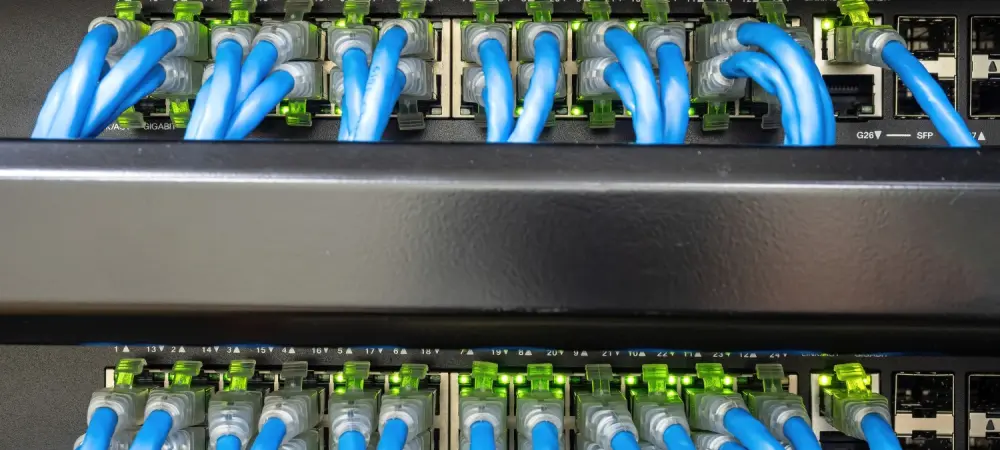
The release of the CN5000 family by Cornelis Networks marks a notable development in the realm of networking for artificial intelligence (AI) and high-performance computing (HPC) environments. This groundbreaking solution is crafted to address the need for efficient large-scale deployments, featuring the capacity to support configurations with up to 500,000 endpoints. In tackling common challenges like scaling inefficiencies and compute underutilization, the CN5000 offers exceptional performance improvements, notably in lossless data transfer and congestion avoidance. CEO Lisa Spelman has emphasized the solution’s ability to capitalize on compute cycles efficiently, underscoring its role as a significant performance multiplier. By striving to unlock the full potential of network-led application acceleration, the CN5000 promises to redefine the landscape for AI and HPC, providing a considerable boost in performance and operational efficiency.
Advanced Features and Capabilities
Key attributes of the CN5000 include superior job completion times and heightened computational efficiency, addressing critical areas for those relying on cutting-edge technology for computational tasks. The CN5000 leads to reduced latency, achieving a notable 35% improvement over InfiniBand NDR. This reduction has a significant impact on processing speed and efficiency, which are crucial for time-sensitive operations in AI and HPC workloads. Specifically, in AI applications, the CN5000 facilitates collective communication at speeds six times faster than RoCE, thanks to Cornelis Networks’ advanced Omni-Path architecture. This enables efficient scaling for training increasingly sophisticated language models while boosting inference capacities to enhance AI output quality. In traditional HPC disciplines, such as climate modeling and seismic simulations, the reduced execution times offer significant improvements in efficiency and accuracy, illustrating the CN5000’s vital role in advancing computing capabilities.
Seamless Integration and Market Impact
The CN5000 series is a highlight in modern networking, offering universal compatibility, a crucial feature for organizations aiming to build unified systems. This solution integrates effortlessly with components from industry giants like AMD, Intel, and NVIDIA, making it highly adaptable across various technological contexts. Support for OpenFabrics software stacks guarantees vendor-neutral operations by enhancing flexibility and reliability. Cornelis Networks presents a comprehensive product lineup that includes SuperNICs, diverse switch setups, management software, and cabling options, empowering users with extensive customization and adaptability. This introduction places Cornelis Networks as a leader in next-gen networking for AI and High-Performance Computing (HPC), setting a new benchmark for performance, scalability, and efficiency. The CN5000 family helps organizations achieve computational goals more effectively and quickly, marking a significant advancement in the capabilities of AI and HPC networks while establishing new industry standards.