

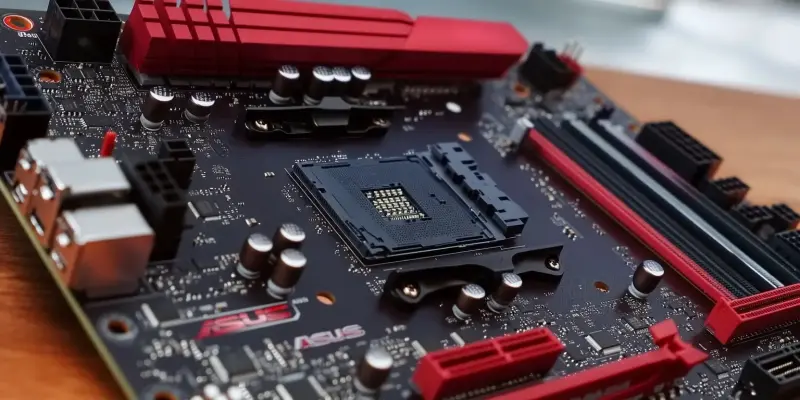
In a recent revelation, an Italian retailer has inadvertently spilled the beans on ASUS’s impending B850 and B840 motherboards, providing eager tech enthusiasts a sneak peek at what to expect from AMD’s upcoming 800-series. This early listing contains a treasure trove of detailed specifications, designs, and price points for the latest additions to ASUS’s ROG Strix, TUF Gaming, and PRIME series. The collective anticipation surrounding AMD’s 800-series has been fervent, and the unveiled details by this retailer offer a tantalizing glimpse into where the industry might be heading next. This article will examine these newly revealed motherboards to see how well they align with industry expectations and consumer demands.
The Feature-Rich ROG Strix Series
The ROG Strix series occupies the mid-range market with its four offerings: the ROG Strix B850-E Gaming WiFi, B850-F Gaming WiFi, B850-A Gaming WiFi, and B850-I Gaming WiFi. Ranging approximately from $322 to $425 with VAT, and from $268 to $354 without VAT, these models aim to offer a balanced blend of performance and features suitable for a wide spectrum of users, particularly gaming enthusiasts. One of the standout models, the B850-E Gaming WiFi, showcases impressive capabilities with its robust 16+2+2 power phases. This configuration is ideal for those who look forward to overclocking their systems to squeeze out every ounce of performance.
However, the features do not end there. The B850-E Gaming WiFi also supports PCIe 5.0 for both graphics cards and M.2 slots, pushing the envelope in terms of future-proofing and performance potential. These attributes cater explicitly to gamers and power users who demand high-speed data transfer rates and the flexibility to upgrade their systems without quickly becoming obsolete. The incorporation of WiFi 6 ensures excellent network performance, further rounding out the utility of these motherboards. This emphasis on high-performance specs suggests that ASUS is committed to meeting, if not exceeding, the expectations of its customer base.
Compact and Budget-Friendly TUF Gaming Series
Serving the needs of budget-conscious buyers and compact build enthusiasts, the TUF Gaming series introduces three models based on the B850 chipset: TUF Gaming B850-Plus WiFi, B850M-Plus WiFi, and B850M-Plus. These motherboards carry price tags that are more accessible, with the latter two models priced around $258 and $272 with VAT, equating to roughly $215 and $225 without VAT respectively. This segment is designed for those who do not require the extensive high-end features found in the ROG Strix series but still seek reliable and capable performance for gaming and other demanding applications.
The TUF Gaming line maintains an excellent balance between cost and capability, featuring sufficient power phases and connectivity options that cater to users who aim to build compact, efficient systems. This deliberate focus on balancing affordability and performance without compromising on essential capabilities like network speed and data transfer is geared towards a demographic looking for practical and sustainable builds. Moreover, these models incorporate a design ethos that prioritizes durability, a hallmark of the TUF Gaming series, ensuring that users receive a product engineered for longevity and reliability.
PRIME Series: The Entry-Level Solution
For those who are new to building PCs or need a fundamental, cost-effective solution, ASUS offers the PRIME series equipped with the AMD B840 chipset. The PRIME B840-Plus WiFi and PRIME B840M-A WiFi are indicative of the company’s attempt to cater to this essential segment. The price point is more appealing, with costs falling at $235 and $213 including VAT, or $195 and $177 excluding VAT. This price tier targets users who prioritize basic functionalities over advanced customizations and do not have plans to venture into overclocking terrain.
These motherboards are replete with critical features that address the needs of budget-focused users without overwhelming them with unnecessary complications. They offer adequate connectivity and stability for everyday computing needs, including casual gaming, streaming, and productivity tasks. By maintaining a competitive price while ensuring the presence of necessary elements such as WiFi connectivity, ASUS strikes a balance that’s ideal for users just stepping into the waters of PC building or those who build systems where cost efficiency is paramount without significantly sacrificing core performance.
Meeting Diverse Consumer Needs
An Italian retailer has recently leaked details about ASUS’s upcoming B850 and B840 motherboards, creating a buzz among tech enthusiasts. This accidental reveal gives an advance look at AMD’s 800-series, showcasing a wealth of specifications, designs, and pricing for the latest models in ASUS’s ROG Strix, TUF Gaming, and PRIME series. The highly anticipated AMD 800-series has been a topic of excitement, with this information offering a promising preview of future industry trends. This article will delve into these newly disclosed motherboards, scrutinizing their features and specs to determine how they measure up to industry standards and consumer expectations. With these motherboards set to include advanced features and possibly improved performance, experts and consumers are eager to see if they will meet the high benchmarks set by previous series and if they will offer significant improvements. The details thus far suggest that ASUS is aiming to maintain its reputation for high-quality and innovative products in line with emerging technology trends.