

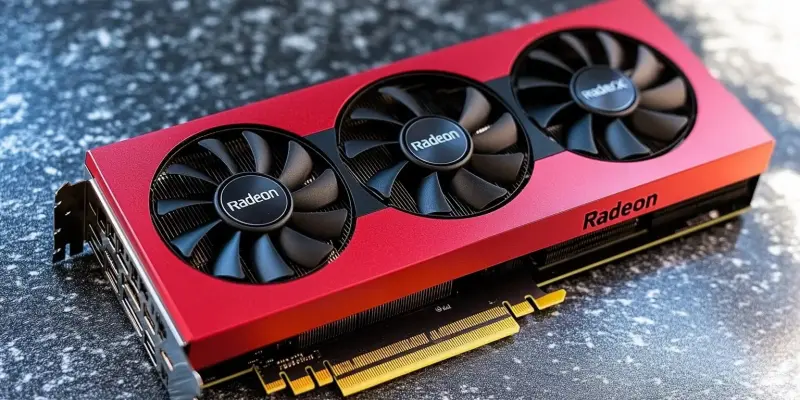
The tech world is abuzz with speculation and anticipation as AMD prepares to launch its Radeon RX 9070 Series graphics cards, poised to compete against Nvidia’s latest GPU offerings. With the RDNA 4 architecture at its core, the RX 9070 Series represents a significant leap in technology, sparking curiosity about its potential to outperform Nvidia’s current market leaders. The newly unveiled lineup includes two distinct models: the RX 9070 XT and the RX 9070, both boasting impressive specifications designed to capture the attention of gamers and tech enthusiasts alike.
RX 9070 XT’s Advancements
Leading the RX 9070 Series is the RX 9070 XT, dubbed the fastest Radeon card of this generation. Built on the robust Navi 48 chip, the RX 9070 XT features 64 RDNA 4 Compute Units (CUs), 64 Ray Accelerators, 128 Render Output Units (ROPs), and an equal number of AI Accelerators, making it a formidable contender in the GPU market. With 4,096 Stream Processors clocked at 2,400 MHz for gaming and an impressive 2,970 MHz boost clock speed, the RX 9070 XT can deliver up to 48.7 TFLOPS of single-precision compute performance. These specifications suggest that the RX 9070 XT is well-equipped to handle demanding gaming and graphics tasks, potentially challenging even the top-tier Nvidia GPUs.
However, the RX 9070 XT’s performance isn’t just about raw power. AMD has introduced several innovative features aimed at enhancing the user experience. Notably, the RX 9070 XT includes 16GB of 20 Gb/s GDDR6 memory on a 256-bit bus, yielding 640 GB/s of bandwidth. Although this figure is lower than the 960 GB/s provided by the RX 7900 XTX, the inclusion of 64 MB of 3rd-Gen Infinity Cache is designed to offset this reduction by improving data access efficiency. Furthermore, with power targets set at 304W TBP, delivered via PCIe 5.0 x16 and two 8-pin power connectors, the RX 9070 XT is anticipated to offer improved power efficiency compared to its predecessors.
RX 9070’s Potential
The RX 9070, while slightly less powerful than its XT counterpart, still presents a robust option for those looking to upgrade their GPUs. Featuring 56 RDNA 4 Compute Units, 56 Ray Accelerators, and 112 AI cores, the RX 9070 is tailored for high-performance gaming and graphics work. Its 3,584 Stream Processors, clocked at 2,070 MHz for gaming and up to 2,540 MHz for boost, make it approximately 10% slower than the RX 9070 XT. Nevertheless, this minor reduction in performance is unlikely to be a deal-breaker for many consumers, especially given the RX 9070’s competitive positioning in the market.
In terms of memory and connectivity, the RX 9070 mirrors the RX 9070 XT, with 16GB of 20 Gb/s GDDR6 memory on a 256-bit bus and 64 MB of 3rd-Gen Infinity Cache. The bandwidth remains at 640 GB/s, and the power target is set at 220W TBP, delivered via the same PCIe 5.0 x16 and dual 8-pin power connectors. One notable difference, however, is the RX 9070’s display connectivity options, which include HDMI 2.1b and DP 2.1a UHBR13.5 but lack the newer DisplayPort 2.1 UHBR20 available on Nvidia’s RTX 50 series. This omission may impact support for high-refresh-rate 4K monitors, potentially making it less attractive to users prioritizing cutting-edge display technology.
Market Positioning and Anticipated Impact
As AMD prepares for the official launch of the RX 9070 Series on February 28, speculation about its market positioning and pricing continues to build. AMD has hinted at a sub-$700 MSRP for these new GPUs, which could make them more accessible to a wider range of consumers compared to Nvidia’s high-end offerings. This pricing strategy, coupled with the RX 9070 Series’ impressive specifications, suggests a potentially strong market performance, particularly among gamers and professionals seeking powerful yet affordable GPU options.
Despite the promising advancements and competitive pricing, there are concerns about the absence of reference cards, which might drive up partner pricing. However, AMD’s focus on improved power efficiency and the introduction of new AI-based upscaling technology, such as FSR 4, could give it an edge over Nvidia. This new technology aims to enhance gaming performance and visual fidelity, addressing one of the critical areas where Nvidia has traditionally held a lead with its DLSS technology. If successful, FSR 4 could significantly improve AMD’s standing in the competitive GPU market.
Final Thoughts and Future Considerations
The tech landscape is buzzing with excitement and speculation as AMD gears up to launch its highly anticipated Radeon RX 9070 Series graphics cards, designed to rival Nvidia’s latest GPU offerings. Anchored by the cutting-edge RDNA 4 architecture, the RX 9070 Series represents a significant technological advancement, raising questions about its capability to outpace Nvidia’s current market leaders. This groundbreaking lineup features two distinct models: the RX 9070 XT and the RX 9070, both engineered with impressive specs intended to captivate gamers and tech enthusiasts alike.
The RX 9070 XT, often referred to as the flagship, is expected to deliver unparalleled performance with advanced ray tracing and AI-enhanced features, paving the way for immersive gaming experiences. Its sibling, the RX 9070, offers a balanced mix of performance and efficiency, making it an attractive choice for a broader audience. As AMD readies itself for this major release, the potential impact on the GPU market and the gaming community is immense, setting the stage for a thrilling showdown between industry giants.