

The race to dominate the next generation of software development is no longer about incremental improvements but about a complete reinvention of the entire lifecycle through artificial intelligence. In a competitive landscape that resembles a land grab for market dominance, technology firms are rapidly redefining the Software Development Lifecycle (SDLC) with AI-powered platforms. Helsinki-based Eficode is making a decisive strategic move to place itself at the center of this transformation. This analysis explores the firm’s ambitious effort to unify its global operating model and present a clear, progressive path toward an AI-orchestrated SDLC. By examining Eficode’s four-stage framework, it becomes clear how organizations can evolve from adopting simple AI tools to implementing a fully autonomous “AI-driven software factory,” fundamentally shifting the human role from tactical execution to strategic oversight.
A Fundamental Market Shift from Point Solutions to End-to-End Advisory
Historically, the software development market evolved through the adoption of disparate tools to solve specific problems, from version control to CI/CD pipelines. This fragmented approach, however, is proving insufficient in the current climate. The industry has reached an inflection point where customer demands have fundamentally changed. Market analysis indicates clients are no longer seeking isolated solutions; they now require a trusted advisor capable of guiding them through a complete, end-to-end digital transformation.
This demand for holistic guidance is driven by the sheer complexity of integrating artificial intelligence securely and scalably across an entire development toolchain. The risks and opportunities are too great for a piecemeal strategy. Understanding this market shift is critical, as it explains why forward-thinking companies are pivoting from being tool providers to becoming strategic partners. They now deliver comprehensive, AI-integrated frameworks designed for the modern era of software creation, a move that meets the market where it is headed.
A Four-Stage Framework for the AI-Driven Software Factory
Stage One and Two From Individual Copilots to Collaborative Agentic Workflows
The journey toward an AI-orchestrated SDLC begins with foundational, accessible steps focused on empowering individuals and teams. The first stage involves the widespread adoption of code assistants and copilots, tools designed to augment the productivity of individual developers, designers, and product professionals. Market projections suggest these tools can deliver an immediate 1.2x increase in development efficiency, providing a tangible return on investment that builds momentum for broader organizational change. However, isolated productivity gains are only the starting point. The second stage scales these benefits from the individual to the team by implementing “agentic workflows.” These collaborative systems enhance communication and streamline processes across product, engineering, and operations, ensuring that the initial efficiency boosts are amplified and integrated into the collective efforts of the entire team. This integrated approach addresses the common pitfall of AI tools creating new silos of productivity.
Stage Three The Rise of Supervised Multi-Agent Automation
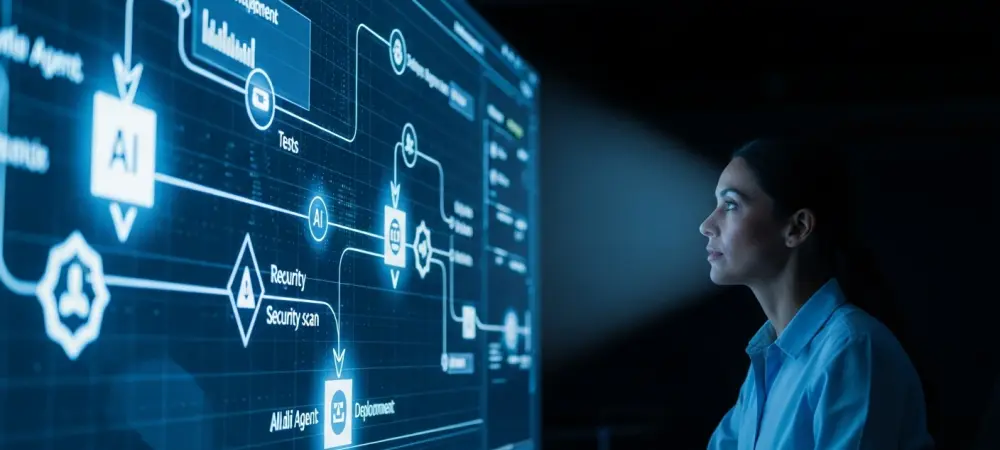
Once a foundation of AI-assisted teamwork is established, the path progresses to a more sophisticated level of automation. This third stage introduces multi-agent tools that can coordinate complex, cross-functional actions throughout the development lifecycle. For example, AI agents can be configured to automatically trigger builds, initiate sophisticated test suites, or run security scans based on real-time pipeline states, which significantly reduces manual handoffs and the potential for human error. In parallel, product professionals can leverage AI to generate functional prototypes, allowing for more rapid idea validation and stakeholder feedback. A critical element of this stage is the emphasis on human supervision. As automation becomes more powerful and pervasive, maintaining human oversight is essential to build trust, ensure consistency, and guarantee that the automated actions align with strategic goals, preventing the system from operating as an unmanaged black box.
Stage Four Achieving Autonomy in the AI-Orchestrated Lifecycle
The final and most aspirational stage of the framework is the creation of a fully autonomous, AI-orchestrated software lifecycle. In this vision, advanced AI agents manage entire delivery pipelines from end to end. These autonomous systems handle deployments, conduct real-time performance monitoring, execute compliance checks, and even perform self-healing actions in response to production issues, all governed by built-in observability. This culmination of AI integration transforms the human role entirely. Developers and engineers shift from performing repetitive, tactical tasks to focusing on higher-level strategy, creative problem-solving, and innovation. This “AI-driven software factory,” where ecosystems of intelligent agents manage the value chain, represents the ultimate market destination, where human intellect guides an autonomous engine of software creation.
Market Validation Through Real-World Implementation and Strategic Alliances
A strategic market roadmap, no matter how compelling, requires validation through real-world application. The viability of this four-stage framework is substantiated by successful implementations with major global clients, including industry leaders like Daimler Trucks and the BBC. These partnerships demonstrate that the progressive adoption of AI in the SDLC is not merely a theoretical concept but a practical pathway to tangible business outcomes. These use cases serve as powerful proof points for the broader market, signaling that the model is both achievable and effective.
Looking ahead, the defining trend will be the maturation of these agent ecosystems into truly autonomous platforms. This evolution is supported by a renewed commitment from platform providers to their strategic partners, with dedicated executive leadership tasked with deepening these relationships to co-create the future of software development. This intense focus on partnership underscores a key market prediction: the future of the AI-driven SDLC will be built not by lone innovators but through collaborative ecosystems that share knowledge, risk, and reward.
Strategic Imperatives for Embarking on the AI Orchestration Journey
This analysis of the evolving SDLC market yields several key takeaways for any organization looking to navigate the AI revolution. The most critical insight is that achieving an AI-orchestrated SDLC is a progressive journey, not an overnight transformation. Success depends on a phased approach that builds institutional trust and demonstrates measurable value at each step. For businesses, the recommended path is to begin with foundational tools like code assistants to secure early wins and build organizational momentum for change.
From that initial foothold, the focus should shift to scaling these benefits through collaborative workflows before introducing more advanced, multi-agent automation under close supervision. Throughout this process, establishing a robust governance framework with clear human-in-the-loop oversight is non-negotiable for managing risk and ensuring alignment with business objectives. Finally, organizations must proactively rethink professional roles and invest heavily in upskilling their workforce to prepare for a future where strategic thinking and creative innovation are the most valuable human contributions to the software creation process.
The strategic re-engineering and clear roadmap presented by market leaders offered a compelling blueprint for the future of software creation. The core themes—the evolution of customer needs toward strategic partnership, the necessity of a phased AI adoption model, and the transformation of human roles—provided a coherent guide for an industry in flux. The concept of an AI-orchestrated SDLC was far more than a passing trend; it represented the next logical step in the quest for greater efficiency, quality, and innovation in software engineering. By unifying operations and articulating a holistic, open, and contemporary vision, key players made a significant and timely move to not only compete in the AI-first era but to become the key architects of its future.