

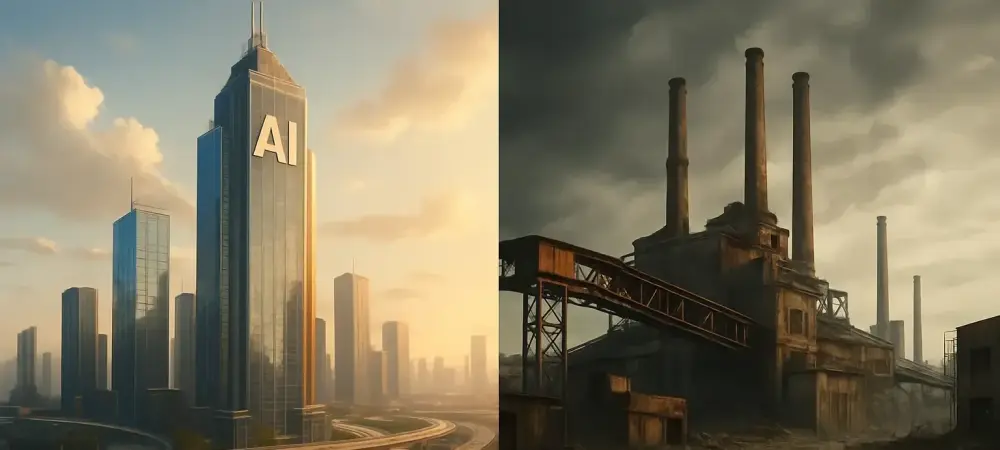
The relentless advance of artificial intelligence presents a profound paradox, simultaneously promising unprecedented individual empowerment while casting a long shadow of mass economic displacement over the global workforce. As a collection of expert analyses and industry forecasts converge, a complex picture of our shared future emerges—one defined by radical opportunity and existential risk. This synthesis of leading predictions unpacks the AI-driven transformations on the horizon, examining the dual potential for empowerment and obsolescence. The exploration ahead charts this tectonic shift across four interconnected fronts: the rise of individual enterprise, the stability of traditional employment, the evolution of global trade, and the state of human well-being.
From Prediction to Reality: Decoding the AI-Driven Future Foresees
Leading industry reports serve as a critical lens through which to view the monumental economic and social transformations currently underway. These analyses are not abstract academic exercises; they are roadmaps detailing the powerful currents of change that businesses, governments, and individuals must navigate. They forecast a future where AI is not merely a tool but the foundational platform for a new era of commerce and creativity.
The central tension animating this discussion is the dual nature of artificial intelligence. On one hand, it holds the potential to democratize technology, equipping individuals with capabilities once reserved for large corporations. On the other, it threatens to automate vast swaths of human labor, challenging the very structure of our economic systems. Understanding this dichotomy is essential, as it frames the defining conversation of our time: whether this technological leap will lead to a renaissance of human potential or a crisis of purpose and employment.
The Four Fronts of a Tectonic Shift
The Dawn of the One-Person Conglomerate
A powerful confluence of technologies is enabling the rise of a new entrepreneurial class. AI-powered tools, direct-to-consumer business models, and blockchain-based systems are providing solo operators with the leverage to build and scale massive commercial ventures from the ground up. This trend signals a future where an individual can conceptualize, market, and manage a global brand with a level of efficiency and reach that was previously unimaginable, effectively becoming a one-person conglomerate.
This transition from digital influencer to C-suite executive is already in motion, with prominent examples illustrating the model’s viability. Creators like Charli D’Amelio with her snack brand and Emma Chamberlain with her coffee company have successfully converted cultural capital into commercial enterprises. Similarly, the launch of Garage Beer by the Kelce brothers demonstrates how personal branding can serve as a powerful launchpad for consumer products. The debate now centers on whether this movement truly democratizes opportunity for all or simply establishes a new, hyper-competitive creator economy where only the most visible can succeed.
The Looming Specter of Redundancy and the Fraying Social Contract
Beneath the optimistic forecasts of individual empowerment lies a pervasive and deeply rooted anxiety about job displacement. The public watches as AI and robotics demonstrate capabilities that surpass human performance in both cognitive and physical domains, from complex data analysis to intricate manual labor. This rapid progress fuels the fear that a significant portion of the human workforce could be rendered obsolete, creating widespread economic instability.
While the prospect of mass unemployment is a primary concern, some analyses point to potential bright spots on the horizon. AI could foster a renaissance for small businesses by dramatically lowering barriers to entry, and it might lead to fairer, less biased hiring practices by removing human prejudice from recruitment. New niche markets may even emerge, with entrepreneurs offering specialized services to AI systems themselves. Nevertheless, this disruption poses a fundamental challenge to the social contract, which has long been built on the assumption of universal employment. This pressure forces a critical re-evaluation of our societal framework, demanding new models for economic participation and social support.
Redrawing the Map: Why Globalization Is Bending, Not Breaking
Contrary to the prevailing narrative of de-globalization, a compelling counter-argument suggests the world is becoming more interconnected, not less. This “Flat Earth” theory posits that while trade frictions between major powers will persist, they are a normal feature of a complex global system, not a sign of its collapse. The fundamental movement of goods, services, and capital across borders is expected to continue, forming a more resilient and adapted version of globalization.
Corporations are not retreating into purely local supply chains, a process that is both prohibitively expensive and slow. Instead, they are adopting sophisticated hybrid strategies to navigate geopolitical tensions. This includes a mix of on-shoring to bolster domestic production and “friend-shoring”—rerouting supply chains through allied nations—to balance efficiency with security. Two powerful forces are reinforcing this global interconnectedness: the relentless flow of capital toward innovation and growth, and the inherently borderless nature of AI development, which advances at a pace that national boundaries cannot contain.
The Human Imperative: Reclaiming Connection in an Automated World
As society becomes more deeply integrated with digital systems, a significant societal response is emerging to address the mental health risks of a hyper-connected, automated world. Forecasts point toward a multi-pronged effort to mitigate these dangers, involving new government regulations on technology, self-imposed limits by individuals and companies, and a growing public awareness of the need for digital well-being. This movement may include coordinated initiatives to reduce screen time among youth and place ethical guardrails on the use of AI-driven tools like virtual therapists. In direct contrast to the digitization of life, a powerful counter-trend is the rising premium placed on authentic, in-person human interaction. Live events, community gatherings, and face-to-face engagement are becoming increasingly valued as essential antidotes to digital isolation. Experts in social wellness project that by 2026, leaders across business, government, and civil society will begin to mobilize a large-scale response to reverse the decline of social connection. This reinforces a fundamental truth: technology can augment human capability, but it cannot replace the core human need for community.
Navigating the New Reality: A Strategic Blueprint for the AI Age
Synthesizing these interconnected trends reveals a clear set of takeaways for the immediate future. The landscape will be defined by hyper-empowered individuals capable of launching global enterprises, a labor market undergoing profound redefinition, resilient global supply chains that adapt to geopolitical shifts, and a renewed societal focus on human connection and well-being. Success in this new era will depend on proactively engaging with these realities rather than passively reacting to them.
For businesses, this means leveraging AI not just for efficiency but for unprecedented agility and innovation. For professionals, the imperative is to cultivate uniquely human skills—such as critical thinking, emotional intelligence, and collaborative creativity—that complement AI rather than compete with it. For policymakers, the challenge is urgent: to rethink social safety nets and educational systems to support a workforce in transition. The most effective strategies will balance aggressive technological adoption with deep investments in human capital, fostering a culture that values both digital fluency and genuine connection.
Charting a Course Between Dystopia and an Unprecedented Renaissance
The analysis of these trends concluded that artificial intelligence was neither a guaranteed utopia nor an inevitable apocalypse. Instead, it was revealed to be a uniquely powerful force whose ultimate impact would be determined by the choices made by society. The currents identified—from the rise of solo empires to the fraying of the social contract—were not distant possibilities but active forces already shaping the global landscape, demanding immediate and strategic engagement from leaders in every field.
Ultimately, the path forward required intentionality. It became clear that steering technological development with a focus on human values was the only way to ensure the future being built would enhance prosperity and connection, rather than undermine them. The crucial task was to harness the immense potential of AI to solve intractable problems and unlock new forms of creativity while simultaneously reinforcing the social fabric and the primacy of human well-being.