

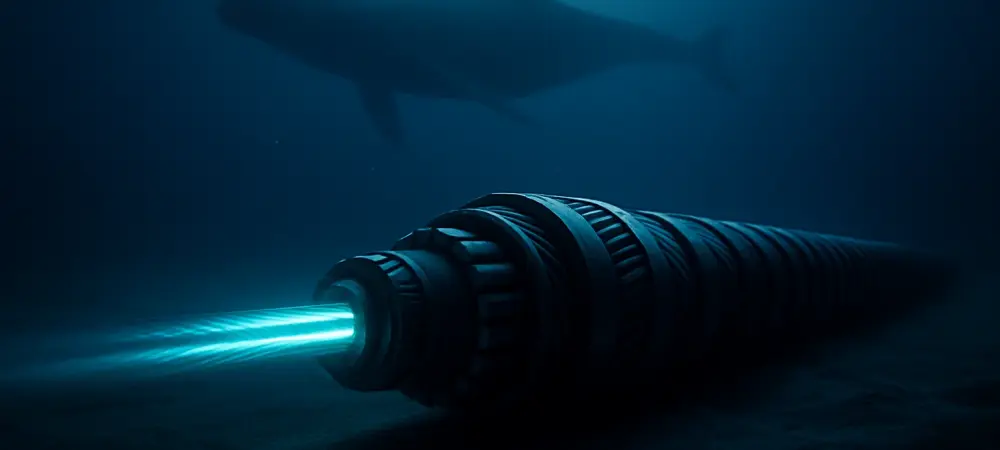
The Unseen Foundation of Our Digital World
In an age of wireless connectivity and “the cloud,” the internet is easily imagined as an ethereal, invisible force. Users connect via Wi-Fi, stream content from abstract digital lockers, and communicate across continents in an instant. Yet, this perception masks a profound physical reality: the global internet is a tangible network, and its backbone rests deep on the ocean floor. An astonishing 99% of all international data—from emails and video calls to financial transactions and AI model training—travels not through satellites in space, but through a vast system of submarine fiber-optic cables. This article explores this startling fact, deconstructing why the internet is fundamentally an underwater network. It delves into the immense capacity, deliberate architecture, and powerful economic drivers that make sub-sea cables the undisputed kings of global connectivity, rendering every other method a mere footnote.
From Telegraph Wires to Fiber-Optic Highways
The concept of connecting continents via undersea cables is not new. The story begins in the mid-19th century with the laying of the first transatlantic telegraph cables, a monumental feat of engineering that proved transoceanic communication was possible. For over a century, copper wires carried faint electrical pulses across the seabed, laying the groundwork for a global network. However, the true revolution arrived in the late 1980s with the advent of fiber-optic technology. A single strand of optical fiber could carry exponentially more information than its copper predecessor, transforming the potential of global data transfer. As the internet commercialized and expanded in the 1990s, the demand for international bandwidth exploded. Satellites and terrestrial links simply could not compete with the speed, capacity, and reliability of fiber. This historical dependency on sub-sea infrastructure shaped the internet’s core architecture, creating a legacy that defines its operations to this day.
Analyzing the Oceanic Supremacy
The Unmatched Capacity of Submarine Superhighways
The primary reason for the dominance of sub-sea cables is their staggering data-carrying capacity. The difference in scale between oceanic and terrestrial routes is monumental. Modern submarine cables are data superhighways, with systems like MAREA (connecting the US and Spain) and JUPITER (linking the US and Asia) capable of carrying hundreds of terabits per second (Tbps). The 2Africa cable, which encircles the African continent, is designed with more capacity than all previous cables serving Africa combined. In stark contrast, all the world’s combined terrestrial cross-border routes are mere “country tracks.” A typical land border crossing between two well-connected European nations, like Germany and France, might only handle a few terabits per second. The imbalance is so extreme that a single large submarine cable can single-handedly out-carry the entire terrestrial cross-border infrastructure of a continent. This raw bandwidth advantage makes alternatives for intercontinental traffic functionally obsolete.
An Architecture Built for Oceans, Not Borders
The internet was not designed as a patchwork of neighboring countries but as a global network connecting major continental hubs. Its architecture prioritizes high-volume, long-distance data flows over regional, country-to-country links. The most significant data arteries are the transatlantic and transpacific corridors, which, along with intra-Asia and Europe-Asia routes, account for well over 90% of global international capacity. This structural design means the vast majority of data traffic is routed onto a sub-sea path by default, well before it approaches a land border. For instance, data sent from South America to Asia is not routed overland through thousands of miles of disparate networks; it is efficiently funneled to a coastal landing station and sent across the Pacific. This architectural reality concentrates global traffic onto a handful of ultra-high-capacity submarine corridors, reinforcing their essential role.
The Economic Imperative: Why Money Rules, Not Maps
Ultimately, the path data takes is determined by cost and performance, not the shortest geographical distance. The global internet is organized around major “port” exchanges in coastal or near-coastal cities like London, Marseille, Amsterdam, and Frankfurt. These hubs are critical interconnection points where hyperscalers (such as Google, Meta, and Microsoft), content delivery networks, and tier-one carriers converge to exchange traffic efficiently. These tech giants are the primary investors in new submarine cables, building private infrastructure to connect their massive data centers and ensure low-latency, high-performance service for their users. This economic model ensures that data is deliberately funneled to these hubs to gain cost-effective access to the global submarine backbone. Consequently, even data between two neighboring inland countries might be routed to a coastal hub and onto a sub-sea segment because it is the most efficient path on the global network.
The Next Wave: AI, Geopolitics, and New Routes
The dominance of submarine cables is set to intensify. The rise of the artificial intelligence “supercycle” is creating unprecedented demand for bandwidth, as training massive AI models requires colossal data transfers between data centers spread across continents. In response, new generations of cables are being developed with even greater capacity and lower latency. Furthermore, geopolitics is playing an increasingly crucial role. As nations recognize these cables as critical national infrastructure, there is a growing push for route diversity and security. This is driving the development of new, strategic pathways, including potential Arctic routes that offer shorter distances between Europe and Asia, and new connections linking emerging economic powerhouses in South America, Africa, and Southeast Asia directly. These trends signal not a shift away from sub-sea cables, but a strategic deepening of global reliance on them.
The Submarine System in a Nutshell
The conclusion is clear: the 99% statistic is the logical outcome of a system designed for massive, intercontinental data exchange. The supremacy of submarine cables is the product of three converging factors: their unparalleled physical capacity, an internet architecture that inherently concentrates traffic on oceanic routes, and a powerful economic model that prioritizes routing data through hyper-connected coastal hubs. A logistics analogy is the most effective way to conceptualize this. Global trade is dominated by enormous container ships moving goods between a few major seaports, handling the vast bulk of worldwide tonnage. In this model, cross-border trucking, while vital for regional distribution, represents a tiny fraction of the total volume. The internet operates on the exact same principle. Sub-sea cables are the container ships of the digital world, while terrestrial links are the regional trucks.
The Silent, Essential Lifeline of Our Planet
The internet may feel wireless, but its reality is tethered to the bottom of the sea. The 99% figure is not an overstatement but a fundamental truth of a network built for global scale. This silent, invisible infrastructure is the essential lifeline of the modern world, powering everything from the global economy to personal connections. As the demand for data continues its exponential climb, driven by innovations like AI and the Internet of Things, dependence on this undersea network will only deepen. The next time you stream a movie, join an international video conference, or access a cloud service, remember the incredible journey data is taking—not through the air above, but through thousands of miles of fiber-optic cable resting on the dark, silent floor of the ocean.