

Dominic Jainy is a seasoned IT professional with deep-rooted expertise in artificial intelligence, machine learning, and blockchain technology. His career has been defined by a commitment to understanding how high-level tech infrastructure intersects with real-world ethical dilemmas and industrial applications. As we witness a massive shift in the AI landscape, Dominic provides a unique perspective on the operational and strategic challenges facing the industry’s biggest players.
This discussion explores the infrastructure strain caused by sudden user migrations, the delicate balance between ethical stances and defense contracts, and the complex legal battles surrounding government-imposed supply-chain risks.
When a service experiences a four-hour disruption and several subsequent outages shortly after hitting the top of the App Store, what specific infrastructure bottlenecks typically emerge? Please explain how engineering teams prioritize scaling the API versus user-facing platforms during such a sudden surge in traffic.
When a platform like Claude suddenly leaps to the top of the App Store, the primary bottleneck usually centers on database concurrency and load balancing capacity. A four-hour disruption, like the one recorded on February 27, suggests that the infrastructure wasn’t just busy; it was likely experiencing a cascading failure where the surge in requests overwhelmed the authentication or session management layers. Engineering teams face a grueling choice: they must decide whether to save the user-facing web interface or protect the API that serves developers and the Claude Code environment. Typically, the API takes priority because third-party integrations represent a critical ecosystem, yet during this surge, even the API suffered three-hour outages on February 28 and March 2. To recover, teams often implement aggressive rate limiting or “circuit breakers” to stop the entire system from collapsing, effectively turning away some traffic to keep the core service alive for others.
With over 2.5 million users shifting platforms due to concerns over military surveillance and automated weapons systems, how do these ethical commitments impact long-term brand loyalty? Can a company successfully maintain strict guardrails while simultaneously navigating the loss of major defense contractors?
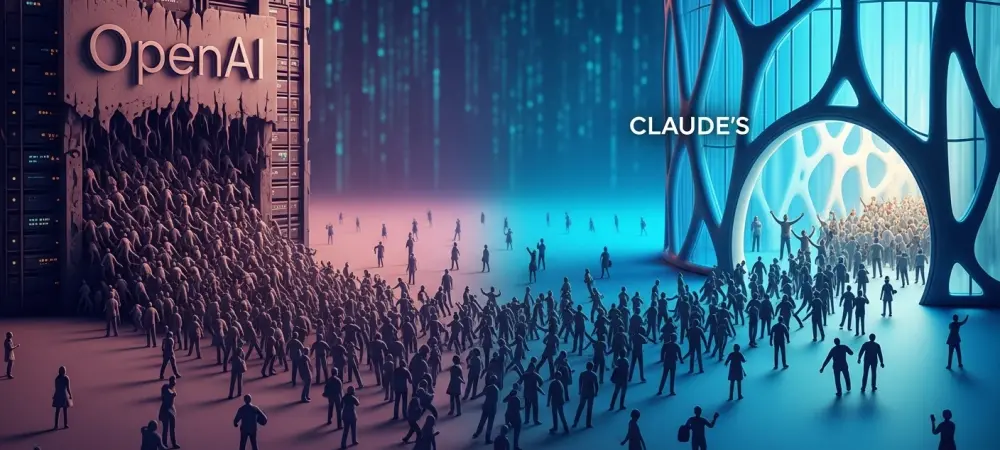
The exodus of 2.5 million users from a competitor to Anthropic is a visceral demonstration that ethics have become a primary feature for the modern consumer. This isn’t just a PR win; it’s a foundational shift in brand loyalty where users prioritize their values over pure convenience or speed. Maintaining these guardrails is an expensive uphill battle, especially when a company like Lockheed Martin cuts ties completely due to those very commitments. It creates a high-stakes environment where the company must prove to the market that civilian and enterprise revenue can outpace the massive, stable budgets of the defense sector. The success of this strategy hinges on the company’s ability to turn that 2.5 million “pledge group” into a loyal, paying user base that validates the decision to walk away from military contracts.
Certain AI providers were recently designated as supply-chain risks by the government, yet some partners continue offering these tools to non-defense clients. How does this designation change the legal landscape for tech giants, and what steps are necessary to challenge such a classification while maintaining business continuity?
The “supply-chain risk” designation is a powerful administrative tool that essentially blacklists a company from the federal procurement ecosystem, creating a complex legal labyrinth for its partners. For a giant like Microsoft, the response involves mobilizing a small army of lawyers to interpret how they can still offer tools to the private sector while strictly adhering to the “Department of War” restrictions. To challenge such a classification, a firm must enter a lengthy court battle to prove its security protocols are robust and that its refusal to participate in specific surveillance programs doesn’t equate to a threat. During this process, business continuity is maintained by isolating government-related data flows and ensuring that no military-adjacent entity can access the specific AI models in question. It’s a delicate dance of compliance where one small technical slip-up could lead to broader sanctions or the loss of even more commercial partnerships.
Competition between AI labs has intensified, with firms making competing claims about the robustness of their safety guardrails. How should users evaluate these claims regarding domestic surveillance, and what specific metrics or transparent reporting should they look for to verify that their data remains protected from intelligence agencies?
Evaluating safety claims in the AI space requires looking past marketing blog posts and focusing on third-party audits and detailed data-retention policies. Users should look for specific metrics, such as whether a provider utilizes end-to-end encryption for prompt data or if they have a “no-log” policy for intelligence agency queries. When OpenAI claims their deal has more guardrails than others, it is vital to scrutinize the actual definitions of “domestic surveillance” and “legal purpose” within their terms of service. Transparent reporting should include annual transparency reports detailing government data requests and the company’s refusal rate. Without these hard numbers and independent verification, “safety guardrails” are often just words used to soothe a nervous public while the underlying data remains vulnerable to shifting political winds.
What is your forecast for the future of the AI industry’s relationship with government defense agencies?
I predict we are heading toward a fractured AI ecosystem where providers will be forced to choose between being a “defense-first” lab or a “neutral-enterprise” platform. The tension we see now is just the beginning; as AI models become more integrated into automated systems, the government will likely increase pressure on developers to grant backdoors or specialized access for national security. We will see some companies lean into massive multi-billion dollar defense contracts, effectively becoming the new “digital” arms of the military, while others will fight to remain independent to keep their global user base. Ultimately, this will lead to a dual-tier market where the most powerful models are siloed for government use, while the public-facing versions are heavily restricted or audited to ensure they meet the ethical demands of a skeptical global audience.