

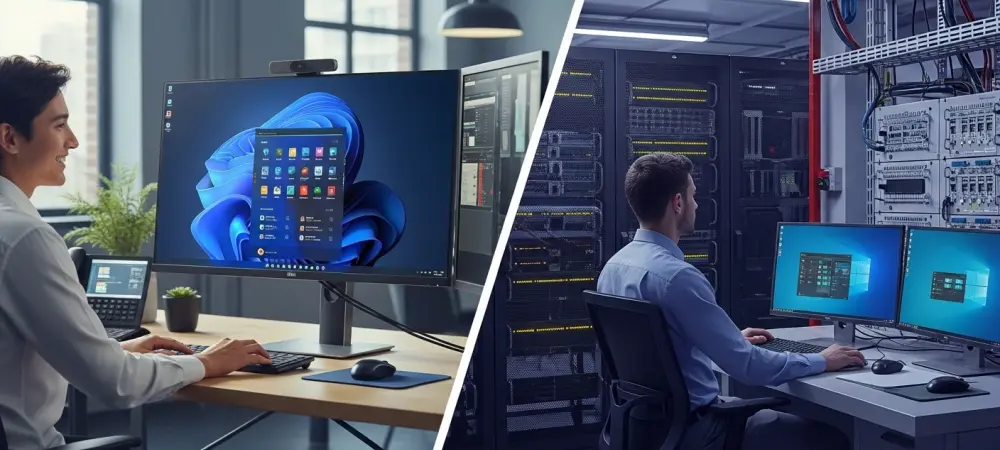
Navigating the Crossroads of Stability and Innovation
Deciding on an operating system for a business environment often involves a delicate balancing act between accessing the latest features and ensuring unwavering operational consistency, a choice that becomes critically important when managing specialized or mission-critical devices. While the standard consumer and enterprise versions of Windows 11 push a steady stream of updates and enhancements, a different path exists for scenarios where predictability is not just preferred but essential. This specialized version, known as the Long-Term Servicing Channel (LTSC), offers a feature-locked, stable platform designed for the long haul.
This article serves as a detailed guide to understanding Windows 11 LTSC. It will explore the fundamental principles behind this operating system, clarify its intended purpose, and delineate the specific environments where its adoption is most beneficial. By addressing the key questions surrounding its deployment, lifecycle, and features, organizations can confidently determine if this highly stable version of Windows aligns with their strategic and operational needs.
Answering the Essential Questions about LTSC
What Exactly Is Windows 11 LTSC
The Windows 11 Long-Term Servicing Channel (LTSC) is a specialized edition of the Windows Enterprise operating system engineered for maximum stability and predictability. Its core philosophy diverges sharply from the mainstream General Availability Channel (GAC) used by most Windows users, which delivers feature updates on an annual basis. The primary purpose of LTSC is to provide a consistent, secure, and unchanging OS environment for devices that perform dedicated, critical functions over many years. This model minimizes the risk of disruption, as new features are not introduced after deployment, thereby preventing potential compatibility issues with essential software and hardware.
In essence, LTSC versions are released every two to three years and, once installed, receive only monthly quality and security updates. They do not receive the annual feature upgrades that define the standard Windows experience. This approach provides a static and reliable foundation, which is paramount in regulated industries or for devices where even minor changes can have significant consequences. The goal is not to offer the latest user interface or productivity tools but to ensure that the underlying platform remains dependable throughout its extended lifecycle.
How Does LTSC Differ from Standard Windows 11
The most significant distinction between LTSC and standard Windows 11 editions lies in their servicing models and update cadences. Standard Windows 11, operating on the General Availability Channel, is designed for constant evolution. It receives an annual feature update that introduces new functionalities, user interface changes, and enhancements, keeping the user experience modern and dynamic. These updates are complemented by monthly quality updates that bundle security patches and minor feature rollouts.
In contrast, Windows 11 LTSC is built on a principle of functional immutability. Once an LTSC version is deployed, its feature set is frozen. It will continue to receive critical security patches and bug fixes through monthly updates, but it is deliberately excluded from the annual feature upgrades. This creates a highly predictable environment, which is a crucial advantage for IT departments managing specialized systems. The effort required for testing and validation is drastically reduced, and the risk of business-critical applications failing due to an OS update is virtually eliminated. This makes LTSC a strategic choice for stability, whereas the GAC is the clear choice for users and organizations that value continuous innovation.
What Are the Ideal Use Cases for LTSC
Microsoft explicitly designs and recommends LTSC for a narrow set of specialized and restricted environments, not for general-purpose deployment across an entire organization. A simple guideline is that if a device runs productivity software like Microsoft Office, it is likely better suited for the standard version of Windows. Information workers who use these tools benefit greatly from the regular feature updates that enhance collaboration and efficiency, which LTSC intentionally omits.
The true strength of LTSC shines in scenarios where consistency and reliability are non-negotiable. These include fixed-function devices that perform a single, critical task. Examples are abundant across various industries: medical systems like MRI and CT scanners, financial infrastructure such as ATMs, industrial controllers on a manufacturing floor, and retail systems including point-of-sale terminals and informational kiosks. For these systems, an unexpected OS change could halt operations, create compliance issues, or even pose safety risks. Therefore, LTSC provides the stable, long-term platform needed to ensure these essential devices function without interruption.
Which LTSC Versions Are Available and for How Long
Microsoft provides two distinct versions of Windows 11 LTSC, each with a different support lifecycle governed by the company’s Fixed Lifecycle Policy to cater to different deployment needs. The first is Windows 11 Enterprise LTSC 2024, which is intended for specialized enterprise PCs. This version comes with a five-year support lifecycle, with its mainstream support set to conclude on October 9, 2029. This timeframe is suitable for devices that have a moderate operational lifespan before being refreshed. The second, more robust option is Windows 11 IoT Enterprise LTSC 2024. This version is specifically targeted at special-purpose industrial and commercial devices like ATMs, medical machinery, and manufacturing equipment, where longevity is a primary concern. It benefits from a much longer 10-year support lifecycle. While its mainstream support also ends on October 9, 2029, it includes an additional five years of extended support, which will not conclude until October 10, 2034. This extended window ensures that these long-term, fixed-function assets remain secure and supported for their entire operational lives.
What Is New in the Latest LTSC 2024 Release
The Windows 11 Enterprise LTSC 2024 release, which became available on October 1, 2024, is a significant update built on the Windows 11 version 24## codebase. It aggregates all the key security and management improvements introduced across Windows 11 versions since its initial launch. This means it incorporates enhancements from versions 21##, 22##, 23##, and the foundational 24##, presenting them in a single, stable package.
Key advancements include a suite of modern security features, such as Microsoft Pluton support, enhanced phishing protection, and passkey capabilities for passwordless authentication. Credential Guard is enabled by default, and the Windows Local Admin Password Solution (LAPS) is now built-in. For administrators, the release integrates with Microsoft Intune for modern device management and introduces Sudo for Windows, allowing elevated commands from a standard console. Additionally, it brings native support for Wi-Fi 7 and HEVC video coding. As part of this evolution, legacy components like Internet Explorer and Microsoft Publisher have been completely removed.
What Are the Key Trade-offs of Using LTSC
Adopting Windows 11 LTSC is a strategic decision that comes with distinct trade-offs. The primary benefit is unparalleled stability, but this comes at the cost of innovation and flexibility. Since LTSC versions do not receive feature updates, organizations miss out on the latest productivity enhancements, security innovations, and user experience improvements that are regularly rolled out to standard Windows editions. This can lead to a user experience that feels dated over time and may lack support for newer third-party applications that rely on features from more recent Windows builds.
Furthermore, there are hardware considerations. An LTSC release officially supports only the processors and chipsets that were available at the time it was launched. Support for newer CPU generations is only introduced in subsequent LTSC releases, which arrive every few years. This means that an organization committed to an older LTSC build may face limitations when refreshing its hardware. Consequently, while LTSC excels at providing a predictable and secure platform for specific use cases, it is not a suitable default for all enterprise PCs, where staying current with both software and hardware is often a priority.
A Calculated Decision for Long-Term Stability
In summary, Windows 11 LTSC stands apart as a specialized tool within the broader Windows ecosystem. Its core value proposition is not rooted in delivering the newest features but in guaranteeing a static, secure, and highly predictable operating environment for mission-critical systems. This is achieved by forgoing the annual feature updates characteristic of mainstream Windows versions in favor of a long-term support model that prioritizes consistency above all else. The ideal candidates for LTSC are fixed-function devices found in regulated and specialized sectors, such as healthcare, finance, and manufacturing. For these scenarios, the trade-off of delayed access to new functionalities is a small price to pay for the assurance of uninterrupted operation. The availability of both five-year Enterprise and 10-year IoT Enterprise lifecycles allows organizations to align the OS with the expected lifespan of their hardware assets, making it a versatile solution for specific needs.
Final Thoughts on Strategic Deployment
The decision to deploy Windows 11 LTSC should not have been taken lightly. It represented a deliberate choice to prioritize operational continuity over the dynamic evolution offered by the General Availability Channel. Organizations that benefited most from this model were those that had clearly identified the specific devices where any change, no matter how small, introduced unacceptable risk. This careful, targeted application was the key to leveraging LTSC’s strengths without succumbing to its inherent limitations in flexibility and feature access.
Ultimately, understanding the “why” behind LTSC was as important as understanding the “what.” It was born from enterprise demand for a slower, more predictable upgrade cycle reminiscent of older Windows eras. By continuing to offer this option, Microsoft has acknowledged that for a crucial subset of computing devices, the most valuable feature is the absence of change. For any organization managing such systems, evaluating LTSC was not just an IT decision but a strategic business one, ensuring that critical infrastructure remained a bedrock of reliability.