

The digital infrastructure landscape is undergoing a tectonic shift, with the insatiable computational demands of artificial intelligence and high-performance computing acting as the primary force reshaping every facet of the data center industry. This analysis provides a forward-looking assessment of the market dynamics poised to define 2026, moving beyond incremental advancements to examine the fundamental re-engineering of facilities in response to unprecedented technological and financial pressures. The purpose of this forecast is to dissect the six interconnected trends—spanning power, cooling, scale, grid integration, operational intelligence, and sustainability—that are converging to create a new competitive paradigm. For investors, developers, and operators, understanding these forces is no longer a matter of strategic advantage but a prerequisite for survival in a market characterized by accelerated timelines, hyperscale campuses, and immense capital deployment.
The Physical Imperatives: Power and Cooling Under Pressure
The core challenge confronting the data center market is rooted in physics. The exponential growth in processing power required by AI models has pushed traditional design paradigms past their breaking point, forcing the industry to adopt new technologies not as niche solutions but as baseline requirements. This evolution is most pronounced in the thermal and power management domains, where legacy systems are proving incapable of supporting next-generation hardware at scale.
The Inevitable Shift to Liquid Cooling
The transition from air to liquid cooling represents the most significant technological pivot in data center design in over a decade. Once reserved for supercomputing and highly specialized applications, liquid cooling is now a mainstream consideration for nearly all new builds. This shift is driven by the simple reality that rack power densities are consistently exceeding the practical thermal limits of air-based systems. As a result, direct-to-chip and immersion cooling solutions are moving from pilot programs to facility-wide deployments. By 2026, the market differentiator will not be the adoption of liquid cooling itself but the ability to integrate it seamlessly with existing air-cooled infrastructure. The focus is on achieving operational harmony, where unified control platforms, standardized maintenance protocols, and cohesive safety systems allow mixed-density environments to function as a single, manageable ecosystem.
Managing Extreme Density Deployments
Concurrent with the rise of liquid cooling is the complex challenge of accommodating extreme rack densities. Client requirements for racks drawing over 100 kW are becoming increasingly common, fundamentally altering the architectural and structural planning of new facilities. These high-density deployments are rarely uniform across an entire data hall, creating a need for zonal design where facilities can support a high average density while provisioning specialized areas for these power-hungry racks. This trend has cascading implications, impacting everything from the load-bearing capacity of the slab to the design of power busways and cable management. Moreover, it necessitates a complete rethinking of commissioning procedures and operational resilience, as the margin for error in these high-heat-flux environments is virtually zero. The critical objective for the market leading into 2026 is to engineer facilities that are not only capable of handling these loads but remain safe, serviceable, and adaptable.
The New Economics of Infrastructure: Scale and Supply
The explosive demand for AI compute has transformed the data center from a specialized real estate asset into a global infrastructure class, attracting unprecedented levels of institutional capital. This shift has industrialized the entire delivery lifecycle, but it has also exposed the most critical dependency limiting growth: access to power.
Industrialization of Delivery Models
The data center construction model is rapidly evolving from bespoke, one-off projects to a productized, industrial-scale delivery system. The emergence of multi-hundred-megawatt campuses, where a 12 MW building is merely a single phase, demands a philosophy centered on design repeatability, modularization, and supply-chain certainty. This industrial approach is driven by a new class of investors, including sovereign wealth and pension funds, who prioritize predictable cost curves and compressed schedules over custom designs. Consequently, the market is favoring operators who can demonstrate a “design one, build many” capability, treating data halls, power skids, and cooling plants as standardized products. Engineering focus has shifted from site-specific drawings to global supply-chain management and factory-led manufacturing, turning the ability to deliver at speed and scale into a primary competitive advantage.
Grid Integration as a Core Competency
Securing sufficient and reliable power has become the single greatest constraint on data center development in every major global market. This bottleneck has forced a strategic realignment, pushing developers into deep, early-stage collaborations with utility providers and prompting aggressive exploration of on-site power generation. Data centers are no longer viewed as passive consumers of electricity but are being designed as active grid participants, capable of providing energy storage and demand-side response services. While natural gas turbines offer a near-term solution for bridging grid-access delays, technologies like hydrogen-ready plants and small modular nuclear reactors (SMRs) are advancing through feasibility stages. A facility’s ability to interact dynamically with the grid—its “grid readiness”—will be a key determinant of its value and viability by 2026.
The Intelligent Layer: Software and Sustainability as Differentiators
As the physical and economic models of the data center evolve, a new layer of differentiation is emerging through the application of artificial intelligence and an uncompromising focus on sustainability. These elements are becoming integral to design and operations, influencing everything from capital allocation to regulatory approval.
AI-Powered Operational Excellence
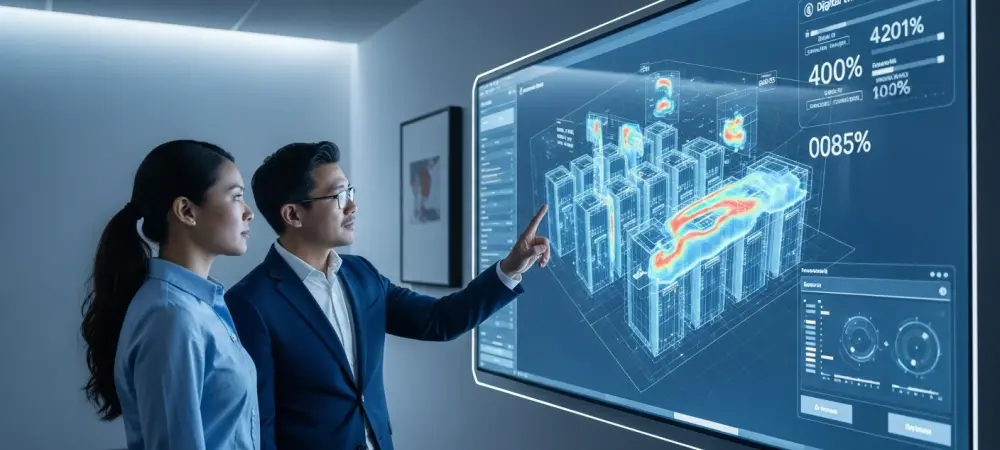
Artificial intelligence is being woven into the fabric of the data center lifecycle. In the design phase, automated BIM tools and generative design scripts are improving accuracy and speed. In operations, machine learning algorithms are now dynamically optimizing cooling systems and power distribution in real time to maximize efficiency. The next market evolution is the creation of live digital twins—sophisticated, real-time virtual models of the facility that can simulate performance, predict failures, and test optimization strategies without physical risk. This trend is reshaping the required skillset for operations teams, who must now be proficient in managing and interpreting data from these complex AI platforms. The convergence of intelligent hardware and software is creating a data-rich environment that enables unprecedented levels of control and predictive insight.
Sustainability as a Non-Negotiable Mandate
Sustainability has transitioned from a corporate social responsibility initiative to an indispensable design principle with significant financial and regulatory implications. The proliferation of high-density, liquid-cooled systems has created a new tension between energy efficiency (PUE) and water efficiency (WUE), demanding a more holistic approach to environmental performance. Market-leading designs now incorporate sustainability from the outset, influencing decisions on everything from the use of low-embodied-carbon materials to the implementation of advanced waste heat recovery systems for district heating. With regulatory bodies, particularly in Europe, tightening environmental standards, operators who can provide audited, verifiable data on their carbon footprint, water usage, and circular economy practices found themselves in a superior position to secure project financing and planning permits.
Strategic Outlook
The market forces that brought the industry to this inflection point were a direct consequence of physical limitations colliding with exponential demand. The widespread adoption of liquid cooling and the re-engineering of facilities for extreme densities were not choices but necessary adaptations to the physics of high-performance computing. Similarly, the pivot toward industrial-scale delivery models represented a pragmatic response to the dual pressures of intense investor expectations for predictable returns and severe global supply chain constraints. The industry learned that success depended less on bespoke innovation and more on the ability to replicate proven designs reliably and quickly. Deepening engagement with utility grids became an essential survival tactic in a power-constrained world, while the integration of AI and a rigorous commitment to sustainability provided the operational intelligence and social license required to build and operate at an unprecedented scale. Ultimately, the defining characteristic that separated market leaders from the rest was adaptability—a cultivated capacity to integrate complex technologies, manage industrial processes, and navigate a rapidly evolving energy landscape.