

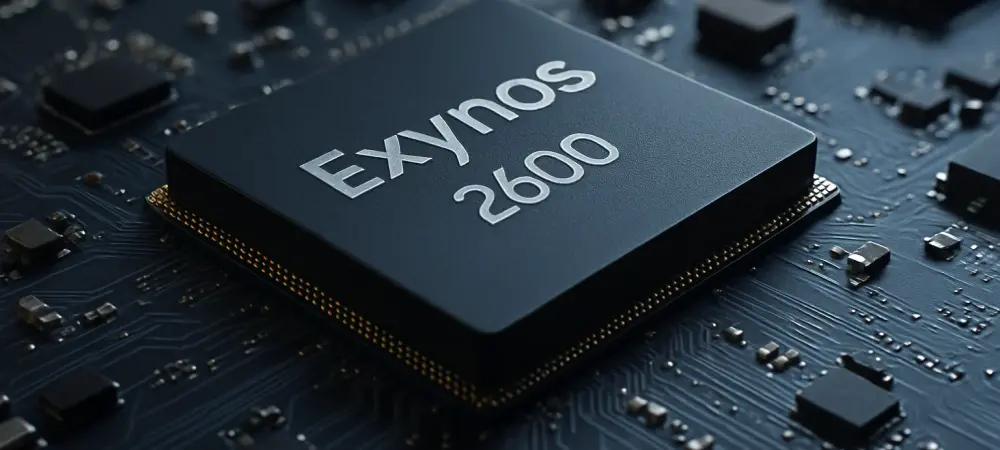
With the recent unveiling of Samsung’s Exynos 2600, the industry is buzzing about the world’s first 2nm smartphone chip. To unpack what this technological leap truly means, we sat down with Dominic Jainy, a veteran IT professional whose work at the intersection of AI, machine learning, and hardware gives him a unique perspective. Our conversation explores the bold engineering choices behind the chip’s new 10-core architecture, the exponential growth in its AI processing power, and how these advancements will redefine what’s possible in mobile gaming, photography, and everyday use for the upcoming Galaxy S26.
The Exynos 2600 is the world’s first 2nm GAA chip and notably drops low-power cores for a 10-core C1 architecture. Can you walk us through the engineering rationale behind this decision and explain how the 2nm process specifically enables this unique CPU configuration to be efficient?
This is a fascinating and audacious move. For years, the industry standard has been a mix of high-performance and low-power efficiency cores. By eliminating the traditional low-power cores, Samsung is making a statement: the baseline for performance is now significantly higher. The rationale is that the leap to a 2nm Gate-All-Around process provides such a fundamental improvement in transistor efficiency that even their “efficiency-tuned” C1-Pro middle cores, running at around 2.75GHz, can handle background tasks with a power draw that was previously the domain of much weaker cores. This design philosophy aims to deliver a more consistent and responsive experience, contributing to that impressive 39% overall CPU performance boost they’re claiming. You’re essentially getting the power of a mid-range core for tasks that used to be relegated to a very basic one, eliminating performance bottlenecks.
With a 113% boost in NPU performance and new SME2 instructions, the chip is clearly built for AI. Beyond the numbers, could you give us a step-by-step example of how these enhancements improve a specific on-device generative AI task, like real-time video editing or translation?
Absolutely. That 113% jump in NPU performance isn’t just an incremental update; it’s a gateway to experiences that were previously impossible on a mobile device. Let’s take real-time video translation during a video call. The moment you start speaking, the new SME2 instructions on the CPU can handle the initial, low-latency audio capture and data preparation. Then, the massively powerful NPU kicks in. It can run a sophisticated, on-device generative AI model that translates your speech into another language, generates a realistic synthesized voice, and—here’s the magic—simultaneously edits the video feed to match your lip movements to the new audio. This all happens in real-time, making a conversation feel natural and seamless. This level of complex, multi-modal AI processing simply couldn’t be done on older hardware without a noticeable, jarring lag.
The new Xclipse 960 GPU promises a 50% jump in ray-tracing performance and introduces Neural Super Sampling. How do these two features work together, and could you provide a technical breakdown or an anecdote on how developers might use them to change the quality of mobile gaming?
They work in perfect harmony to solve a classic graphics problem: the trade-off between quality and performance. Ray tracing, which creates incredibly realistic light, shadows, and reflections, is notoriously demanding and can cripple frame rates. That’s where Neural Super Sampling becomes the hero. A developer can now enable stunning, complex ray-traced effects because the GPU isn’t rendering the game at the screen’s full native resolution. Instead, it renders at a lower, more manageable resolution and then uses the AI-powered Neural Super Sampling to intelligently upscale the image. It even generates entirely new frames to slot in between the rendered ones. For a developer, this means they can design a game with dynamic, console-quality lighting that reflects off every surface without worrying about turning the phone into a slideshow. The user gets the best of both worlds: the visual splendor from that 50% ray-tracing performance increase and a game that Samsung says “feels” three times smoother.
Samsung has integrated a Heat Path Block for the first time, reducing thermal resistance by 16%. Can you detail how this component functions differently from previous cooling methods and what this means for sustained performance during intensive tasks like 8K video recording or console-level gaming?
This is a crucial innovation for unlocking the chip’s full potential. Traditional cooling methods like vapor chambers work by spreading heat across a wide surface area, but the Heat Path Block sounds like a more direct and engineered solution. Think of it as a thermal superhighway designed to pull heat directly from the chip’s hottest points—like that C1-Ultra prime core running close to 3.8GHz—and channel it efficiently to the phone’s frame. Reducing thermal resistance by 16% is a big deal. It means heat is evacuated much more quickly, which directly combats thermal throttling. For the user, this translates to sustained performance. You can record a long 8K video or play a demanding game for an extended period without the chip having to slow itself down to cool off. It’s the key to ensuring that the incredible peak performance doesn’t just vanish after a few minutes of heavy use.
The ISP supports massive 320MP sensors and an AI Visual Perception System. How do these two systems collaborate to achieve zero shutter lag on a 108MP shot? Please describe the process from the moment a user presses the shutter button to the final, AI-enhanced image.
The secret to “zero shutter lag” is that the work is done before you even press the button. From the moment you open the camera app, the Image Signal Processor (ISP) is already furiously capturing full 108MP resolution images and storing them in a temporary buffer. In parallel, the AI Visual Perception System (VPS) is actively analyzing this live feed, identifying subjects, recognizing motion, and understanding the lighting of the scene. When you finally tap the shutter button, the system doesn’t need to take a new picture. It simply plucks the perfect, crisp frame from the buffer that corresponds to that exact moment. Immediately after, that AI-driven understanding of the scene is used to apply intelligent enhancements in post-processing, like the deep learning noise reduction for low-light shots, to deliver a final, polished image. The capture feels instantaneous because, from a user’s perspective, it is.
What is your forecast for the future of on-device AI in smartphones?
We’re on the cusp of a major shift from reactive to proactive AI. With the kind of power we’re seeing in the Exynos 2600, especially that 113% NPU improvement, smartphones will evolve from tools that respond to our commands into true cognitive assistants that anticipate our needs. Instead of you asking for a summary of your day, your phone will have it ready for you when you wake up, synthesized from your emails, messages, and calendar. It will be able to generate content, not just edit it, and perform complex tasks that are deeply personalized because the AI models are running securely on your device with access to your context. The future is a smartphone that works for you in the background, making your life smoother and more efficient without you even having to ask.