

With deep expertise in artificial intelligence and its real-world applications, IT professional Dominic Jainy has a unique vantage point on the technological shifts reshaping our world. Following the recent CES 2026, we sat down with him to discuss the profound implications of AI’s evolution from a simple “tool” to an omnipresent, integrated layer of our lives. Our conversation explores how this transition, evident in everything from humanoid robots to AI-infused hardware, is set to redefine collaboration in the workplace, challenge established enterprise technology, and fundamentally alter the nature of human work itself.
CES 2026 highlighted “embodied AI” like Boston Dynamics’ Atlas working alongside humans. Beyond just automating tasks, how does this change the nature of human-robot teamwork in industrial settings? Can you walk me through the key steps a company might take to integrate these autonomous collaborators effectively?
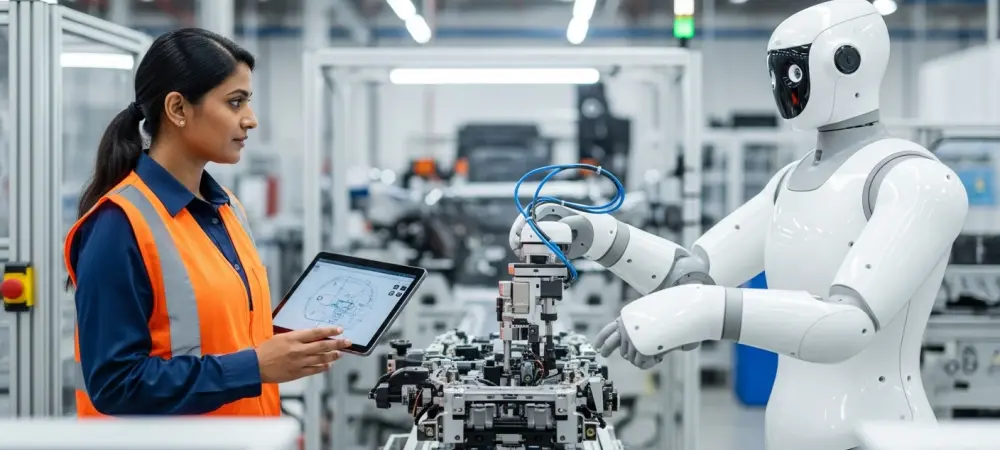
It’s a complete paradigm shift. We’re moving away from the old model of a human giving a direct command to a machine that then performs a pre-programmed, isolated routine. The latest evolution of robots like Atlas, which is set to be deployed in Hyundai’s manufacturing plants, represents a move toward continuous, autonomous collaboration. These machines will be working alongside humans, not just for them. It feels less like operating a forklift and more like having a new, tireless team member. To integrate them, a company first needs a cultural shift; they must start seeing these machines as co-workers, not just tools. Second, they need to redesign workflows to be collaborative, identifying points where human intuition and robot precision can complement each other. Finally, they need to invest in interface and safety protocols that allow for seamless, real-time interaction, ensuring that the human-robot team can operate fluidly and safely on a busy factory floor.
Samsung’s vision for AI as a coordinating “background fabric” in the home was a key theme. How do you see this ambient AI concept translating to the workplace? Could you share a specific, step-by-step example of how it might proactively orchestrate a team’s documents, data, and workflows?
That “background fabric” concept is incredibly powerful, and its transition to the workplace is inevitable. Imagine a project management team kicking off a new initiative. Instead of a manager manually assigning tasks and chasing updates, an ambient enterprise AI would already be at work. Step one, upon creating the project, the AI scans connected codebases, documents, and past project data to identify potential risks and resource needs. Step two, it proactively schedules kickoff meetings based on everyone’s real-time availability and even drafts a preliminary agenda by analyzing the project scope. Step three, as the team works, the AI monitors progress, automatically flagging dependencies where one person’s delay might impact another, and suggests solutions before a bottleneck even occurs. It’s not a copilot you have to ask for help; it’s an always-on autopilot, quietly orchestrating the complex dance of enterprise operations to solve problems before we’re even aware of them.
The article compares the coming AI shift to how the iPhone’s user experience beat the enterprise-focused Blackberry. What are the biggest risks for businesses whose workplace AI feels clunky compared to consumer versions? What specific design principles from consumer tech should enterprise developers prioritize to ensure adoption?
The biggest risk is outright rejection. History has shown us, with the iPhone dethroning Blackberry, that user experience is king. If the AI your company provides is frustrating and unintuitive while the AI on your team’s personal devices is seamless and predictive, you’ll see a massive drop in adoption and buy-in. Employees will find workarounds or simply ignore the clunky system, rendering a potentially massive investment completely useless. The core design principle to borrow from consumer tech is to make the AI invisible. It should blend into the fabric of the workday. Enterprise developers must prioritize creating a friction-free experience where the AI feels less like a separate application you have to open and more like an inherent, intelligent quality of the tools you already use. It should be proactive and agentic, anticipating needs rather than waiting for commands.
Companies like Dell and Arm are embedding AI directly onto hardware for edge processing. Beyond the stated privacy and latency benefits, how does this on-device AI strategically change the game for businesses? Could you provide a metric or anecdote that illustrates its impact in a high-stakes industry?
On-device AI is a strategic game-changer because it moves intelligence from a centralized, distant cloud to the immediate point of action. The privacy and latency benefits are huge, but the real advantage is the capacity for instantaneous, autonomous decision-making. Think of a connected, smart factory floor. If a critical piece of machinery is monitored by a cloud-based AI, the data has to travel to a server, get processed, and a command has to be sent back. That round trip, even if it’s just milliseconds, can be the difference between a minor adjustment and a catastrophic failure. With edge AI built directly into the machine’s hardware, it can analyze its own operational data in real time and make a predictive adjustment to prevent a breakdown before it happens, saving millions in downtime and repairs. It turns reactive systems into proactive ones, which is a fundamental shift in managing high-stakes physical operations.
The content predicts employee roles will shift from executing tasks to supervising automated processes and focusing on strategy. What actionable steps should a leader take today to prepare their team for this transition? What new training programs or metrics for success will this new dynamic require?
Leaders need to start re-skilling their teams immediately. The first step is to conduct an audit of current roles, identifying the routine, executable tasks that are prime for automation. Then, they must invest heavily in training programs focused on what the article calls “uniquely human skills.” This isn’t about learning to code AI, but about honing abilities in long-term strategic planning, creative problem-solving, building and motivating teams, and navigating complex interpersonal relationships. The metrics for success must also evolve. Instead of measuring an employee’s value by the volume of tasks completed, we’ll need to measure their impact on strategic outcomes, the efficiency of the automated systems they supervise, and the innovative solutions they develop for challenges that machines can’t tackle.
What is your forecast for the evolution of human-AI collaboration in the workplace over the next decade?
My forecast is that the very concept of “using AI” will feel archaic. CES 2026 made it clear that the era of AI as a standalone tool is ending. Over the next decade, we won’t be logging into an AI application; we’ll be working within an AI-infused environment. The technology will be so deeply and seamlessly embedded into our hardware and workflows that it becomes an invisible, collaborative partner. Our roles will be elevated, moving from doers to thinkers, strategists, and supervisors. The future isn’t about humans versus machines; it’s about humans augmented by machines, working together to enhance our collective potential and tackle challenges we previously thought were insurmountable.