

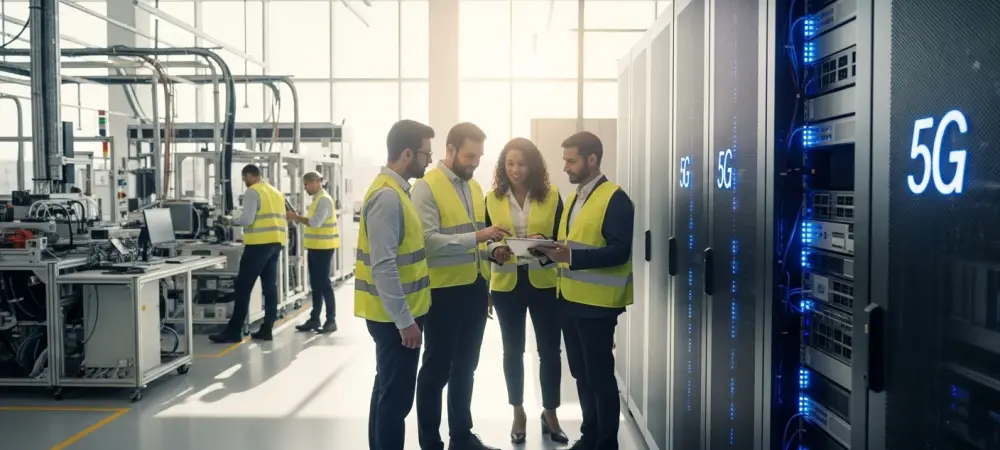
The sudden shift from experimental 5G trials to robust industrial deployments has fundamentally altered how global enterprises approach their digital infrastructure needs. Private cellular networks now serve as the bedrock for mission-critical operations. This transition marks a departure from basic connectivity toward a sophisticated integration of wireless and wired assets.
Telecommunications giants like Verizon and Nokia are recalibrating their business models. They are moving beyond the role of service providers to become holistic technology partners. By merging private 5G with fiber-optic networks, these companies provide the low-latency pipelines required for modern industrial automation.
The Evolving Landscape of Private 5G and Enterprise Connectivity
The current industrial climate demands a unified digital backbone where fiber and 5G work in tandem. This synergy allows for the transfer of massive data volumes essential for healthcare and manufacturing. High-bandwidth links are no longer optional as facilities move toward autonomous operations.
Verizon and Nokia lead this charge by refining how private networks are managed. Their strategies focus on creating stable environments that withstand heavy industrial use. This maturity reflects a trend of technological convergence where disparate systems are brought under one management framework.
Strategic Shifts Driving the Next Phase of Network Maturity
Emerging Trends: AI Integration and the Rise of 5G RedCap Technology
Integrating Artificial Intelligence into workflows has created a demand for power-hungry network solutions. Verizon prioritized 5G architectures that handle the processing loads of generative AI. This ensures businesses run complex algorithms locally without sacrificing speed.
The rise of 5G RedCap technology facilitates a broader adoption of the Internet of Things. By offering a reduced capability set, RedCap provides a cost-effective alternative for devices that do not require massive bandwidth. This shift allows for a diverse range of connected equipment across the factory floor.
Leadership transitions also influence corporate strategy and execution. Robb Juliano took the helm of the 5G Acceleration team at Verizon to maintain momentum. His role focuses on ensuring that corporate goals align with client needs during rapid technological change.
Market Projections and the Economic Impact of Industrial Automation
Market data suggests a pivot toward specialized applications that justify the investment in private 5G. Companies are moving away from general connectivity and toward purpose-built architectures. This trend drives economic growth as efficiency gains from automation begin to manifest.
Nokia signaled a strategic shift by exploring the potential divestment of its campus business. This allows the vendor to concentrate on its core mobile and fiber segments. Such realignment highlights the competitive nature of the market as providers seek to optimize their portfolios.
Navigating Operational Hurdles and Structural Realignment
Maintaining continuity in infrastructure projects remains a challenge amidst leadership turnover. Organizations must ensure that technical expertise is preserved even as corporate structures evolve. This requires a robust framework for knowledge transfer and a clear long-term vision. Integrating 5G with legacy systems presents another layer of technical complexity. Engineers must bridge the gap between wireless protocols and older wired standards. Overcoming these obstacles is necessary for enterprises that want to modernize without replacing all existing hardware.
Perceptions of instability during restructuring can also hinder market momentum. Stakeholders often view divestments with caution, which may delay deployment timelines. To counter this, providers must demonstrate a consistent commitment to service reliability and innovation.
Compliance and Standardizing the Private Spectrum
Regulatory bodies play a crucial role in global scalability by allocating dedicated spectrum. Consistent policies allow companies to deploy similar configurations across borders, reducing costs. This standardization is essential for multinational corporations looking to harmonize global operations.
Security protocols are becoming increasingly stringent as networks handle sensitive data. Adhering to 3GPP standards ensures that 5G RedCap and IoT technologies remain secure. Compliance with these international standards is a prerequisite for any mission-critical deployment.
The Future Roadmap: Connectivity as a Catalyst for Industrial Intelligence
Next-generation campus networks will serve as the primary catalyst for digital transformation. These networks are expected to integrate edge computing more deeply, allowing for real-time processing. This architecture will support the next wave of industrial intelligence and smarter decision-making.
Specific verticals like logistics and high-tech manufacturing are poised for the fastest adoption. As global economic conditions stabilize, the pace of innovation in 5G is expected to accelerate. This synergy will create opportunities for enterprises to differentiate themselves through superior connectivity.
Synthesizing Market Realities for Long-Term Enterprise Growth
The strategic pivots made by Verizon and Nokia aligned their operations with the requirements of an AI-driven economy. By focusing on specialized applications and fiber solutions, these companies secured their positions. This evolution transformed private 5G into a stable and essential utility for modern business. Enterprises that embraced these shifts prepared themselves for a landscape where connectivity and intelligence were inseparable. Future investments moved toward scalable architectures that accommodated both high-bandwidth AI and low-power IoT devices. The focus remained on building resilient systems that adapted to the shifting vendor landscape.