

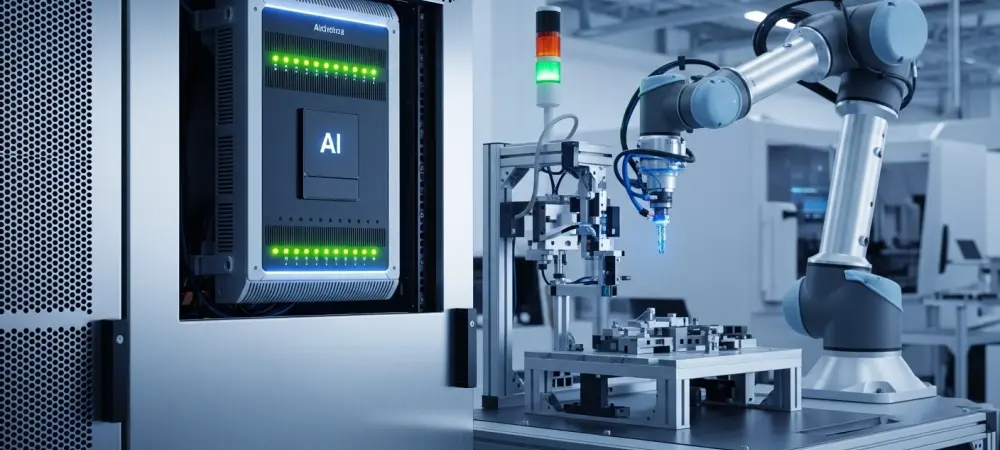
The persistent volatility of modern supply chains has forced a dramatic shift in how manufacturers view the role of robotics on the factory floor. While traditional automation once relied on rigid, pre-programmed routines that faltered at the slightest change in part orientation, the emergence of the Generalized Robotic Industrial Intelligence Pipeline, or GRIIP, introduces a new era of adaptable autonomy. This technology represents a significant departure from the application-specific engineering that has historically constrained small and mid-sized enterprises. By moving toward a “physical AI” framework, the system eliminates the need for the extensive, manual reconfiguration often required when a production line switches from one product to another. The result is a manufacturing environment where robots no longer just follow instructions but instead perceive and react to their physical surroundings with a level of sophistication previously reserved for high-end, custom-built research installations. This transition marks a pivotal moment for an industry seeking to reduce its dependence on specialized programming talent while simultaneously increasing operational resilience in an increasingly unpredictable global market.
The Technical Architecture of Physical Intelligence
At the heart of this technological leap lies a sophisticated integration of perception and reasoning that bridges the gap between digital simulation and physical execution. The GRIIP system utilizes a unified pipeline that merges proprietary machine learning models with advanced foundation models, including specialized frameworks for stereo matching and six-degree-of-freedom pose estimation. This complex software stack is hosted on a high-performance AI controller, leveraging edge computing to process massive amounts of visual data in real time. By digitizing the workspace instantly, the system can identify objects, determine their exact orientation, and calculate collision-free trajectories without requiring a human operator to define every intermediate movement. This shift from “teaching” a robot through points to “informing” it through data allows for a more fluid interaction between the machine and its environment. Consequently, the hardware is no longer limited by the static nature of its code but is instead empowered by a dynamic understanding of the spatial relationships within the manufacturing cell.
Building on this foundational intelligence, the hardware-software synergy ensures that complex tasks like object segmentation and grasp selection occur within milliseconds. The use of foundation models specifically optimized for industrial environments allows the robot to handle a vast array of geometries and surface textures that would typically confuse standard vision systems. For instance, the system can distinguish between overlapping parts in a bin or identify a specific component amidst a sea of visual noise, such as reflective surfaces or shifting shadows. This capability is powered by the seamless communication between the vision sensors and the motion controller, creating a feedback loop that continuously refines the robot’s path. By offloading the computational burden to dedicated edge AI hardware, the system maintains a low-latency response rate, which is critical for maintaining safety and efficiency in high-speed production settings. This architecture effectively democratizes high-tier robotics, allowing facilities without deep robotic expertise to implement solutions that were once the exclusive domain of elite automotive or aerospace manufacturers.
Reliability and Performance in Unstructured Environments
Operational consistency remains the primary metric for success in any industrial setting, and recent evaluations have demonstrated that this AI-driven approach excels under rigorous conditions. During extensive testing phases involving continuous “lights-out” operations, the pipeline maintained a steady throughput of five parts per minute, proving that autonomous decision-making does not have to come at the expense of speed. Unlike legacy systems that often require a controlled environment with specific lighting and standardized part placement, GRIIP remains robust against environmental variables. It delivers sub-millimeter accuracy in pose estimation, even when dealing with transparent materials or extreme fluctuations in factory illumination. This level of precision ensures that secondary processes, such as machine tending or precise kitting, can be performed with the same reliability as human-guided operations. The stability of the system over long periods suggests that the era of “babysitting” robots is coming to an end, as the AI can now self-correct and adapt to minor deviations in the production flow.
This performance is further enhanced by a deployment model designed for rapid integration into existing workflows. In a sector where downtime is measured in thousands of dollars per hour, the ability to initiate a new picking task in roughly fifteen minutes by simply uploading a CAD file is a transformative advantage. A complete robot cell can transition from a crate of parts to a fully functional production unit in as little as two days, a timeline that was previously unthinkable for complex autonomous systems. This speed is made possible by the “training-free” nature of the platform; because the AI uses generalized models rather than task-specific datasets, it does not need to spend weeks learning the nuances of a new component. Instead, it applies its existing understanding of physics and geometry to the new object immediately. This flexibility allows manufacturers to respond to market demands or design changes in real time, shifting the focus from the technical challenges of automation to the strategic goals of the business.
Versatility Across Diverse Manufacturing Applications
The practical applications of such a generalized pipeline extend far beyond simple pick-and-place routines, reaching into the most labor-intensive corners of the factory. In tasks like bin picking, where parts are randomly oriented or mixed, the AI’s ability to plan complex, non-linear trajectories prevents the mechanical jams and errors that frequently plague traditional automation. Furthermore, the system’s adaptability makes it an ideal candidate for surface finishing tasks, such as sanding or polishing, where the robot must adjust its tool path based on the real-time orientation and contour of the workpiece. This versatility also translates to kitting and depalletizing operations, where the robot can handle a wide variety of box sizes and weights without needing a different end-effector or a software overhaul for every new SKU. By providing a single platform capable of managing these disparate functions, the system reduces the complexity of the factory’s technology stack, making it easier for maintenance teams to support and scale their robotic fleet across different departments.
Beyond immediate task execution, the longevity and relevance of the technology are preserved through a modern software delivery model. Because the system supports over-the-air updates via WiFi or LTE, new foundation models and performance optimizations can be pushed to the factory floor without requiring hardware replacements or on-site technician visits. This means that a robot installed today will actually become more capable over the next few years as the underlying AI models continue to evolve and improve. This “future-proof” characteristic is essential for manufacturers looking to make long-term capital investments in an era of rapid technological change. As the AI learns to handle even more complex materials and lighting scenarios, the range of feasible applications will continue to expand, moving from the back-end of the warehouse to the front-end of precision assembly. This continuous improvement cycle ensures that the initial investment remains productive and competitive, regardless of how quickly the broader industry standards or consumer preferences might shift.
Strategic Considerations for Future Automation
As industrial entities look toward the horizon of 2026 and beyond, the adoption of generalized AI platforms will likely become a prerequisite for maintaining a competitive edge. The transition from application-specific engineering to a platform-centric model allows for a more modular and scalable approach to factory design. Manufacturers should begin by identifying high-variability tasks that currently rely on manual labor or brittle automation, as these are the areas where physical AI provides the most immediate return on investment. It is also crucial to consider the organizational shift required to support these systems; while the AI reduces the need for low-level coding, it increases the value of personnel who can manage data-driven workflows and oversee the integration of autonomous cells into the broader enterprise resource planning system. Implementing a pilot program focusing on a single, high-impact area—such as random bin picking or machine tending—can serve as a proof of concept before a wider rollout across the entire facility.
The long-term strategy for any forward-thinking production facility must involve a move toward a unified hardware and software ecosystem. By standardizing on a platform that offers continuous updates and generalized intelligence, companies can avoid the “automation silos” that occur when different departments purchase incompatible, specialized robots. This holistic approach not only simplifies maintenance but also creates a more flexible workforce where robots can be redeployed to different tasks as production needs change. Looking ahead, the focus will likely shift toward even deeper integration between the factory floor and the cloud, where collective learning from thousands of deployed robots can be used to refine global foundation models. For now, the priority should be on building a robust infrastructure that supports edge AI, ensuring that the necessary connectivity and power are in place to handle the next generation of autonomous machines. The path forward is no longer about making robots smarter for one specific job, but about making them intelligent enough to handle any job they are given.