

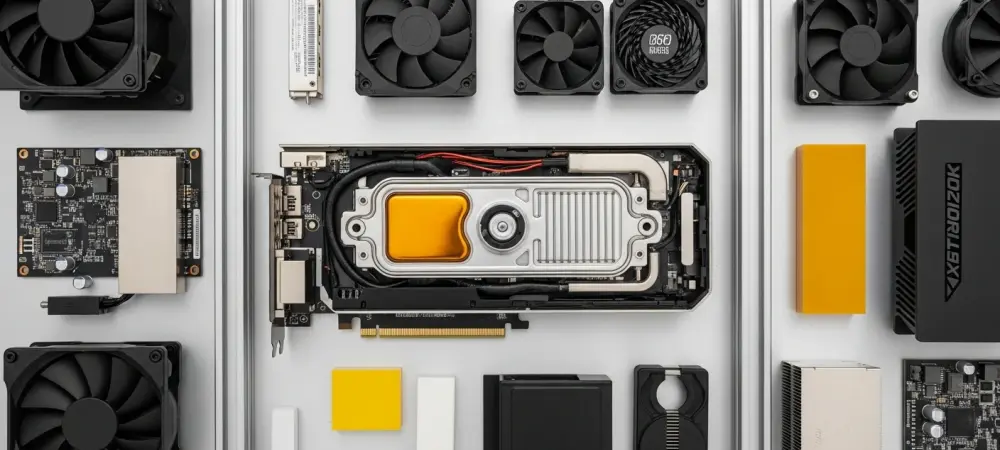
Modern high-performance computing has reached a critical threshold where traditional thermal solutions struggle to dissipate the staggering heat generated by next-generation silicon. This review examines how vapor chambers utilize phase-change cycles to manage rising power densities. As GPU consumption nears the kilowatt mark, these systems provide a scalable path forward without the complexities of liquid loops.
Evolution and Fundamentals of Vapor Chamber Cooling
This technology uses vacuum-sealed chambers where liquid evaporates at the source. Unlike standard copper pipes, vapor chambers provide multidimensional heat spreading, which is crucial as processing units approach extreme thermal limits. This transition reflects a necessary shift from simple conduction to advanced latent energy transfer.
Technical Architecture of High-Performance Thermal Solutions
The Mechanics of Phase-Change Heat Dissipation
Sintered internal wicks facilitate rapid fluid return to the GPU die. This prevents localized hotspots by distributing energy across a vast surface area immediately. The resulting equilibrium ensures that high-end silicon maintains peak clock speeds without thermal throttling.
Industrial-Grade Scaling: 1,000W Thermal Capacity
Akasa’s latest industrial designs prove that air cooling can manage 1,000W outputs. These units bypass liquid cooling complexities through massive metalwork and optimized internal volume. This scaling demonstrates that air remains a viable medium for even the most demanding workstation hardware.
Emerging Trends in High-Density Thermal Management
Modern designs are moving away from integrated fans toward high-static-pressure server ducting. This utilitarian shift reduces mechanical failure points while maximizing airflow efficiency. Such trends indicate a convergence between professional data center cooling and enthusiast-grade hardware.
Real-World Applications and Deployment Environments
Professional cards like the RTX PRO 6000 utilize these blocks for sustained AI workloads. While designed for servers, modders have begun adapting these solutions for consumer desktops. These applications prioritize raw thermal headroom over traditional aesthetics or noise levels.
Engineering Challenges and Market Limitations
Massive heatsinks face structural hurdles, necessitating specialized mounting to prevent PCB damage. They also require high-airflow environments to function effectively at peak capacity. Balancing fin density with the physical weight of the chamber remains a significant engineering trade-off.
Future Outlook for Vapor Chamber Innovations
Material science breakthroughs, such as graphene coatings, will likely further increase thermal conductivity. As the RTX 5090 and future iterations push power limits, enterprise-level thermal engineering will become standard. This evolution suggests a future where high-TDP components rely on even more sophisticated phase-change structures.
Assessment of the Current Thermal Landscape
The transition toward 1,000W air cooling proved that robust thermal management could evolve alongside rising hardware demands. It demonstrated that vapor chambers provided a reliable bridge for the next generation of high-TDP components. This development offered a stable foundation for the reliability of high-performance systems.