

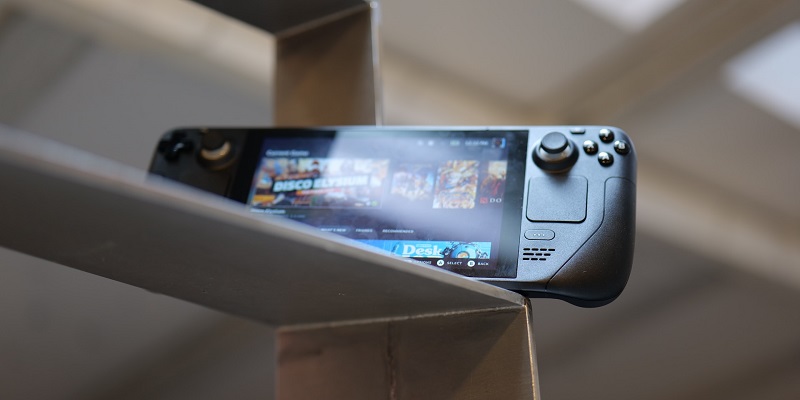
Valve, the company behind the highly-popular gaming platform, Steam, has officially announced the release of its long-awaited handheld gaming device – the Steam Deck. After years of rumors and speculation, gaming enthusiasts and Valve fans alike can finally get their hands on the new device.
In this article, we will take a closer look at the technical specifications, display, gaming library, pricing, availability, industry impact, and comparison of the Steam Deck to the Nintendo Switch.
Power and Storage: The Technical Specifications of the Steam Deck
The Steam Deck is powered by a custom AMD APU, paired with 16GB of LPDDR5 RAM. This powerful combination is capable of running modern games smoothly and efficiently. The device comes in three storage variants, with the highest offering 512GB of NVMe SSD storage. This means that gamers will have plenty of space to store their favorite games and files.
In terms of connectivity, the Steam Deck features Bluetooth 5.0, Wi-Fi, and USB-C. It also has a microSD card slot, allowing users to expand their storage even further. The device’s battery life is reported to last between 2-8 hours, depending on usage and settings.
A Look at the 7-Inch Touchscreen Display
One of the standout features of the Steam Deck is its 7-inch touchscreen display, which has a resolution of 1280×800 pixels and a refresh rate of 60Hz. Valve claims that the display is designed to provide gamers with an immersive and comfortable gaming experience. The device also includes a gyroscope and an accelerometer, allowing players to use motion controls in certain games.
Gaming Library: All the Games You Could Want with the Steam Deck
Perhaps the most impressive aspect of the Steam Deck is its vast gaming library. Valve has stated that the device will offer “the entire Steam library” of games, which includes thousands of titles from a variety of genres. This means that players will have access to popular games like Cyberpunk 2077, Death Stranding, and Valheim, as well as indie games and classic titles. Additionally, the device will allow players to access their existing Steam library and cloud saves, making it easy to pick up where they left off.
Pricing and Availability: How to Pre-Order and Release Information
The Steam Deck is now available for pre-order, starting at $399 for the 64GB model. The 256GB model is priced at $529, while the 512GB model is priced at $649. Valve plans to release the Steam Deck in December 2021 in the US, Canada, the EU, and the UK. Interested customers can pre-order the device directly from the Steam website or through select retailers.
Impact on the industry: Negative effects on Nintendo and Sony
Valve’s announcement of the Steam Deck has had a negative impact on the stock prices of Nintendo and Sony. This is because the Steam Deck is being touted as a direct competitor to the Nintendo Switch and Sony’s PlayStation Portable. The Steam Deck’s powerful hardware, extensive gaming library, and relatively affordable price point may make it an attractive option for gamers who are looking for a portable gaming device.
Comparison to the Nintendo Switch: Can the Steam Deck compete?
Since the announcement of the Steam Deck, many people have been drawing comparisons between it and the Nintendo Switch. While the two devices share some similarities, such as their portability and ability to play games on the go, they also have some distinct differences. The Steam Deck’s more powerful hardware and extensive gaming library may give it an edge over the Nintendo Switch. However, the Switch’s first-party titles, including popular games like Animal Crossing: New Horizons and Super Mario Odyssey, may still give it an advantage in the eyes of some gamers.
The Steam Deck is a long-awaited device that has generated a lot of excitement among gamers. With its impressive hardware, extensive gaming library, and relatively affordable price point, it has the potential to become a popular gaming device. Whether it can compete with the Nintendo Switch and other handheld gaming devices remains to be seen, but it is definitely a device worth keeping an eye on. With its release just a few months away, many gamers are eagerly anticipating the opportunity to get their hands on the Steam Deck and see what it can do.