

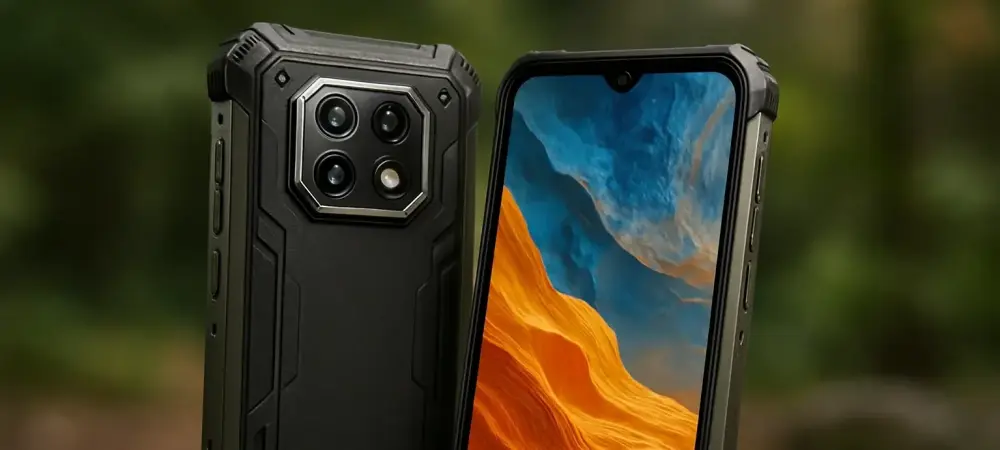
When gear fails miles from a job site or a trailhead, uptime beats raw speed every single time because lost minutes become lost money and sometimes real risk in the field. That is the backdrop for Ulefone’s RugKing 4 Pro, a budget-friendly rugged phone slated for an early December launch with pricing still unannounced. The pitch is pragmatic: trade flashy specs for durable construction, long battery life, and flexible storage, then wrap it all in current Android for better longevity.
The device targets real work rather than lab benchmarks. It resists dust, water, and drops, and it favors a huge battery over wafer-thin styling. Moreover, it leans into practicality with NFC for tap-and-go workflows and a rare triple-slot tray that supports two SIMs plus microSD at once, which matters when connectivity is spotty and local data is king.
Positioning and Value
The mission is straightforward: keep running in harsh conditions and stay online longer between charges. That means resilience comes first, with performance tuned for reliability instead of headline-making speed. In this context, 4G-only connectivity is not a liability so much as a calculated choice that helps control costs and power draw.
This strategy aligns with how many logistics, construction, and utility teams operate. Devices circulate in fleets, get replaced on predictable cycles, and must be easy to manage. Against that playbook, the RugKing 4 Pro reads like a tool, not a trophy.
Hardware and Design
An IP68/IP69K chassis with 2-meter drop resistance anchors the build, while reinforced port covers and a thick frame signal serious intent. The body is big—178.6 x 84 x 19.2 mm—and that size serves the armor and the battery rather than fashion.
Practical touches show up everywhere: grippy textures for gloved hands, sealed doors to keep grit out, and structural rigidity that shrugs off tosses into a truck bed. It feels born for job sites, not showrooms.
Display and Everyday Use
A 6.56-inch display at 720 x 1,612 favors endurance over razor-sharp text. However, the claimed 120 Hz refresh rate keeps scrolling smooth, and 500 nits help under bright skies. The result is a screen that is pleasant enough without draining the battery too fast.
There is a clear trade: less pixel density means softer edges, especially on tiny fonts and detailed maps. Yet in return, the phone stretches runtime and remains snappy in motion-heavy interfaces.
Performance and Connectivity
The Unisoc T7250 with 8 GB of RAM aims at dependable productivity—messaging, navigation, EMM agents, and basic multitasking. Paired with 256 GB UFS 2.2 storage, app launches and file handling feel brisk for the class.
NFC is on board for access control and payments, while 4G-only radios keep complexity down. For many regions and deployments, that balance remains viable, particularly where 5G coverage is uneven or unnecessary.
Software and Support
Shipping with Android 15 sets this model apart from typical budget rugged phones still stuck on older builds. Newer APIs, stronger privacy controls, and improved device management tools improve fleet readiness and compliance. The real question sits with update cadence. Security patches and warranty terms will determine whether this phone stays trustworthy across its service life.
Battery and Charging
A 10,200 mAh pack (39.47 Wh) underpins multi-day use, especially paired with the low-resolution panel and midrange silicon. Field teams can plan for long days without hugging a charger. Charging at 18 W is reasonable but slow for this capacity. Overnight top-ups and vehicle adapters will be the sane routine rather than quick pit stops between tasks.
Imaging and Use Cases
A 48 MP main camera targets documentation first: site photos, equipment labels, receipts, QR and barcodes. There is no night vision module, and low-light performance relies on software.
In daylight, results are clear and accurate enough for reports and workflows. After hours, expectations should be modest—usable evidence beats creative flair here.
Expansion and Flexibility
The triple-slot tray is a standout: dual SIMs plus microSD simultaneously. Travelers and remote teams can run a local line, keep a work number, and store maps, manuals, and media offline without compromise. This flexibility matters where connectivity drops or data is capped. Local storage becomes a buffer that keeps work moving.
What to Watch Before Buying
Final pricing and regional availability will set the value story. Network band support, especially for rural carriers, will dictate performance in the field.
Accessories will round out deployments: docks, mounts, holsters, and screen protectors. Firmware tuning for the 120 Hz mode and battery management could also tip the scales.
Verdict
The RugKing 4 Pro delivered a sensible blend of toughness, endurance, and modern software for the money-conscious rugged crowd. Its omissions—no 5G, slowish 18 W charging, and a 720p-class panel—were deliberate, allowing resources to flow into IP68/IP69K protection, a massive battery, NFC, and that rare triple-slot tray. The smartest next steps were to confirm price, patch cadence, warranty coverage, and carrier bands, then pair it with the right mounts and chargers for field use. For teams that valued resilience and uptime over raw speed, it fit the brief and left room in the budget for the rest of the kit.