

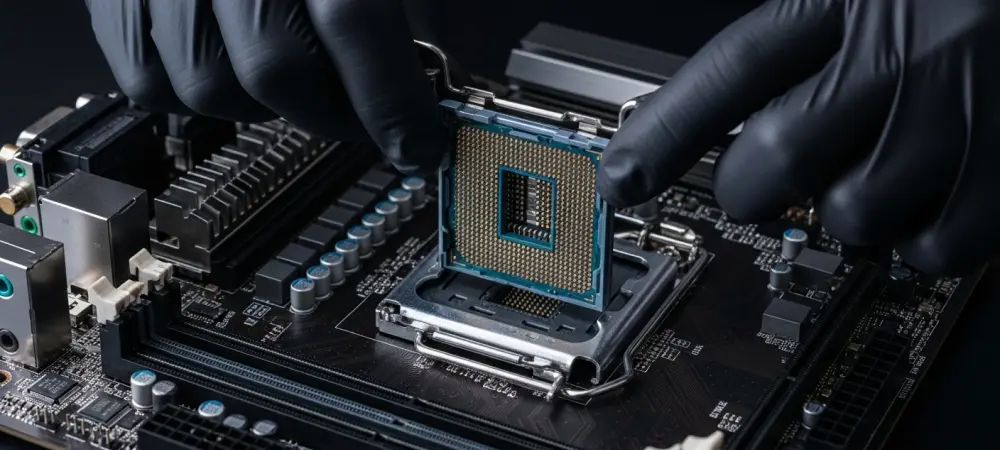
A recently surfaced shipping manifest has sent ripples through the tech industry, unveiling a mysterious high-performance AMD processor that hints at a fundamental redefinition of what professionals can expect from their workstations. In fields like engineering, content creation, and scientific research, raw computational power is not a luxury; it is the engine of progress, directly translating to accelerated productivity and innovation. The emergence of this new chip signals a pivotal moment. This analysis dissects the details of the leaked AMD Ryzen 9 Pro 9965X3D, examines the growing trend of integrating high-core-count designs with specialized cache technology for professional platforms, and explores the profound implications for the future of the industry.
The Emerging Trend High Core Count High Cache Pro CPUs
Unpacking the Leaked AMD Ryzen 9 Pro 9965X3D
The key data from the shipping manifest points to a processor identified as the Ryzen 9 Pro 9965X3D, a Design Validation Testing (DVT) sample built on the 16-core Zen 5 architecture. Its existence as a DVT sample indicates it is in an advanced stage of development, moving beyond concept and into physical testing, suggesting a serious strategic exploration by AMD. Significantly, the chip incorporates 3D V-Cache technology, a first for a 16-core model within the Ryzen Pro series. This positions it as a new flagship offering, sitting well above the current 12-core Ryzen 9 Pro 9945 and signaling AMD’s intent to bring its most advanced performance-enhancing technologies to the professional market. Furthermore, its listed 170W TDP marks a stark departure from the 65W rating of existing Ryzen Pro 9000 models. This substantial increase in power draw suggests a design philosophy that prioritizes maximum, sustained performance over thermal efficiency.
Real World Implications for Professional Workflows
A processor with these specifications stands to dramatically accelerate workflows across numerous industries. For media and entertainment, the combination of 16 cores and massive cache could slash 3D rendering times and make complex VFX simulations more fluid. In software development, it would speed up resource-intensive compilations, reducing developer wait times. Similarly, scientific and data analysis fields would benefit from the ability to process larger datasets and run more sophisticated models without being constrained by CPU bottlenecks. The fusion of a high core count with a large, stacked cache like 3D V-Cache is engineered specifically to tackle memory-intensive tasks that often cripple standard CPUs. By keeping more data immediately accessible to the processing cores, this design minimizes the latency associated with fetching information from system RAM. The result is a more efficient and responsive system, leading to tangible productivity gains that can be measured in hours saved on critical projects.
Industry Analyst and Expert Commentary
Industry experts view AMD’s strategy of migrating consumer-focused gaming technologies like 3D V-Cache into its Pro series as a clear signal of market convergence. The performance characteristics that benefit high-frame-rate gaming—namely, low-latency access to large amounts of data—are increasingly the same ones required by demanding professional applications. This move indicates that the line between a high-end gaming PC and a professional workstation is becoming increasingly blurred.
The 170W TDP has also drawn considerable attention from analysts, who see it as evidence of a market shift in the high-end workstation segment. For top-tier professionals, the priority is shifting away from power efficiency and toward achieving the absolute highest raw performance possible. However, this trend places new demands on system builders and IT departments, who must now account for more robust cooling solutions and higher-capacity power delivery to support these next-generation processors.
Projecting the Future The Next Wave of Workstation Processors
This leak strongly suggests the creation of a new tier of “mega-workstation” CPUs. These processors are poised to bridge the performance gap that has long existed between mainstream professional desktops and costly, high-end server platforms like Threadripper or Xeon. This new category will empower small studios, independent creators, and researchers with computational power that was once the exclusive domain of large enterprises.
Given its status as an advanced DVT sample, the Ryzen 9 Pro 9965X3D could see an official announcement later this year, with a potential launch serving as a powerful mid-cycle refresh for the Zen 5 architecture. This aggressive product cadence would intensify competition with Intel in the lucrative prosumer and professional workstation markets. Consequently, this push toward more powerful, power-hungry processors may also accelerate innovation in system design, driving the adoption of new form factors and more advanced liquid cooling solutions to manage the increased thermal output.
Conclusion Redefining Professional Performance
The leaked Ryzen 9 Pro 9965X3D exemplified a definitive trend toward integrating higher core counts and specialized cache technologies directly into professional-grade processors. This evolution in CPU design moved beyond incremental improvements and represented a targeted effort to dismantle long-standing performance bottlenecks.
This development was significant because it directly addressed the escalating computational demands of modern professional workloads, from complex data simulation to high-fidelity content creation. The industry recognized that simply adding more cores was no longer sufficient; processors needed to become more intelligent in how they accessed and managed data to unlock true productivity gains.
Ultimately, the accelerating innovation cycle in the workstation market signaled a new era of performance. It was a clear call to action for professionals and IT decision-makers, who understood that staying informed on these advancements was essential to maintaining a competitive edge in an increasingly demanding digital landscape.