

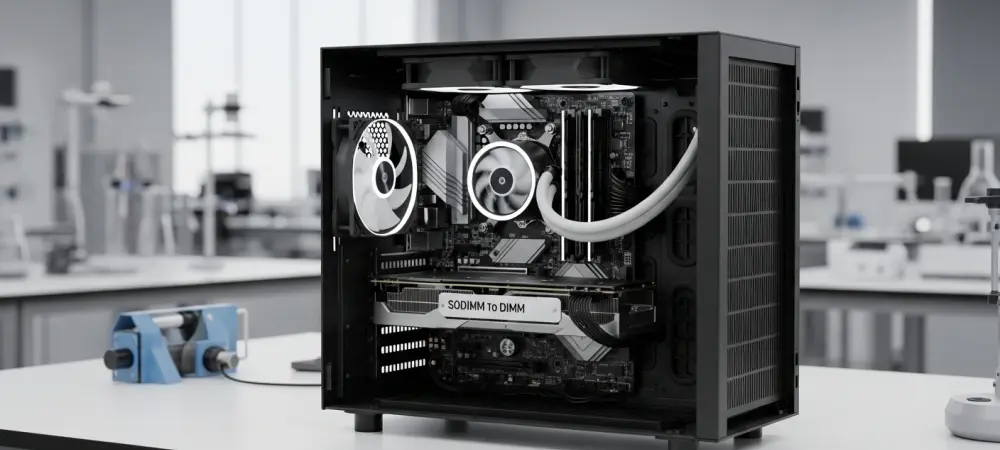
The dream of building a powerful desktop computer often collides with the harsh reality of component prices, forcing enthusiasts to seek increasingly creative ways to stretch their budgets and sustainably upgrade their systems. As the cost of essential hardware, particularly RAM, continues to climb, a growing movement within the tech community is championing upcycling as a dual solution to e-waste and prohibitive expenses. This trend analysis will explore the rise of component repurposing through a case study of the Ashata SODIMM to DIMM adapter, examining its market drivers, technical limitations, and its ultimate place within the DIY PC ecosystem.
The Rise of Cost-Effective Hardware Solutions
Economic Drivers and Market Demand
The sharp and persistent increase in desktop RAM prices has been a primary catalyst for innovation in the budget hardware sector. This economic pressure created a fertile market for affordable alternatives, pushing consumers toward solutions that maximize the value of components they already own. The emergence of products like the Ashata adapter, with its remarkably low price point of approximately €13, serves as a key adoption statistic, illustrating the minimal investment required to breathe new life into older hardware.
The very existence of such an adapter is compelling evidence that the upcycling trend is not just a niche curiosity but a direct response to tangible market demand. For budget-conscious builders, the prospect of repurposing a spare laptop memory stick for a fraction of the cost of a new desktop module is an irresistible proposition. This movement reflects a broader shift toward resourcefulness, where extending the lifecycle of existing components becomes a primary strategy for system building and upgrades.
The Ashata Adapter A Real-World Application
The Ashata SODIMM to DIMM adapter provides a concrete and functional example of this upcycling trend in action. Its core purpose is simple yet ingenious: it converts DDR4 laptop memory modules, known as SODIMMs, into the full-sized DIMM format required for desktop motherboards. This allows a user who has upgraded a laptop to take the old, perfectly functional RAM and integrate it into a new or existing desktop build, preventing it from becoming electronic waste.
Remarkably, this bridge between old and new technology extends to modern systems. The adapter maintains compatibility with a range of CPUs that support DDR4 memory, including budget-oriented Intel Alder Lake and Raptor Lake processors. This cross-generational compatibility demonstrates how legacy components can be thoughtfully integrated into current-generation builds, providing a viable pathway for users to assemble functional systems without purchasing every part brand new.
Technical Realities and Performance Trade-offs
While the adapter is a practical tool, technical analyses present a clear consensus: its use involves significant performance compromises when compared to native desktop memory. The primary limitation stems from supported memory speeds, which officially cap at 2133MHz. Consequently, users should anticipate noticeably lower bandwidth and higher latency, creating a performance bottleneck in memory-intensive applications like high-end gaming or professional content creation.
Furthermore, stability can become a notable challenge. Achieving a stable system may require users to manually lower clock speeds in the BIOS, a task that can be daunting for novices. These stability concerns are often amplified when attempting to mix memory modules from different manufacturers, as mismatched timings can lead to system crashes or a failure to boot. The adapter’s 4-layer PCB design is a deliberate engineering choice aimed at ensuring stable electrical connections, but it cannot fundamentally overcome the inherent performance limitations of the laptop memory it adapts.
Future Outlook for Component Repurposing
The success of this memory adapter hints at potential future developments, perhaps leading to similar solutions for other components as technology standards evolve. The benefits are clear and compelling: users gain access to significant cost savings, while the positive environmental impact of reducing e-waste speaks for itself. This approach empowers consumers to make more sustainable choices without abandoning the DIY spirit.
However, a primary challenge looms over the long-term viability of this trend. The performance gap between upcycled components and new, native hardware will likely continue to widen with each technological generation. This reality ensures that such solutions will remain confined to a niche market of budget builders and experimenters. Despite this, the broader implication is powerful, as the trend supports a more circular economy within the tech space, encouraging users to think creatively about extending the lifecycle of their hardware.
Conclusion A Practical Niche in a High-Priced Market
Ultimately, the Ashata adapter and similar solutions exemplified a growing upcycling trend driven by clear economic necessity. The device offered a viable, cost-effective way to repurpose old laptop RAM for use in non-demanding desktop builds where budget was the overriding concern. Its existence underscored a clever and sustainable strategy, proving that old hardware could still hold significant value in the right context.
It was, however, crucial for builders to understand the inherent trade-offs. While innovative, these upcycled solutions were not a substitute for high-performance memory in systems designed for gaming or heavy productivity. The performance compromises were real and placed such products firmly in a specific niche. For those builders, the decision to upcycle represented a pragmatic choice that prioritized fiscal responsibility and environmental consciousness over achieving peak performance benchmarks.