

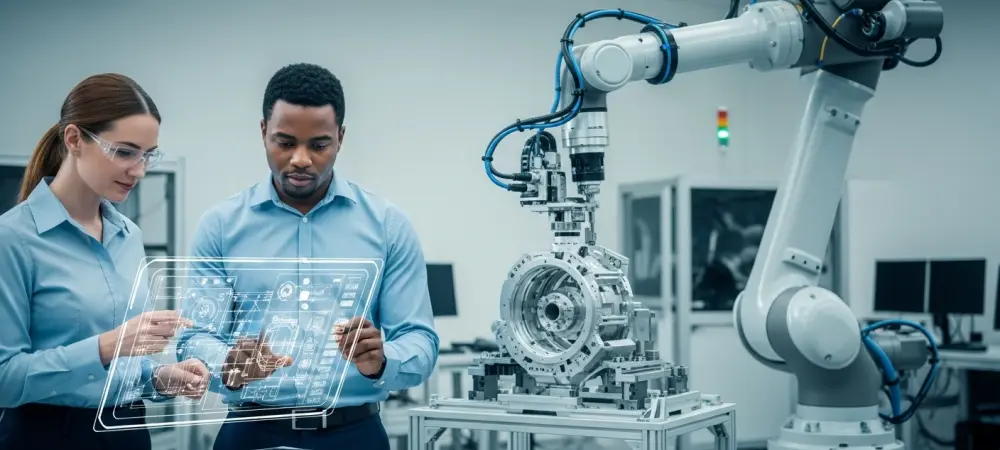
At the Davos 2026 summit, a declaration was made that reframes the entire narrative around artificial intelligence, positioning it not as a digital gold rush but as the single largest infrastructure buildout in human history. This assertion, delivered by NVIDIA CEO Jensen Huang, casts the current AI revolution as a foundational economic shift demanding trillions in capital, on par with the industrial or internet revolutions. It suggests that what the world is witnessing is not the birth of a niche technology but the assembly of a new global economic engine. This analysis will dissect this monumental buildout by exploring its core components, the immense scale of investment, the key technological drivers fueling its expansion, and its profound geopolitical implications for the future.
Deconstructing the New Global Infrastructure
The Five-Layer Stack: The Blueprint for AI
Understanding the AI buildout requires a clear framework, which can be visualized as a five-layer infrastructure stack that clarifies how value is created and where capital is being deployed. The foundational prerequisite for all computation is energy, the absolute base layer without which nothing else can function. Above this sits the chips and computing infrastructure, the specialized hardware like GPUs and the physical plants that form the engine of AI. These tangible assets are being constructed at a staggering rate, with examples like TSMC building 20 new fabrication plants and Foxconn constructing 30 new computer facilities to meet demand.
Building upon this physical hardware is the cloud infrastructure, the layer of scalable services that deliver computational power to users on demand. Above the cloud are the AI models themselves—the large language and foundational models that provide the intelligence. Finally, at the very top is the application layer, where AI solves industry-specific problems and generates direct economic value in fields from drug discovery and finance to advanced manufacturing. While the application layer is the most visible, its existence is entirely dependent on the massive, capital-intensive construction of the four foundational layers beneath it.
The Paradigm Shift: From Programming to Teaching
This enormous investment is justified by a fundamental change in how humans interact with computers. The traditional software paradigm was “pre-recorded”; it relied on human engineers writing explicit, step-by-step algorithms to process highly structured information. The computer was a passive executor of human commands, limited by the precision of its programming and the cleanliness of its data. This model, while powerful, created a high barrier to entry and limited the scope of problems that could be solved digitally.
In stark contrast, the new era of computing is defined by a different relationship: the computer is taught rather than programmed. This AI-powered paradigm allows machines to understand and process unstructured information—the messy reality of human language, images, and sound. It can infer user intent, reason through complex tasks, and generate solutions without needing every step to be explicitly coded. This shift from programming to teaching dramatically democratizes software creation, exponentially expanding the range of applications and empowering a far broader audience to build sophisticated digital tools.
Expert Insight: The View from the Epicenter
Debunking the Bubble: Demand, Scarcity, and Capital Flows
Amidst the massive capital deployment, concerns about a speculative “AI bubble” have become widespread. However, a closer look at market fundamentals suggests that the investment surge is driven by tangible utility and genuine scarcity, not just hype. The evidence points away from a speculative frenzy and toward a rational, albeit aggressive, response to a technology that is already generating real-world value.
A key indicator of this reality is hardware scarcity. The spot price for renting even two-generation-old NVIDIA GPUs is steadily rising, a clear sign that demand for computational power is far outstripping the available supply. If this were a speculative bubble, one would expect the value of older, less powerful hardware to decline. Instead, the persistent demand for any available computing resource indicates that companies are deploying this technology for productive purposes and are constrained by a genuine supply shortage.
This utility-driven demand is further validated by venture capital flows. In 2025, over $100 billion was invested globally in “AI-native” application companies. This capital was not primarily directed at building foundational infrastructure but at the very top of the stack—funding companies that are using AI to solve real problems in healthcare, robotics, and finance. This explosion in application-layer innovation creates a powerful and sustained demand pull on all the infrastructure layers below it, justifying the colossal investment in chips, data centers, and energy.
Three Breakthroughs Fueling the Revolution
The current buildout was ignited by three critical technological developments that transformed AI from a promising research field into a reliable economic engine. The first was the emergence of more grounded models. Early AI was prone to “hallucinations,” making it unreliable for mission-critical tasks. Recent advancements have produced models that can reliably research information, reason through complex problems, and execute multi-step tasks with high fidelity, making them suitable for deployment in professional and industrial settings.
A second pivotal moment was the rise of open models. The release of powerful open-source reasoning models, such as DeepSeek, democratized access to advanced AI capabilities that were previously the exclusive domain of a few large corporations. This allows companies and researchers worldwide to innovate on top of a powerful foundation, building specialized, domain-specific applications without the prohibitive cost of developing a foundational model from scratch.
Finally, the revolution has been propelled by the emergence of physical intelligence. AI’s understanding has expanded beyond language to encompass the complex systems of the physical world, including protein structures, chemical interactions, and quantum mechanics. This is profoundly reshaping industries like pharmaceuticals, where research and development is shifting from a reliance on physical “wet labs” to AI supercomputers. NVIDIA’s partnership with Eli Lilly to accelerate drug discovery exemplifies this trend, demonstrating AI’s power to interact with and analyze the fundamental building blocks of biology.
The Future of the Buildout: Opportunities and Bottlenecks
A Generational Opportunity for Industrial Economies
The AI revolution is also reshaping the global geopolitical landscape, creating new opportunities for nations to establish leadership. While the United States dominated the previous software era, this new paradigm plays directly to the historic strengths of other regions. For instance, Europe, with its robust industrial base and deep scientific expertise, is uniquely positioned to lead in fields that merge physical engineering with artificial intelligence. Robotics, in particular, represents a generational opportunity for established industrial nations. The creation of intelligent machines requires not only advanced AI but also world-class mechanical and electrical engineering—domains where many European and Asian economies have long excelled. This provides a strategic pathway for these nations to compete and lead in the AI era by focusing on applications where digital intelligence meets the physical world, an area not limited to software alone.
The Energy Imperative: The Ultimate Prerequisite
However, all future opportunities are contingent upon solving the single greatest bottleneck facing the AI buildout: energy. Participation in the AI economy is not just a matter of having the best algorithms or the most skilled engineers; it is fundamentally a question of access to massive, reliable, and scalable power. This places energy infrastructure at the center of national and corporate strategy for the coming decade.
The warning is stark: any country or region that fails to aggressively expand its energy capacity will be unable to build and operate the foundational layers of AI. They will be locked out of owning the core technology that will drive future economic growth. In this scenario, such nations would be relegated to the role of perpetual consumers of AI services developed and controlled elsewhere, effectively ceding a significant degree of their economic sovereignty and innovative potential to those who made the necessary investments in power.
Conclusion: Building the World’s Next Economic Engine
The analysis of the unfolding AI infrastructure buildout revealed it to be a multi-trillion-dollar, five-layer global project driven by a seismic shift in computing. Far from a speculative bubble, this expansion was shown to be a rational economic response to tangible technological breakthroughs and insatiable market demand. The evidence pointed not to hype, but to the methodical construction of a new engine for global productivity, one that redefines how problems are solved across every industry. This transformation was fueled by a move from programming to teaching machines, the maturation of AI into a reliable tool, and its expansion into understanding the physical world. Ultimately, the future of this buildout hinged on a single, non-negotiable prerequisite: energy. The strategic decisions made by nations and corporations regarding power generation will determine who becomes an architect of this new economic era and who is left behind as a mere user.