

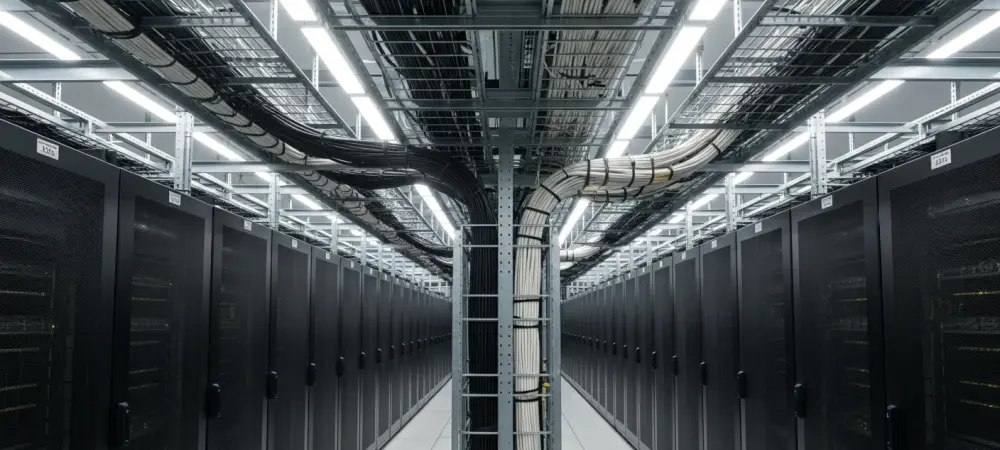
The massive capital investments poured into artificial intelligence over the last few years are finally facing a reckoning as organizations realize that raw processing power alone cannot solve the persistent problem of underutilized silicon. While the industry has obsessed over the core count and clock speeds of high-end accelerators, the real bottleneck has shifted from the chip itself to the intricate web of connectivity that binds these components together. This mismatch between theoretical peak performance and actual workload execution has birthed a new era of infrastructure design, where the “smart fabric” is no longer a secondary consideration but the primary engine of efficiency.
The Rise of High-Radix Smart Fabrics
Market Dynamics and the GPU Utilization Crisis
The economic landscape of data center connectivity has undergone a seismic shift, with the “scale-up” switching market ballooning from a modest $5 billion to a staggering $20 billion in less than two years. This explosive growth reflects a desperate need to solve what engineers call the “completion time tax.” In modern AI environments, fragmented workloads often lead to significant portions of a cluster sitting idle, waiting for data to arrive from distant nodes. When GPUs are forced to pause for these fragmented cycles, the return on investment for expensive hardware plummet, turning high-performance clusters into underutilized assets. Efficiency metrics have become the new gold standard for measuring data center health, moving beyond raw flops to more nuanced indicators of throughput. Adoption statistics for memory-semantic architectures show a compelling trend: hyperscale environments implementing these technologies have reported a reduction in collective I/O by nearly 49%. By allowing systems to treat the entire network as a unified memory pool rather than a series of disconnected storage bins, operators have finally begun to close the gap between potential and realized compute capacity. This transition marks the end of the era where simple bandwidth was the only metric that mattered.
Real-World Applications and Industry Leaders
Astera Labs has emerged as a pivotal force in this architectural revolution, particularly with the introduction of the Scorpio X-Series. By implementing 320-lane high-radix switches, the company has managed to simplify complex data center topologies that previously required multiple layers of management. These high-radix designs reduce the “hop count”—the number of intermediate points data must traverse—which directly lowers latency and improves the predictability of large-scale training runs. In a world where microseconds determine the success of an inference call, reducing these physical and logical barriers is essential for maintaining a competitive edge.
The technological shift also includes the integration of specialized engines like the Hypercast engine, which facilitates in-network compute. Instead of requiring GPUs to handle the heavy lifting of collective operations such as all-reduce or all-gather, the network fabric itself manages these tasks. This offloading process ensures that the most expensive silicon in the rack remains focused on the primary computation of tokens rather than the administrative overhead of data synchronization. Furthermore, the collaborative push toward the UALink (Ultra Accelerator Link) standard by heavyweights like AMD, Broadcom, and Marvell demonstrates a collective industry effort to combat proprietary vendor lock-in and ensure that smart fabrics remain interoperable across diverse hardware ecosystems.
Industry Perspectives on Fabric Intelligence
Expert Insight on Workload Fragmentation
Analysts like Matt Kimball have frequently argued that traditional, linear execution models are fundamentally obsolete for modern Large Language Models. In the past, compute tasks were predictable and sequential, but modern AI workloads are inherently messy and non-linear. As data flows through a cluster, it branches and recombines in ways that traditional networking “plumbing” cannot efficiently manage. Without a fabric that understands the semantic nature of the data it carries, the system inevitably falls victim to bottlenecks that choke performance during the most critical phases of model training.
The Shift to Memory-Semantic Communication
Leadership perspectives from within the connectivity sector suggest that the fabric is moving from a utility to a “first-class infrastructure decision.” This means that when architects design a new data center, they are choosing the fabric first and the accelerators second. Memory-semantic communication allows for a level of fluidity that was previously impossible, essentially turning a massive rack of servers into a single, giant computer. This shift is vital for scaling models that have billions or even trillions of parameters, as the memory requirements of these models far exceed the capacity of any individual GPU or accelerator node.
Vendor Agnosticism vs. Proprietary Stacks
A strategic tension continues to define the industry as companies weigh the benefits of integrated ecosystems against the flexibility of open standards. While proprietary stacks like Nvidia’s NVLink offer high performance through deep integration, there is a growing demand for PCIe-based and open-source alternatives. Hyperscalers are increasingly wary of becoming overly dependent on a single supplier, leading to a surge in interest for standards that allow for the mixing of different chip architectures. This push for agnosticism is driving innovation in the smart fabric space, as vendors compete to provide the most adaptable and efficient connectivity solutions for a diverse range of hardware.
The Future of AI Infrastructure Evolution
Convergence of Scale-Up and Scale-Out
The historical distinction between “scale-up” connectivity within a single rack and “scale-out” connectivity across a whole cluster is rapidly disappearing. By late 2026, the lines will have blurred to the point where the entire data center operates under a unified fabric protocol. This convergence allows for more flexible resource allocation, where a single training job can seamlessly utilize accelerators across multiple rows of racks without the typical latency penalties associated with traditional networking layers. This architectural unity is the key to unlocking the next level of AI scalability.
Tokens per Watt Optimization
Environmental and economic pressures are forcing a move toward “intelligent” connectivity as a means of optimizing compute efficiency. The metric of “tokens per watt” has become a central focus for data center operators who are facing rising energy costs and stricter sustainability mandates. By improving the intelligence of the fabric, companies can achieve higher throughput without simply adding more power-hungry chips. This focus on efficiency ensures that the expansion of AI remains economically viable even as the models themselves become more demanding.
Challenges of Multi-Tenancy
Maintaining low latency in the “messy” environments of multi-tenant cloud providers remains one of the most significant hurdles for fabric designers. When multiple customers are running unpredictable, competing workloads on the same physical infrastructure, the risk of “noisy neighbor” interference increases. Smart fabrics must therefore become more autonomous, using real-time telemetry to redirect traffic and isolate workloads to prevent performance degradation. Solving these multi-tenancy issues is crucial for the democratization of AI, as it allows smaller players to access high-performance clusters without the cost of dedicated hardware.
The End of Data Movement Friction
The ultimate goal of these advancements is a future where the network fabric acts as a seamless extension of accelerator memory. In this scenario, the hardware-workload mismatch that plagued early AI deployments is completely eliminated. Data flows through the system with zero friction, moving from storage to compute nodes and back again without the overhead of traditional protocols. This evolution will transform the data center from a collection of discrete parts into a living, breathing organism that adapts its internal connectivity to the specific needs of the AI model it is currently running.
Conclusion and Strategic Outlook
The architectural shifts witnessed over the last two years signaled a definitive move toward high-radix connectivity and in-network compute as the primary remedies for infrastructure inefficiency. The industry successfully transitioned from a mindset of raw power to one of systemic intelligence, recognizing that the connections between chips were just as important as the chips themselves. This period marked the decline of the “completion time tax” as memory-semantic architectures became the standard for high-performance clusters. The final verdict on this evolution demonstrated that the success of major AI investments depended more on the intelligence of the fabric than on the sheer processing power of the silicon. Organizations that prioritized interoperable and scalable connectivity solutions found themselves better positioned to handle the unpredictable nature of next-generation workloads. Infrastructure architects ultimately moved toward memory-semantic solutions to ensure long-term viability, effectively bridging the gap between hardware capability and real-world application needs.