

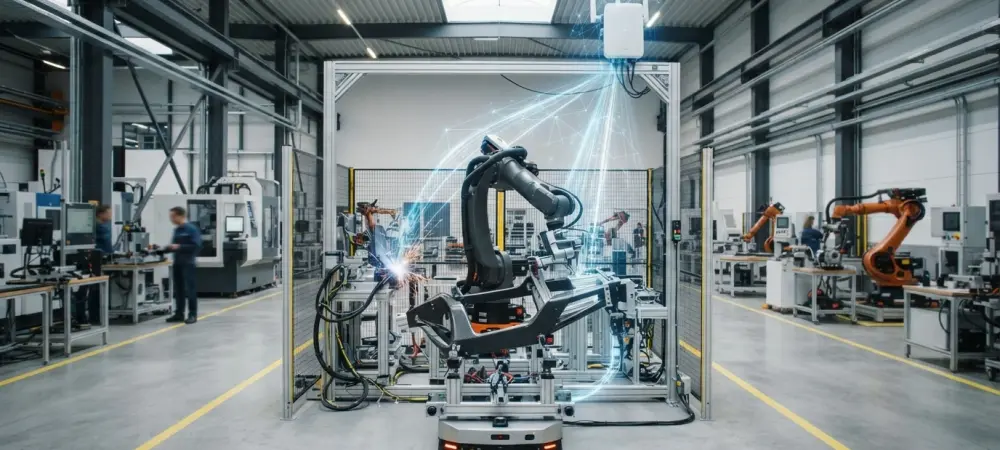
The industrial landscape is currently navigating a fundamental transformation where high-performance connectivity has transitioned from being a mere IT utility to serving as the central nervous system of Operational Technology. This seismic shift is defined by the emergence of “Physical AI,” a category of intelligence where autonomous machines and mobile robots do not just process data in a digital vacuum but interact directly with the physical world in real-time. As manufacturing and logistics hubs move toward fully autonomous operations, the network becomes as critical as the electricity powering the facility. A single dropped packet or a momentary surge in latency is no longer a minor inconvenience for an office worker; it is a mechanical failure that can bring a multimillion-dollar production line to a grinding halt.
The integration of private 5G is the primary catalyst for this evolution, providing the low-latency and high-bandwidth pathways that traditional wireless solutions have failed to deliver. Unlike previous generations of industrial networking, which often treated connectivity as a localized patch for specific tasks, modern 5G infrastructures are being designed as holistic “control loops” for the machines they support. This means that the wireless signal is now an integral part of the machine’s internal logic. When an autonomous mobile robot (AMR) navigates a complex warehouse floor, its ability to perceive obstacles and make split-second safety decisions depends entirely on the integrity of the network. Consequently, the industry is witnessing a move away from standard IT help-desk mentalities toward a rigorous, zero-failure engineering approach.
Operational Technology (OT) professionals now view the wireless network as a foundational component of the factory’s hardware stack. This perspective shift is necessary because Physical AI systems generate a continuous stream of high-definition data that must be processed with extreme precision. The period from 2026 to 2028 is expected to see a massive influx of these technologies as enterprises move beyond small-scale pilots and into full-scale deployments. In this environment, the network must offer more than just “coverage”—it must provide a guarantee of performance that aligns with the physical requirements of the machinery, ensuring that every movement is synchronized and every sensor remains online without exception.
The Rise of Connected Autonomy
The transition toward autonomous industrial environments is fundamentally changing the way machines communicate with their surroundings. In the past, industrial automation was characterized by static robots performing repetitive tasks in a caged environment, isolated from human workers and other machines. However, the rise of Physical AI has introduced a new era of “connected autonomy,” where machines such as autonomous mobile robots and automated guided vehicles (AGVs) navigate freely through dynamic, unscripted spaces. These machines are equipped with a sophisticated array of sensors, including LiDAR, 3D cameras, and haptic feedback systems, all of which require a constant and massive exchange of data to function safely and efficiently.
This dynamic environment creates a unique set of challenges for traditional wireless networks like Wi-Fi. As a robot moves through a facility, it often encounters radio-frequency (RF) hostile zones, such as narrow aisles lined with metal racking or areas with heavy electromagnetic interference from large motors. Traditional networks struggle with “handoffs”—the process of moving a connection from one access point to another—which frequently results in micro-outages. For an autonomous vehicle carrying a heavy payload, even a half-second loss of connectivity can trigger a safety stop, leading to a cascade of delays across the entire facility. The demand for seamless, nonstop connectivity has thus made private 5G an essential requirement for the modern autonomous fleet.
Moreover, the complexity of Physical AI means that these machines are not just consumers of data but significant creators of it. While a standard office laptop might focus on downloading files, an industrial robot is constantly uploading 4K video feeds and sensor telemetry to edge servers for real-time processing. This high-demand “uplink” requirement is a complete reversal of the traditional consumer-focused 5G model. The industrial sector is consequently prioritizing network architectures that can handle this heavy, concentrated data traffic without causing congestion or latency spikes that would compromise the robot’s ability to react to its environment in real-time.
Market Growth: The Economic Engine of Adoption
The financial implications of network reliability are the primary drivers for the rapid expansion of the private 5G market. Industry data from leaders like ABB and Siemens indicates that the cost of unplanned downtime in a high-output factory is staggering, often averaging $125,000 per hour across general manufacturing. In the automotive industry, where precision and timing are even more critical, these costs can surge to as much as $2 million per hour. Because Physical AI integrates the wireless network directly into the production workflow, any connectivity failure translates immediately into a massive financial loss. This reality has shifted the conversation around 5G from an IT expense to a mission-critical insurance policy for operational continuity.
As we look at the trajectory from 2026 to 2029, the adoption of private 5G is expected to accelerate as companies realize the ROI of “zero-failure” connectivity. Organizations are no longer content with “good enough” wireless coverage that works most of the time; they are seeking infrastructures that provide five-nines (99.999%) availability. This demand is fueling a surge in investments toward virtualized network solutions that can be scaled and managed with the same flexibility as cloud software. The market is moving toward a model where connectivity is purchased as a guaranteed service level, ensuring that the network can support the increasing density of robots as a facility grows in complexity.
Real-World Applications: Leading the Industrial Charge
Innovative companies are already demonstrating the power of private 5G through the deployment of virtualized Radio Access Networks (vRAN). For instance, Globalstar’s XCOM RAN division has pioneered a coordination-based approach to wireless connectivity that is specifically designed for the most challenging industrial environments. In massive logistics warehouses where hundreds of robots navigate through dense metal structures, traditional cellular designs often fail due to signal blockage and interference. By using a virtualized architecture, these systems allow multiple radios to work together as a single “virtual cell,” effectively eliminating the boundaries between radio towers and providing a continuous, unbreakable signal path for every machine on the floor.
This technological shift is particularly evident in high-density smart factories where the volume of data being transmitted is immense. In these settings, a standard network would quickly become overwhelmed by the sheer number of devices competing for bandwidth. However, by implementing coordinated multipoint technology, operators can maintain high-bandwidth connections for 4K video and LiDAR streams simultaneously across a large fleet. These real-world applications prove that the future of Physical AI is not just about the robots themselves, but about the invisible infrastructure that allows them to perceive, think, and move in a synchronized ballet of industrial productivity.
Perspectives: Wisdom from Industry Experts
Thought leaders in the industrial sector are increasingly vocal about the need to redefine the relationship between networking and mechanical engineering. The prevailing expert opinion suggests that the industry must move away from “average-case” network planning. In a typical office environment, network capacity is planned around average usage patterns, with occasional slowdowns being accepted as part of the system. However, experts in Physical AI argue that industrial networks must be engineered for “worst-case scenarios.” This involves identifying the most critical data packets—such as collision-avoidance signals—and ensuring they are delivered with absolute priority and guaranteed latency, even when the rest of the network is under heavy load.
Furthermore, industry veterans emphasize that the wireless network should be treated as a “control loop” similar to the electrical or hydraulic systems within a machine. This perspective requires a deep collaboration between IT departments and OT engineers who understand the physical demands of the production line. Experts highlight that while a two-second delay in email delivery is irrelevant, a two-second delay in a smart factory can lead to total fleet immobilization, safety hazards, and significant logistical bottlenecks. The consensus is that the successful implementation of Physical AI depends on treating connectivity with the same engineering rigor as the physical hardware it supports.
Future Projections: Navigating the Industrial Horizon
The next phase of industrial evolution will likely be defined by the “uplink crisis,” a term used to describe the massive aggregate demand for data transmission from machines to the cloud. As the number of autonomous vehicles in a single facility grows from dozens to hundreds, the traditional ways of managing spectrum will become insufficient. This challenge will necessitate the wider adoption of technologies like Multi-User MIMO (MU-MIMO), which allows multiple machines to transmit data over the same frequency at the same time. By increasing spectral efficiency, companies can support a higher density of robots without the need for expensive new radio spectrum, effectively “stacking” data streams to maximize the capacity of the existing network.
Another significant trend on the horizon is the total elimination of handoffs through advanced radio coordination. The goal for the coming years is to create a “borderless” wireless environment where a robot can travel miles through a complex facility without ever experiencing a change in its connection state. This will be achieved through the continued virtualization of the network, where software manages the radio signals in real-time to ensure that every device always has a clear line of sight to a signal source. As these technologies mature, the barrier between the physical machine and the digital network will continue to blur, leading to a state of “fluid automation” where connectivity is as reliable and invisible as the air.
Summary: The Strategic Evolution of Key Trends
The transition to 5G-enabled physical intelligence reached a definitive tipping point as enterprises recognized that traditional wireless infrastructures could not support the heavy uplink demands of autonomous fleets. This shift necessitated a move toward requirement-based design, where network capacity was calculated based on the specific sensor outputs and latency tolerances of the machines rather than simple square footage coverage. The industry successfully adopted virtualized radio architectures to mitigate the risks associated with signal blockage in dense, metal-heavy environments, effectively treating the wireless signal as a measurable mechanical component.
Moving forward, the focus must shift to the integration of predictive maintenance for the network itself, ensuring that potential connectivity gaps are identified and rectified before they can impact production. Organizations should prioritize the deployment of coordinated multipoint systems to achieve the zero-failure performance required for high-density robot populations. By treating the private 5G network as a mission-critical piece of the industrial stack, decision-makers ensured that their facilities remained resilient, scalable, and capable of supporting the next generation of Physical AI. The long-term success of autonomous industrial evolution proved to be dependent on this fundamental alignment between digital connectivity and physical motion.