

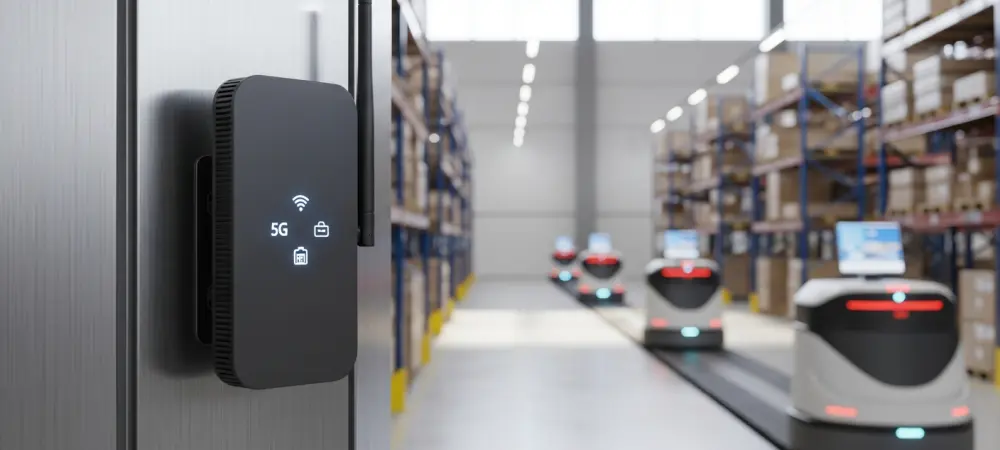
Traditional public cellular infrastructures are increasingly failing to meet the rigorous demands of heavy industry, prompting a massive migration toward dedicated, high-performance private corridors. As the smart factory transitions from a conceptual blueprint into a high-speed operational reality, the demand for ultra-reliable communication has never been more acute. In an environment where data sovereignty and ultra-low latency are considered non-negotiable requirements, Private 5G—specifically Captive Non-Public Networks (CNPN)—has emerged as the essential backbone for Industry 4.0. This shift marks a departure from reliance on generic connectivity toward bespoke, localized infrastructure designed to handle the specific burdens of industrial automation.
The current landscape represents a silent revolution where the ability to control a network is just as valuable as the data flowing through it. This article examines the rise of bespoke enterprise connectivity, the strategic shift toward public-private partnerships, and the technical implications of localized network infrastructure that define the present industrial era.
The Accelerating Adoption of Captive Non-Public Networks
Market Trajectory: The Global Push for Industrial Digitalization
Recent data indicates a surge in demand for dedicated communication infrastructures, driven largely by the inherent limitations of public cellular networks in high-stakes environments. The liberalization of telecommunications policy, particularly in emerging markets like India, has created standardized categories for providers to deploy private LTE and 5G solutions effectively. This regulatory clarity has allowed enterprises to move beyond experimental phases, integrating connectivity directly into the core of their operational strategies. Adoption statistics show that sectors such as manufacturing, logistics, and mining are prioritizing “full-stack” digital infrastructure. These industries require systems capable of supporting thousands of simultaneous IoT sensors and autonomous machinery without the risk of interference from consumer traffic. Consequently, the push for digitalization is no longer just about software; it is about owning the physical and virtual pathways that ensure 24/7 operational continuity.
Real-World Implementation: The Strategic Empanelment Model
The partnership between Blue Cloud Softech Solutions and BSNL serves as a prime example of how technology firms are transitioning from software providers to specialized infrastructure partners. Under the CNPN Framework, companies are now authorized to handle the entire lifecycle of a network, ranging from architectural design and site planning to long-term maintenance and optimization. This 60-month agreement highlights a pivot toward long-term service stability in the enterprise sector.
Furthermore, the integration of Unified Licenses as Virtual Network Operators allows these entities to offer end-to-end services that bridge the gap between state-owned spectrum holdings and private technical agility. This model provides enterprises with the security of a government-backed spectrum and the innovation of a private tech firm. By maneuvering through these complex empanelment processes, tech companies are securing their “right to play” in an increasingly crowded industrial market.
Industry Perspectives: Technical and Strategic Advantages
Industry experts emphasize that the primary driver for Private 5G is not merely speed, but comprehensive control over the digital environment. Enterprises require the ability to manage their own network slices to ensure that mission-critical applications receive the necessary bandwidth regardless of external conditions. This level of customization ensures that a robotic arm on a factory floor receives the same priority as a high-level security alert, providing a reliability profile that public networks simply cannot match.
Moreover, the convergence of 5G with Artificial Intelligence and Edge Computing allows for real-time analytics that were previously impossible on congested public frequencies. Thought leaders highlight that by processing data at the edge of the network, firms can reduce latency to single-digit milliseconds. This technical advantage is the primary catalyst for the adoption of autonomous guided vehicles and remote-controlled heavy machinery, which require instantaneous feedback loops to operate safely and efficiently.
Future Projections: AI Integration and Infrastructure Challenges
The next phase of evolution will likely see Private 5G networks becoming inherently “AI-enabled,” where the network itself optimizes data traffic and predicts maintenance needs for connected machinery. Such developments will likely expand into remote healthcare and smart campuses, where high-density user environments demand dedicated, high-bandwidth connectivity for telemedicine and remote instruction. In these settings, the network acts as a sentient layer of infrastructure rather than a passive utility.
However, potential challenges remain, including the high capital expenditure required for initial deployment and the necessity of navigating evolving regulatory landscapes regarding spectrum allocation. Long-term implications suggest a definitive shift toward data sovereignty, where sensitive operational data remains within a firm’s physical perimeter. This localized approach significantly mitigates the cybersecurity risks associated with public traffic, making it a cornerstone of modern corporate risk management.
Conclusion: Defining the Next Era of Enterprise Connectivity
The transition toward decentralized, enterprise-owned communication infrastructure solidified the foundation for the current industrial landscape. This shift proved that the most resilient organizations were those that prioritized architectural agility over standard connectivity. The collaboration between state giants and agile technology firms reaffirmed that the future of connectivity remained both collaborative and highly customized. As enterprises moved toward a more automated and intelligent existence, the deployment of Private 5G stood as the most critical factor in determining digital maturity. Organizations that successfully integrated these networks achieved a level of operational resilience that shielded them from the volatility of public infrastructure. Moving forward, the focus must remain on strengthening internal spectrum expertise and fostering deeper integrations between AI-driven software and the physical network backbone to maintain this competitive edge.