

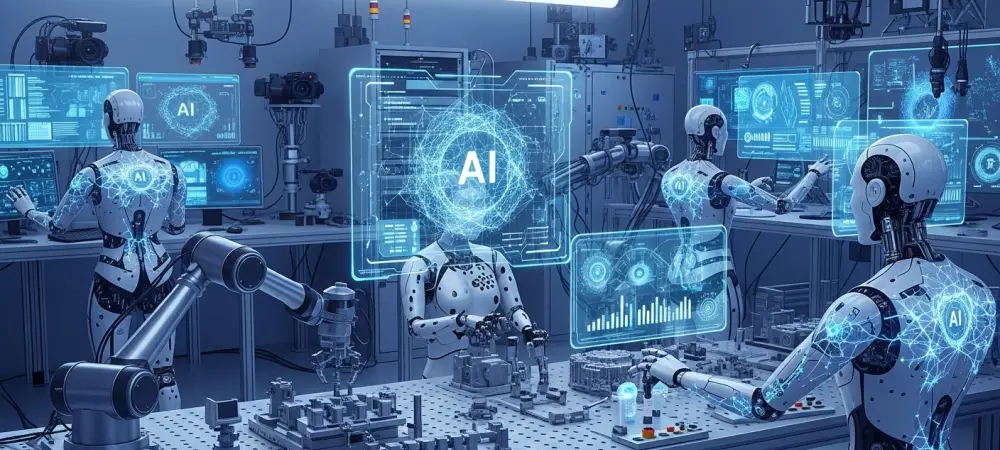
The line between digital thought and physical action has begun to evaporate as machines transition from rigid, pre-programmed tools into entities capable of perceiving and navigating the complexities of our shared reality. This emergence of “Physical AI” marks a fundamental departure from the era of static industrial automation, signaling a shift where intelligence is no longer trapped behind a glass screen. Instead, we are witnessing the birth of autonomous systems that can reason through spatial challenges and interact socially within urban environments, theme parks, and logistics hubs. This integration is not merely a technical upgrade; it represents a new chapter in the relationship between human logic and the tangible world.
The State of Physical AI and Market Adoption
Data-Driven Growth: The Sim-to-Real Revolution
Current expansion in the robotics sector is largely fueled by a radical shift in how these machines learn, moving away from slow, human-recorded demonstrations toward high-velocity synthetic data generation. Because the real world is too unpredictable and dangerous for trial-and-error at scale, developers have turned to massive GPU-accelerated simulations. By utilizing platforms like the Isaac Lab and advanced physics solvers, engineers can now compress centuries of experiential learning into a few days of digital training. This “sim-to-real” pipeline allows robots to master complex motor skills in a virtual environment before ever touching a physical floor, effectively bypassing the traditional data gap that once stalled humanoid development.
This transition has paved the way for the adoption of foundation models, such as GR00T, which apply the same scaling laws that empowered Large Language Models to the realm of physical movement. In the current landscape spanning from 2026 to 2028, these models are enabling robots to generalize their skills across different hardware configurations and environments. As a result, sectors like manufacturing and logistics are seeing a surge in “plug-and-play” autonomy. Machines are no longer specialized for a single task; they are becoming generalists that can adapt to new warehouse layouts or assembly line changes with minimal human intervention.
Real-World Applications: From Disney to Robo-Taxis
One of the most compelling demonstrations of this trend involves high-profile collaborations that merge entertainment with cutting-edge spatial reasoning. A prime example is the partnership involving Nvidia, Disney, and researchers from DeepMind, which resulted in small, expressive robots capable of social interaction and real-time adaptation. These characters, like the robotic iterations seen in international theme parks, use differentiable physics to maintain balance and eye contact while navigating crowded guest areas. This represents a leap in social robotics, where the goal is not just utility but a seamless, non-threatening integration into human social spaces.
Beyond the realm of leisure, the autonomous transportation industry serves as the most significant commercial theater for Physical AI. Modern robo-taxis have evolved from purely reactive machines into entities capable of generative reasoning. These vehicles can now verbalize their internal logic to passengers, explaining why they chose a specific detour or how they identified a hidden hazard. This transparency is a strategic move to build public trust, transforming the autonomous vehicle from a “black box” into a communicative partner. By bridging the gap between mechanical action and human-understandable reasoning, the industry is overcoming the psychological barriers to widespread adoption.
Expert Perspectives on the AI-Robotics Synergy
Industry leaders, most notably figures like Jensen Huang, have identified this period as the “GPT moment” for the robotics industry. The consensus among experts is that the convergence of foundation models and high-fidelity physics simulation provides the missing link for true machine autonomy. They argue that the “four scaling laws”—increased compute, massive data volume, larger model sizes, and extended training times—are finally being applied to physical machines with the same success seen in text and image generation. This synergy allows robots to develop a “common sense” regarding gravity, friction, and object permanence that was previously impossible to program manually.
However, professionals in the field remain cautious about the “uncanny valley” and the technical hurdles of perfecting the transition from simulation to reality. While digital twins are increasingly sophisticated, the sheer entropy of the physical world—varying light conditions, unpredictable human behavior, and mechanical wear—still poses risks. To mitigate these, thought leaders emphasize the necessity of robust safety guardrails. Frameworks like NeMo are being integrated into the robotic stack to ensure that as these machines become more autonomous, they remain tethered to ethical guidelines and predictable safety protocols, preventing the “black box” problem from migrating into heavy machinery.
The Road Ahead: Future Implications and Challenges
As we look toward the immediate horizon, the trajectory of Physical AI suggests a world where autonomous actors are woven into the fabric of everyday life. We are moving toward “open robotics” architectures that allow diverse machines—ranging from bipedal humanoids to autonomous delivery units—to share a unified intelligence base. This modularity means that a breakthrough in a walking algorithm for a toy could theoretically improve the stability of a medical exoskeleton or a heavy-duty construction bot. This shared learning environment will likely accelerate the decline of proprietary, siloed systems in favor of more collaborative, versatile platforms.
The potential benefits of this evolution are vast, including increased labor efficiency and enhanced accessibility for those with mobility challenges. Nevertheless, the path forward is not without significant friction. The energy and compute requirements needed to sustain high-fidelity, real-time reasoning are immense, requiring a parallel evolution in hardware efficiency. Furthermore, as robots become more “social,” society must grapple with the psychological impact of interacting with machines that mimic human emotion and logic. Balancing the drive for technological perfection with the need for human-centric design will be the defining challenge of the coming years.
Conclusion: Embracing the Autonomous Era
The integration of Physical AI and robotics fundamentally altered the trajectory of industrial and social development. By moving beyond the limitations of human-captured data and embracing synthetic environments, the industry successfully navigated the transition from simulation to the streets. These advancements moved the needle from mere automation to true autonomy, where machines began to explain their choices and interact with the world with a level of transparency that was previously unimaginable. The focus shifted from simply building faster machines to creating intelligent partners that could coexist with humans in dynamic, unpredictable settings.
Moving forward, the primary objective for stakeholders shifted toward the standardization of these “intelligence stacks” and the refinement of edge-computing capabilities. It became clear that the next phase of growth would require a focus on localizing high-level reasoning to the hardware itself, reducing latency and ensuring reliability in mission-critical scenarios. Industries that prioritized the early adoption of these modular, reasoning-capable systems found themselves better positioned to handle labor fluctuations and complex logistical hurdles. The era of Physical AI proved that when digital intelligence is given a body, the potential for innovation is limited only by our ability to define the parameters of its autonomy.