

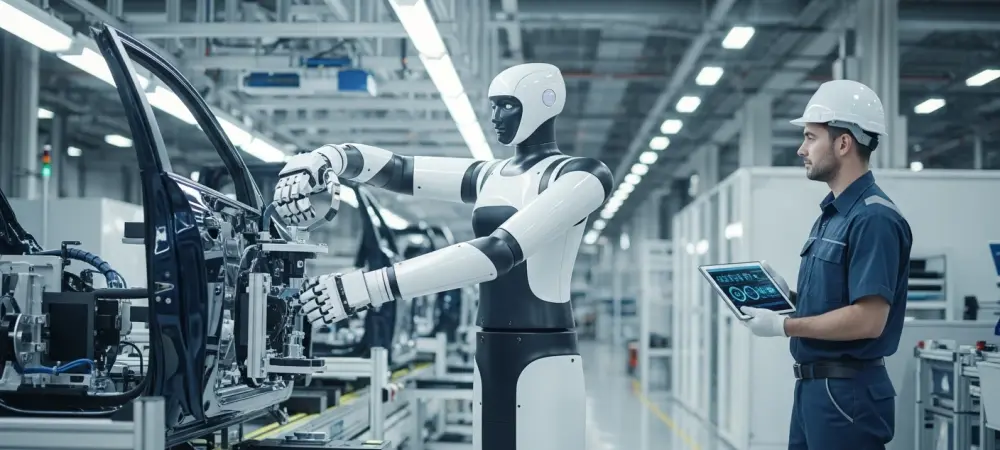
The abstract world of artificial intelligence, long confined to digital screens and data centers, is now breaking free into the physical realm, with Alibaba’s open-source RynnBrain acting as a powerful catalyst for this transformation. This monumental shift is not merely a product of technological ambition but a direct response to urgent economic and demographic pressures that are reshaping industries worldwide. As AI learns to see, touch, and interact with its environment, a new industrial epoch begins. This analysis will dissect the key players battling for dominance, the profound economic drivers fueling this trend, the core technologies making it possible, and the ultimate challenge that will define its future: governance.
The Accelerating Momentum of Embodied Intelligence
From Lab to Factory Floor The Growth Trajectory
What was once the domain of long-term research is rapidly becoming a near-term industrial reality. A Deloitte 2026 Tech Trends report indicates that physical AI has crossed a critical threshold, moving from theoretical exploration to practical application on factory floors and in warehouses. This transition from concept to concrete implementation signals a major turning point, where intelligent robotics is no longer a future promise but a present-day strategic asset. The groundwork laid in simulation and synthetic data generation has dramatically shortened development cycles, allowing companies to deploy and iterate on robotic systems faster than ever before.
This accelerating adoption is reflected in bullish financial forecasts that underscore the trend’s economic magnitude. Analysts at UBS project a dramatic influx of humanoid robots into the global workforce, with millions expected by 2035, creating a market projected to exceed $1.7 trillion. This isn’t just about replacing labor; it’s about creating new efficiencies and capabilities in sectors facing critical worker shortages. Moreover, the trend’s geopolitical significance is highlighted by substantial national-level investments. South Korea, for instance, has committed $692 million to bolster its AI semiconductor industry, a clear acknowledgment that leadership in physical AI requires a robust, vertically integrated supply chain, from foundational software models to domestically produced, high-performance chips.
Physical AI in Action Current Implementations
The practical value of physical AI is already being demonstrated by industry leaders across the globe. Alibaba’s RynnBrain showcases this progress with robots capable of performing complex, nuanced tasks, such as delicately sorting fruit by identifying ripeness and quality with a precision that rivals human perception. This level of dexterity and cognitive ability marks a significant leap from the rigid, repetitive automation of the past, opening the door to applications in agriculture, quality control, and other fields requiring fine motor skills and judgment.
This trend is not limited to emerging players; established giants are scaling their deployments aggressively. Amazon has revolutionized its logistics and fulfillment centers by deploying over a million robots, a testament to the massive efficiency gains achievable through physical automation. These robots handle everything from sorting packages to transporting goods, forming the backbone of a highly optimized supply chain. In parallel, industrial manufacturing leaders like BMW are actively testing humanoid robots for intricate tasks on their assembly lines. By integrating these advanced robots into complex workflows, BMW is proving the technology’s value in high-stakes environments where precision, reliability, and adaptability are paramount.
Insights on the High Stakes Competitive Landscape
The race to develop and deploy physical AI has ignited a strategic battle among the world’s most formidable technology companies for what is widely seen as a multitrillion-dollar opportunity. This competitive arena features a clash of titans, including Alibaba, Nvidia, Google DeepMind, and Tesla, each bringing a unique strategy to the table. The competition extends beyond mere technological prowess, encompassing platform-building, ecosystem development, and the fundamental philosophical choice between open and closed systems.
In this high-stakes environment, Alibaba has made a pivotal strategic move by releasing RynnBrain as an open-source model. This approach is designed to accelerate adoption and foster a vibrant developer community, creating a network effect that can challenge the more proprietary systems developed by competitors. By making its powerful vision-language-action (VLA) model accessible, Alibaba aims to establish RynnBrain as a foundational layer for a diverse range of robotic applications, mirroring its successful strategy with its Qwen family of large language models. At the heart of this competitive push is a broad consensus on the core technological enabler: the convergence of vision, language, and action into sophisticated VLA models. These models are the “brains” that allow a robot to perceive its environment through cameras (vision), understand complex commands and context (language), and translate that understanding into precise physical movements (action). This integration is the key that unlocks unprecedented adaptability, enabling robots to move beyond pre-programmed routines and perform tasks dynamically in unstructured, real-world settings.
The Future Horizon Governance as the Ultimate Differentiator
Looking forward, the primary constraint on the widespread deployment of physical AI will likely shift from technical capability to the effectiveness of governance. As these intelligent systems become more powerful and autonomous, the ability to manage risk, ensure safety, and assign responsibility becomes the most critical challenge. Unlike a software bug, which can be patched remotely with limited consequence, a failure in a physical AI system has immediate and potentially severe real-world impacts on safety and operations.
This challenge necessitates a new paradigm for risk management. A single malfunctioning robot on a busy factory floor or in a public space can cause injury, halt production, and create significant legal liabilities. Consequently, the development of robust governance frameworks is not just a matter of compliance but a prerequisite for building trust and achieving scalable deployment. The World Economic Forum has proposed a vital three-tiered governance model to address this complexity: an Executive tier for setting high-level risk strategy, a System tier for engineering safety controls and change management, and a Frontline tier that empowers human workers with clear authority and mechanisms to override autonomous systems when necessary.
This imperative for strong governance will also shape the global competitive dynamic, particularly between the United States and China. While one nation might gain an early lead through rapid deployment in controlled industrial environments, long-term success will not be determined by speed alone. The ultimate competitive advantage will belong to the nation or company that develops the most robust, scalable, and trustworthy governance models. These are the frameworks that will allow physical AI to operate safely and reliably not just in structured factories but in the chaotic, unpredictable environments of our daily lives.
Conclusion Embracing the Physical AI Revolution
The analysis confirmed that physical AI has evolved from a futuristic concept into a rapidly accelerating trend, propelled by a powerful combination of economic necessity, intense corporate competition, and transformative technological breakthroughs. The journey from digital intelligence to embodied autonomy is well underway, reshaping industries and defining the next frontier of innovation.
It became evident that as the underlying technology matures and becomes more accessible, the true competitive advantage will shift. The ability to effectively govern these complex autonomous systems—ensuring their safety, reliability, and accountability—will become the ultimate differentiator between success and failure. The companies and nations that master this challenge will lead the charge.
This transition from simple automation to true autonomy called for industry leaders and policymakers to move with urgency and foresight. Proactively building robust frameworks of responsibility and control was not an obstacle to progress but the very foundation upon which a safe and prosperous future with physical AI could be built.