

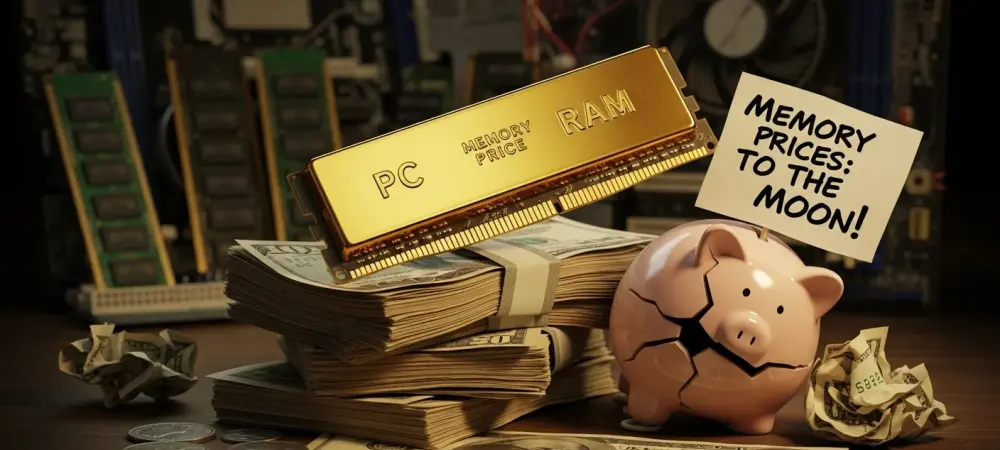
Anyone attempting to build or upgrade a personal computer in recent months has likely encountered a jarring reality at checkout: the price of essential memory has skyrocketed without warning, transforming once-affordable components into luxury items. This alarming and sudden spike in the cost of RAM and solid-state drives is far more than an inconvenience for hobbyists. These components are the bedrock of virtually all modern electronics, from high-end workstations to everyday laptops and gaming consoles. Their price directly impacts consumers, system integrators, and the trajectory of the tech industry at large. This analysis will dissect the forces driving this hyperinflation, present the startling data emerging from key manufacturing hubs, examine the pivotal role of the artificial intelligence boom, and forecast the long-term consequences for the global market.
The Anatomy of a Price Crisis
Charting the Surge: The Data from South Korea
The most compelling evidence of this burgeoning crisis originates from South Korea, a global epicenter for memory manufacturing. Since November 2025, market data reveals that prices for Samsung’s DRAM and SSDs have not just risen but have doubled, and in some cases, even tripled. This isn’t a gradual increase; it’s a vertical climb that has caught the market off guard.
To put this into perspective, a standard 16GB DDR5 RAM module that was widely available for approximately $69 just a few months ago now commands a staggering $278 on the same market. This represents an unprecedented 300% increase, illustrating the sheer velocity and severity of the price inflation. Because South Korea’s electronics sector often acts as a bellwether for global component pricing, these figures serve as a critical, and deeply concerning, indicator of what is to come for the rest of the world.
From Manufacturer to Consumer: How the Shortage Spreads
The mechanism driving these price hikes is a classic case of supply and demand, albeit one engineered by strategic market shifts. A supply shortage has been created specifically for the consumer segment, forcing distributors and wholesalers to compete for a dwindling pool of available memory modules. Consequently, they must purchase components from manufacturers like Samsung at these newly inflated prices to maintain any inventory at all.
These dramatically increased costs are not absorbed by distributors; instead, they are passed down the supply chain in a domino effect. From the manufacturer to the distributor, then to the retailer, and finally to the end-user, each step adds its own margin, compounding the initial price shock. While the first reports are surfacing from a single region, the interconnected nature of the global hardware distribution network ensures that these price hikes are set to propagate worldwide, becoming the new unwelcome standard.
The AI Boom’s Unintended Consequence
A Strategic Pivot to a More Lucrative Market
The primary driver behind this consumer-facing scarcity is a deliberate and strategic pivot by the industry’s largest players. Major memory manufacturers, including Samsung and Micron, are actively reallocating their sophisticated production capacity away from the consumer market. Their focus has shifted squarely toward the high-demand, high-margin AI enterprise sector.
This move is motivated by pure economics. The AI industry requires colossal quantities of specialized, high-performance memory to train and operate complex models, and corporate clients are willing to pay a significant premium for it. By prioritizing this lucrative segment, manufacturers are maximizing their profits. However, this calculated business decision has created an artificial famine in the consumer hardware space, leaving PC builders and everyday users to grapple with the consequences.
An Industry Analyst’s Sobering Prediction
The gravity of this trend is reinforced by expert analysis from within the industry. An analyst at Counterpoint Research recently issued a sobering forecast, suggesting this is not a temporary market fluctuation but a fundamental and potentially permanent shift in hardware economics. The core of the prediction is that memory could soon constitute as much as 30% of the total manufacturing cost for a vast range of electronic products.
Such a forecast underscores the profound impact of the manufacturers’ strategic pivot. When a foundational component category begins to dominate the bill of materials, it forces a complete reevaluation of product design, pricing, and market strategy. This expert opinion confirms that the industry is not merely weathering a storm but is witnessing the dawn of a new, more expensive era for hardware.
Brace for Impact: The Future of PC Hardware Costs
The New Reality for Consumers and System Builders
For consumers and system builders, the future is direct and unavoidable: significantly higher prices are coming for a wide array of hardware. This extends beyond individual components to include pre-built PCs, laptops, and even next-generation gaming consoles, all of which rely heavily on DRAM and flash storage. The most severe effects will become more pronounced globally throughout 2026 as existing, lower-cost inventory is depleted and replaced by new stock purchased at hyperinflated rates.
This new cost reality is likely to alter consumer behavior. We can anticipate a potential slowdown in PC upgrade cycles as users hold onto their existing hardware for longer to avoid the high cost of new builds. Moreover, a more robust market for used components may emerge as a viable alternative for budget-conscious builders, creating a new dynamic in a market previously defined by the rapid adoption of new technology.
Long-Term Reshaping of the Electronics Industry
On a broader scale, this trend is forcing a price normalization at a much higher baseline, fundamentally altering budget expectations for both consumers and manufacturers. Device makers face a difficult choice: absorb the rising costs and accept lower profit margins, reduce the amount of memory in entry-level products to maintain price points, or pass the full expense on to their customers.
This situation poses a significant challenge for innovation, particularly in the consumer space. The high cost of essential components could stifle the development of affordable, next-generation technology, as the baseline expense to produce any new device becomes prohibitively high. The industry may see a widening gap between premium, high-spec products and budget-oriented devices that make significant compromises on performance and longevity.
Conclusion: Navigating the Era of Expensive Memory
The analysis showed that the hyperinflation of PC memory was not a random market event but a direct consequence of a calculated shift by manufacturers to prioritize the booming AI sector. This strategic pivot created a supply crisis for the consumer segment, and the startling price hikes first observed in South Korea served as a clear warning of an emerging global standard for hardware costs. The era where memory was a cheap, abundant commodity has decisively ended. Consumers and the tech industry alike must now adapt their expectations and strategies to navigate a future where memory is no longer an afterthought but a premium, budget-defining component.