

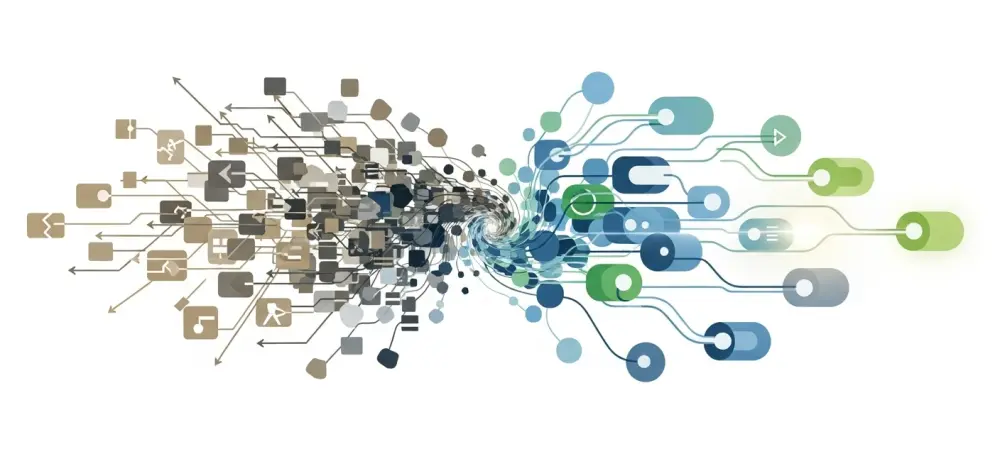
Scaling a business beyond the $10 million revenue mark often feels like navigating a vessel through a thickening fog where the instruments that once guided the ship suddenly become unreliable. As organizations move through this developmental phase, they frequently enter a state of operational limbo, a precarious zone where existing manual processes and entry-level accounting software can no longer sustain the weight of increased transaction volumes and organizational complexity. This friction is particularly acute for companies situated between $10 million and $75 million in annual revenue, where the systems that facilitated initial success now act as anchors, preventing the very agility required for the next stage of evolution.
The digital transformation of mid-sized enterprises has transitioned from a discretionary technical upgrade to a non-negotiable survival necessity in an increasingly interconnected global economy. Modern firms no longer view a robust Enterprise Resource Planning (ERP) system as a luxury for the distant future but as a foundational requirement for maintaining market relevance and operational integrity. This analysis explores the deepening “ERP Gap,” examining why entry-level tools fail at scale and how the strategic adoption of agile solutions like Microsoft Dynamics 365 Business Central provides a necessary bridge for businesses striving to move beyond administrative stagnation.
Identifying the ERP Gap and Current Market Shifts
Data-Driven Evolution: Why Mid-Market Firms Are Migrating
As companies approach the $10M–$75M revenue threshold, they typically experience a significant spike in ERP adoption driven by the sheer exhaustion of manual data management and fragmented reporting. Recent market data indicates that firms in this bracket often encounter a “Manual Consolidation Tax,” where finance departments lose upwards of forty hours per month simply reconciling disparate spreadsheets that have outgrown their original utility. This inefficiency is a primary catalyst for migration, as leadership teams recognize that human capital is being wasted on clerical error-correction rather than high-level strategic forecasting or market expansion.
Furthermore, statistics regarding the “Time to Value” metric have reshaped how mid-market firms evaluate potential software investments in the current landscape. Unlike the traditional enterprise model where implementation could span multiple years, today’s migrating firms prioritize systems that offer rapid deployment and immediate operational relief. Recent trends suggest that the success of a transition is now measured by how quickly a platform can standardize core accounting and reporting functions, rather than by an exhaustive list of complex features that may remain unused for years.
Practical Implementations: Transitioning From Entry-Level to Scalable Systems
Real-world applications in distribution and light manufacturing sectors have demonstrated that replacing fragmented “bolt-on” tools with a unified ERP significantly reduces the friction of daily operations. For instance, companies that previously relied on separate systems for inventory, sales, and accounting often struggled with delayed visibility and mismatched data across departments. By consolidating these functions into a single environment, these firms achieve a unified version of the truth, allowing for more precise decision-making and a dramatic reduction in redundant data entry.
The “Microsoft Ecosystem” effect plays a pivotal role in this transition, as familiar tools like Excel and Teams serve as a bridge toward higher system adoption across the entire workforce. When employees can leverage native integrations to pull data directly from their ERP into familiar formats, the cultural resistance to new technology diminishes significantly. This shift is essential for distribution firms that require automated multi-warehouse management and landed cost tracking to maintain profitability, ensuring that inventory transparency and audit compliance are built into the workflow rather than being managed through manual workarounds.
Expert Insights on Navigating the Enterprise Trap
Implementation consultants frequently warn against the “Enterprise Trap,” a phenomenon where mid-sized firms over-invest in Tier 1 systems like SAP or Oracle before their internal infrastructure is truly ready. The risks associated with this premature move include excessive operational rigidity and a high cost-to-utility disparity, where a company pays for global-scale features it may not need for a decade. Experts suggest that the administrative overhead required to maintain these enterprise systems can paradoxically slow down a growing company, replacing one form of paralysis with a much more expensive version.
Moreover, thought leadership in the sector emphasizes the growing necessity of immutable audit trails and sophisticated governance as companies move toward institutional maturity. As a business seeks external funding or prepares for potential acquisition, the ability to demonstrate a clean, automated financial history becomes a major asset rather than a back-office requirement. Professionals argue that selecting a mid-market system that balances this need for rigorous control with operational flexibility is the most effective way to avoid the enterprise trap while still preparing for future complexities.
The Future of Scalable Business Infrastructure
The role of AI-driven demand planning and real-time data visualization is projected to become the standard for mid-market operations as companies seek to automate predictive analytics. Through tools like Power BI, companies are gaining access to enterprise-grade analytics that allow them to spot trends and identify inefficiencies with unprecedented speed. This shift toward “future-proof” cloud environments ensures that modular complexity can be added as needed, preventing the costly cycle of total system replacement every few years and allowing a business to scale its digital infrastructure in lockstep with its revenue growth.
Global competitiveness is also set to increase as mid-market firms gain access to these sophisticated tools at a fraction of their historical cost. However, this transition toward integrated cloud environments brings the ongoing challenge of cybersecurity and data integrity to the forefront of executive concerns. Protecting sensitive financial data and maintaining system uptime are now central components of any ERP strategy, requiring a delicate balance between accessibility for remote teams and the stringent security protocols necessary to safeguard the organization’s intellectual and financial property.
Final Assessment: Bridging the Gap for Long-Term Success
The analysis of the mid-market transition highlighted the critical balance required between cost, capability, and compatibility. It was established that the ERP Gap represented a period where internal growth outpaced technological support, necessitating a move toward more robust infrastructure. The findings suggested that the most successful organizations were those that recognized the limitations of entry-level software early and chose a scalable path that did not sacrifice agility for the sake of enterprise prestige.
The choice of an ERP was identified as a strategic pivot that determined whether a company would scale effectively or suffer from internal paralysis. By adopting platforms that offered enterprise-grade features within a mid-market framework, leadership teams positioned their organizations for sustainable growth. It was recommended that firms performed formal readiness assessments to ensure that their technological investments aligned with their long-term revenue targets and operational capabilities, ultimately providing the stability needed to bridge the gap toward institutional excellence.