

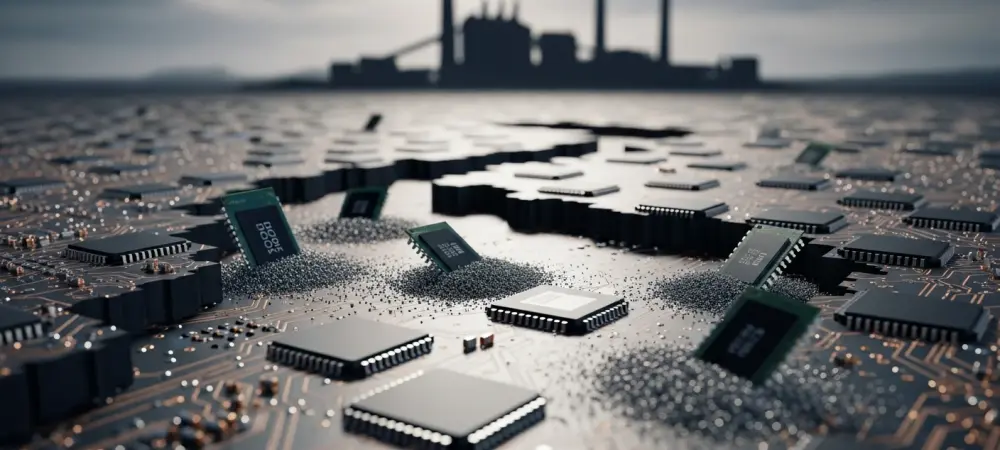
The global semiconductor landscape stands at a precarious crossroads where the relentless hunger of artificial intelligence applications is beginning to strip away the foundational capacity once reserved for everyday consumer technology. As the industry moves toward 2027, the divergence between advanced AI hardware and standard components is creating a structural imbalance. This shift is not merely a temporary supply chain hiccup but a fundamental realignment of manufacturing priorities that threatens the stability of global electronics.
The Divergence of Supply and Demand in the AI Era
Quantifying the Impending 2027 Shortfall
Current market data reveals a staggering gap between the 12% annual growth in total wafer supply and the 22% surge in enterprise demand. This friction arises because High Bandwidth Memory, or HBM, now consumes nearly 50% of all new production capacity across major fabs. Consequently, the bit growth for non-HBM DRAM is projected to stall at only 15%, which is insufficient for the broader consumer market.
Furthermore, the surge in AI-driven requirements means that the traditional data center market is competing directly with smartphone and PC manufacturers for the same silicon wafers. This competition creates a deficit where standard memory chips are sacrificed to fuel the AI revolution, leading to a permanent tightening of the available supply.
Strategic Infrastructure and Capacity Expansion
To address this deficit, Samsung has designed a roadmap to scale HBM shipments to 20 billion Gb by 2027, largely through the activation of its P5 Fab 1 facility. This expansion is critical to maintaining the momentum of high-performance computing as the current 12 billion Gb output becomes obsolete. Meanwhile, SK hynix is investing heavily in the Yongin Y1 fab, aiming to deliver 24 billion Gb of specialized memory by early 2027. While China’s CXMT attempts to bridge the gap with DDR6 transitions, these massive infrastructure projects may not stabilize the global market before the projected 2027 bottleneck.
Expert Perspectives on Structural Industry Shifts
SK hynix CEO Kwak Noh-jung has highlighted the “cannibalization” of standard DRAM production lines as manufacturers prioritize AI-optimized hardware. This strategic pivot indicates that specialized silicon is no longer a niche requirement but a dominant force that creates a long-term imbalance in the supply chain.
Industry leaders argue that the current fabrication timelines are so tight that any delay in new facility construction will result in a global productivity stall. The consensus suggests that the transition to AI-centric hardware is irreversible, leaving traditional memory markets under-supplied for the foreseeable future.
Future Implications for the Global Technology Landscape
The resulting “memory chipflation” will likely reshape the cost structures of data centers and personal computing devices. Manufacturers may face extended lead times and significant price volatility as they compete for limited resources, making consumer electronics more expensive for the end user.
However, the massive capital expenditure in new facilities promises a more resilient, AI-centric supply chain eventually. This period of constraint will force businesses to adopt new inventory strategies, ensuring that hardware availability dictates the pace of technological innovation rather than software capabilities.
Conclusion: Adapting to a Supply-Constrained Market
The critical drivers of the 2027 memory deficit were identified as the aggressive prioritization of HBM over standard DRAM. Industry stakeholders recognized that a lack of diversified production strategies led to a significant market stall during the transition. Businesses finally prepared for a future where high-performance hardware availability governed the overall pace of technological progress.