

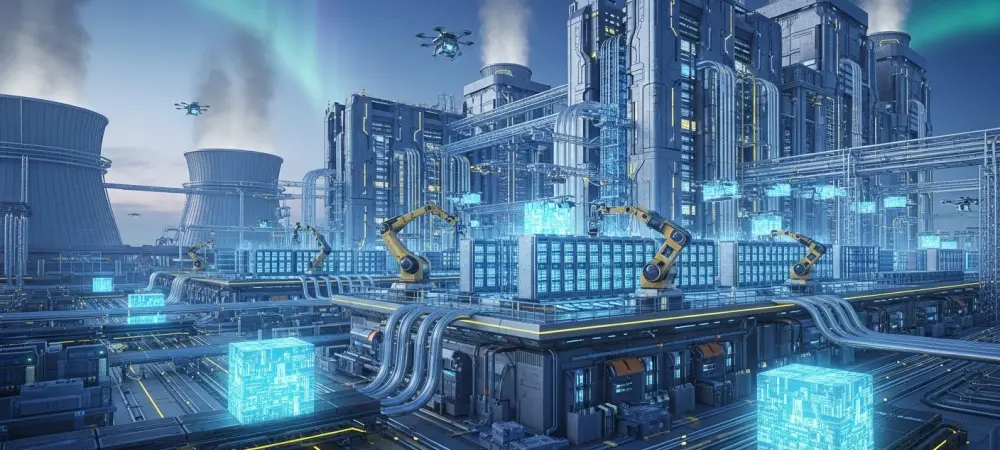
The raw power of computational silicon has moved beyond the laboratories of research scientists and into the massive, humming halls of global industrial production centers. This transition signifies the birth of a new era where artificial intelligence is no longer an experimental luxury but a standardized utility, comparable to electricity or high-speed telecommunications. As organizations move toward this industrialized model, the focus is pivoting from the sheer act of building intelligence to the high-velocity deployment of that intelligence at scale. The infrastructure supporting this shift is becoming more sophisticated, moving toward a unified ecosystem that integrates compute, networking, and storage into a single, seamless fabric.
The Shift Toward Industrial-Scale AI Production
Market Dynamics and the Transition to Inferencing: Scaling for 2027
The global landscape of artificial intelligence is currently undergoing a massive structural realignment, with Nvidia projected to reach a staggering $1 trillion in revenue potential by 2027. This financial trajectory is driven not just by the sale of individual components, but by the widespread adoption of comprehensive “AI Gigafactories” that serve as the backbone for modern computation. While the previous few years were dominated by the heavy lifting of model training, the current focus has shifted toward distributed inferencing. This stage represents the monetization phase of the technology, where models are put to work generating real-time predictions and interactions for millions of users simultaneously.
Adoption statistics across various sectors indicate that the pivot toward real-time prediction generation is now the primary driver of enterprise value. Organizations are no longer content with static models; they require dynamic, xPU-powered integrated systems that can handle fluctuating workloads with minimal latency. This transition toward inferencing is fundamentally changing the way data centers are designed, moving away from centralized silos and toward a distributed model where computation happens as close to the data source as possible. The result is a global network of intelligence that is constantly active, processing trillions of tokens and providing actionable insights across every conceivable industry.
Moreover, the scaling of these integrated systems has led to a standardization of hardware that was previously unheard of in the tech sector. The hardware once reserved for elite research institutions is now being deployed in standard enterprise racks, allowing even mid-sized companies to harness the power of industrial-scale AI. This democratization of high-performance compute is accelerating the development of new applications, ranging from autonomous logistics to real-time financial fraud detection. As the infrastructure matures, the barrier to entry continues to drop, further fueling the expansion of the “AI Factory” model as the new standard for global business operations.
Real-World Applications and Architectural Innovation: Building the AI Factory
Industry leaders like Dell and Lenovo are at the forefront of this architectural revolution, implementing “AI Factory” frameworks that have already demonstrated documented returns on investment of nearly 3x for early adopters. These implementations are not merely about adding faster chips; they represent a total reimagining of the data center. By integrating specialized hardware like the Groq 3 LPX and BlueField-4 DPUs, these companies are overcoming the traditional compute bottlenecks that have long plagued high-velocity data environments. This integration allows for a massive increase in token production velocity, ensuring that AI agents can respond with the speed and accuracy required for mission-critical applications.
The integration of advanced networking components is equally vital in this new architectural paradigm. High-velocity data environments require more than just raw processing power; they need a sophisticated data highway that can transport information without congestion. The use of BlueField-4 DPUs allows for the offloading of networking and security tasks from the main processor, freeing up valuable compute cycles for AI workloads. This creates a more efficient ecosystem where every component is optimized for maximum throughput. These innovations are enabling enterprises to move past the experimental stage and into full-scale production, where AI is integrated into the very fabric of their daily operations.
Simultaneously, edge computing initiatives such as Akamai’s “AI Grid” are bringing this industrial-scale intelligence closer to the end-user than ever before. By utilizing thousands of Blackwell GPUs across global locations, Akamai is creating a distributed network that minimizes the physical distance data must travel. This edge-centric approach is crucial for applications that require near-instantaneous response times, such as augmented reality or autonomous vehicle navigation. By moving the “brain” of the AI closer to the “eyes” and “ears” of the edge devices, these initiatives are setting the stage for a world where intelligent responsiveness is a ubiquitous feature of the digital landscape.
Expert Perspectives on Tokenomics and Ecosystem Maturity
The Metric of the ErJensen Huang on Tokenomics
In the current technological landscape, the fundamental business metric has evolved from traditional data throughput to what industry experts, including Jensen Huang, call “Tokenomics.” This framework treats the “token”—the basic unit of AI-generated text or data—as a tangible commodity that must be produced, managed, and optimized. In this era, the capacity of an organization is increasingly measured by its ability to generate and process these tokens efficiently. This conceptual shift allows businesses to apply rigorous economic principles to their AI deployments, moving away from vague notions of “intelligence” and toward concrete measurements of production and value.
The maturity of the AI ecosystem is further evidenced by the way technical throughput is being translated into tangible corporate Key Performance Indicators. Chief Experience Officers are now being tasked with managing “token budgets,” a practice that mirrors the management of financial capital or bandwidth. By viewing AI capacity as a finite and valuable resource, organizations can prioritize high-value tasks and ensure that their computational investments are yielding the maximum possible return. This professionalization of AI management is a clear sign that the industry has moved past the initial hype and into a phase of disciplined, strategic execution.
Furthermore, the rise of Tokenomics is driving a new wave of innovation in how AI services are priced and consumed. Instead of simple subscription models, we are seeing the emergence of more granular, usage-based systems that reflect the actual computational cost of each interaction. This shift is encouraging developers to create more efficient models and prompting enterprises to be more thoughtful about how they deploy AI agents. As the industry settles on these new economic standards, the focus will continue to sharpen on the balance between the quality of the output and the cost of the tokens required to produce it.
NeuralMesh and the Necessity of Inference Network Fabrics
Networking and storage specialists are increasingly emphasizing that raw compute power is useless without a sophisticated fabric to connect and feed it. The concepts of “Inference Network Fabrics” and “NeuralMesh” have emerged as the necessary infrastructure to sustain industrial-grade workloads. Unlike traditional networks, these fabrics are designed specifically for the unique traffic patterns of AI, which involve massive bursts of data and the need for extreme synchronization between thousands of processing units. Without these specialized connections, the most advanced GPUs in the world would spend more time waiting for data than actually processing it.
The development of NeuralMesh architectures represents a significant leap forward in storage technology, creating a high-performance, scalable data pipeline that can keep up with the demands of modern xPUs. This approach treats memory and storage as a unified grid, allowing for the rapid movement of data across the entire system. By eliminating the silos that traditionally separate compute from storage, NeuralMesh ensures that AI models have constant, low-latency access to the information they need to function. This level of integration is essential for supporting complex, multi-agent workflows where data must be shared and processed in real-time across a distributed environment.
Moreover, the emergence of these specialized fabrics is fostering a more collaborative ecosystem where hardware and software are co-designed for maximum efficiency. Networking companies are working closely with silicon manufacturers to ensure that every switch and cable is optimized for the specific requirements of AI traffic. This holistic approach is moving the industry toward a future where the entire data center operates as a single, giant computer. As these “Inference Network Fabrics” become the standard, the focus will shift from individual component performance to the overall efficiency and reliability of the entire computational grid.
Future Projections and the Transition from Hype to Utility
Standardizing the Agentic Future: From PoC to OpenClaw
The transition from experimental AI Proofs of Concept to standardized, industrialized workflows is being accelerated by the adoption of robust governance frameworks. Initiatives like OpenClaw are providing enterprises with the tools they need to build and manage AI agents in a secure, controlled environment. These frameworks are essential for moving beyond simple chatbots and toward complex “agentic” workflows, where AI systems can autonomously perform tasks, make decisions, and interact with other systems. By providing a clear set of rules and protocols, OpenClaw is helping to ensure that these autonomous agents operate reliably and within the boundaries of corporate policy.
As these agentic workflows become more common, the industry is seeing a shift toward hybrid environments where cloud-native and virtual compute must coexist. Many organizations are finding that a one-size-fits-all approach to AI infrastructure is insufficient for their needs. They require the flexibility to run some workloads in the public cloud for maximum scalability, while keeping others on-premises or at the edge for security and latency reasons. Managing this complexity requires a new generation of orchestration software that can seamlessly move agents and data across diverse environments, ensuring that the right resources are always available for the task at hand.
The Broader Implications of an “Intelligent AI Grid” also involve addressing significant challenges, such as the massive energy consumption required to power these industrial-scale operations. As the demand for tokens continues to grow, the industry must find ways to reduce the environmental impact of its computational needs. This involves not only creating more energy-efficient silicon but also optimizing the cooling and power management systems of the data centers themselves. The democratization of high-velocity compute depends on the ability to make these systems sustainable in the long term, ensuring that the benefits of the AI revolution are not outweighed by its environmental costs.
Evaluating the AI Wave: Performance-Based Outcomes
The current trajectory of the AI sector suggests that we are witnessing a sustainable technological wave rather than a speculative bubble. Unlike the “dot-com” era, where many companies lacked a clear path to profitability, the current AI buildout is supported by documented performance-based outcomes and tangible ROI. The monetization phase of model deployment is already underway, as enterprises across every sector utilize AI to streamline operations, enhance customer experiences, and develop new products. This focus on utility and measurable value is a strong indicator that the current investment in infrastructure is built on a solid foundation.
Moreover, the shift from training to inferencing represents a maturing of the market, where the focus moves from “learning” to “doing.” The models that were built at great expense over the last few years are now being put to work in the global economy, generating value and driving further investment in the infrastructure required to sustain them. This cycle of innovation and deployment creates a powerful momentum that is likely to continue for years to come. As the cost per token continues to drop, the range of viable AI applications will only expand, further cementing the role of high-velocity compute as a fundamental component of modern civilization.
Ultimately, the democratization of high-velocity compute will be the defining characteristic of this new industrial era. As the technology becomes more accessible and affordable, we can expect to see a surge in innovation from smaller players and emerging markets. This global expansion of intelligence will drive progress in fields as diverse as healthcare, education, and environmental science, providing the tools needed to solve some of the world’s most pressing challenges. The transition from hype to utility is not just a business trend; it is a fundamental shift in the way humanity interacts with information and technology.
Conclusion: The New Standard for Global Intelligence
The transformation of AI infrastructure from specialized, niche hardware into a ubiquitous and industrialized ecosystem marked a definitive turning point in the history of computation. This evolution moved the focus away from the speculative potential of intelligent machines and toward the practical, high-velocity production of tokens as the primary output of the modern enterprise. Organizations that successfully optimized their infrastructure for token velocity and efficiency secured a significant competitive advantage, allowing them to respond to market shifts with unprecedented speed and accuracy. The “AI Factory” model emerged as the new gold standard for industrial-scale intelligence, providing a scalable and reliable framework for the deployment of sophisticated agentic workflows across the globe.
Strategic investments in distributed architectures and edge-centric computing ultimately paved the way for a more resilient and responsive global intelligence grid. By bringing inferencing closer to the end-user, the industry successfully minimized latency and unlocked a new generation of real-time applications that were previously impossible. This shift also highlighted the critical importance of a holistic approach to data center design, where networking, storage, and compute were treated as a single, integrated fabric. The move toward this edge-centric future ensured that intelligence was not just centralized in a few massive hubs but was instead woven into the very fabric of daily life, democratizing access to high-performance computation for everyone.
As the AI revolution matured, the industry moved past the initial challenges of energy consumption and cost, finding sustainable ways to power the global intelligent grid. The focus shifted toward the long-term governance of AI agents and the ethical implications of a world where autonomous systems played an increasingly prominent role in decision-making. The transition from experimental proofs of concept to standardized, industrial-scale utility was completed, leaving behind a world where intelligence was as accessible and reliable as any other essential service. This new standard for global intelligence redefined the limits of human achievement, providing the foundational infrastructure for a future limited only by the boundaries of collective imagination.