

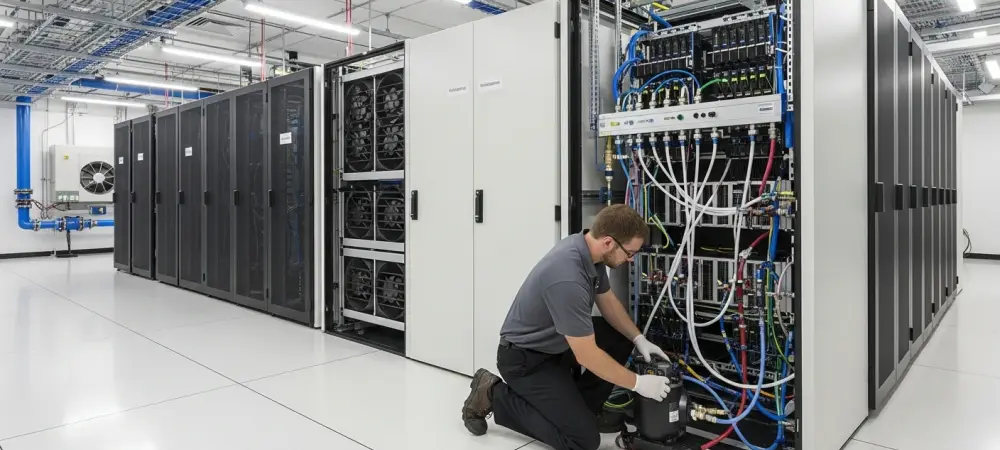
AI-scale heat now arrives faster than facility upgrades can catch up, pushing operators to blend air and liquid in the same white space to tap stranded power, protect SLAs, and stretch budgets without gutting mechanical plants. This hybrid path preserves existing assets, trims PUE and WUE, and redirects CAPEX toward compute, not wholesale rebuilds.
Why Hybrid Cooling Is Accelerating in the AI Era
Hybrid cooling gained momentum as rack densities leapt to 30–80 kW, with >100 kW designs on deck. Legacy rooms stay viable when liquid targets hotspots while efficient air handles the rest.
Adoption Signals, Densities, and Performance Benchmarks
Surveys from Uptime Institute and hyperscaler disclosures point to pilots of rear-door heat exchangers, direct-to-chip, and immersion, often side by side. ASHRAE TC 9.9 and OCP/OAI mechanicals anchor designs that keep server inlet temps within spec.
Retrofits show lower PUE than pure air and better WUE with dry or adiabatic assist, especially when compressors are eliminated. Reliability improves as short-cycling falls and MTTR drops through modular, rack-bound components.
How Hybrid Strategies Are Deployed in Practice
Operators stage upgrades: efficient air for mid-density rows, liquid at racks or servers where AI heat spikes. Mixed halls pair RDHx at 20–50 kW with D2C for >60 kW pods, avoiding plant upheaval.
Airsys’s LiquidRack brings rack-level distribution, pumps, and controls to each server, skipping separate CDUs and easing tie-ins. It uses a dielectric spray on vertical, waterproof servers, moves heat through a plate exchanger to facility water, and rejects via dry coolers—compressor-free and fluid-light versus immersion.
Airsys’s UniCool-Max extends air-cooled envelopes to 60 kW, avoiding on/off compressor stress to lift lifecycle reliability. Sites that remain air-first can still meet rising loads while planning liquid pilots.
Voices From the Field: Expert and Operator Perspectives
Operators prize speed, facility safety, and serviceability: no major plant changes, dripless quick-connects, and pump swaps without draining loops. Analysts warn that TCO over a decade beats nameplate metrics, and that leak isolation and telemetry matter as much as kilowatts.
Vendors emphasize motherboard, NIC, and cold-plate interoperability, with modular, factory-integrated kits reducing site risk. Regulation tightens on refrigerants and water, nudging dry/adiabatic and compressor-free loops.
What’s Next: Design Trajectories, Risks, and Opportunities
Technical Roadmap for Hybrid Cooling
Expect deeper rack integration of pumps, exchangers, and controls, plus interchangeable manifolds and quick-connects. Fluids evolve toward lower-GWP and better thermal sprays, while AI-driven controls tune setpoints to workload bursts.
Operational, ESG, and Risk Considerations
Leak containment at rack boundaries, electrical isolation, and N+1 pumps protect uptime. Tracking WUE with PUE, shifting to dry assist, and training techs on liquid handling close the skills gap.
Economics, Procurement, and Phased Adoption
Business cases lean on CAPEX deferral by reusing air assets and OPEX cuts from compressor-free heat rejection. Phasing starts with audits, then small liquid pilots, pod expansion with BMS/DCIM hooks, and finally standardization.
Conclusion and Action Plan
Hybrid cooling proved to be the fastest bridge from air to liquid, unlocking density while preserving facilities. The next steps included mapping hotspots, piloting rack-level liquid with clear KPIs, training teams, and aligning procurement to reliability SLAs and ESG targets—laying the literal plumbing for liquid-first builds without stalling AI growth.