

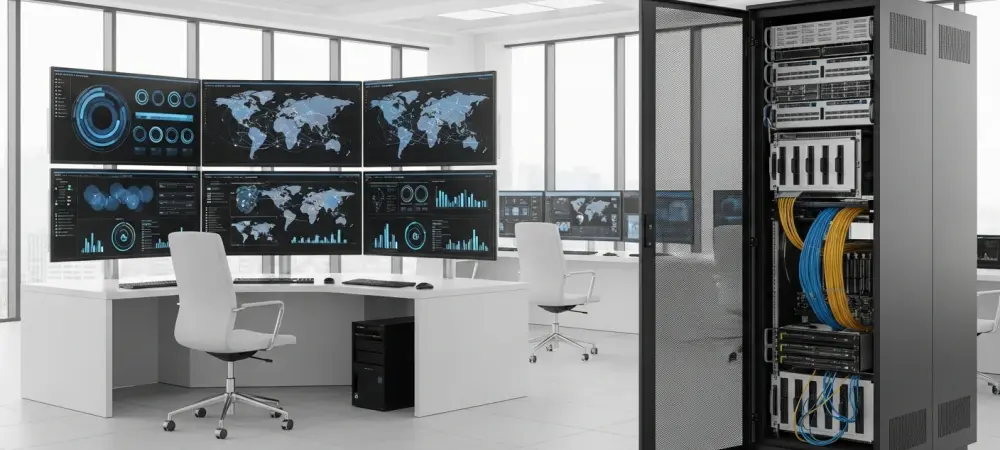
As global enterprises face the dual pressure of digital transformation and strict data sovereignty, the “all-or-nothing” approach to cloud migration is fading in favor of a more sophisticated middle ground. This evolution reflects a growing realization that while the cloud offers unparalleled administrative flexibility, the physical reality of security—massive video files, high-bandwidth requirements, and the need for local autonomy—demands a sturdier foundation. For regulated industries and large-scale corporations, this shift toward hybrid cloud physical security represents a pivotal moment, allowing for centralized management without sacrificing the reliability of local hardware. This analysis explores the rising adoption of hybrid models, examines the impact of high-density appliances like the Genetec Cloudlink 2210, and discusses how this trend balances operational resiliency with long-term scalability.
The Accelerating Shift Toward Hybrid Security Architecture
Market Momentum and Adoption Drivers for Hybrid Systems
The current security landscape is witnessing a decisive move toward “cloud-managed” rather than “cloud-only” solutions, primarily driven by the economic realities of data storage. While initial cloud enthusiasm suggested that everything would eventually live in a remote data center, the high costs of long-term cloud storage for high-definition video have forced a strategic rethink. Organizations are finding that maintaining local retention for the “heavy lifting” of video data is significantly more cost-effective than paying recurring monthly fees for off-site storage that consumes massive amounts of bandwidth.
Moreover, infrastructure consolidation has become a priority for multi-site corporations that need to unify fragmented legacy systems. In sectors like finance and healthcare, the adoption of high-capacity local retention is not just a preference but a necessity to satisfy data-residency requirements. These organizations must keep sensitive data within specific geographic or physical boundaries while still providing security teams with the ability to maintain cloud-based oversight from a central headquarters.
Real-World Integration: The Genetec Cloudlink 2210 in High-Density Environments
Bridging the gap for large-scale enterprises requires hardware that can handle intense workloads without faltering. The Genetec Cloudlink 2210 acts as this essential bridge, unifying video management, access control, and intrusion detection on a single 2U rack-mount appliance. By centralizing these core security functions, it eliminates the “silo” effect where different security components operate on incompatible hardware. This unification allows security operators to manage an entire campus or a global network of offices through a single interface, even if the physical devices are spread across different continents.
High-density storage applications are particularly well-served by this hybrid approach, especially in environments where extensive retention is mandatory. With a capacity of up to 240TB, the Cloudlink 2210 provides the localized power needed to store months of high-resolution footage. This is especially useful during phased rollouts, where an organization might not be ready to replace every legacy camera. An open-architecture design allows these older assets to be integrated into modern cloud workflows, extending the life of existing investments while still moving the management layer to the cloud.
Expert Perspectives on Operational Resiliency and Cybersecurity
The concept of “operational certainty” has emerged as a cornerstone of modern hybrid architecture. Security professionals argue that a system is only as good as its performance during a crisis, which often includes network or cloud connectivity outages. By utilizing RAID protection and redundant components, hybrid appliances ensure that local recording and access control continue to function even if the link to the external world is severed. This local autonomy provides peace of mind that a simple internet flicker will not leave a facility vulnerable.
From a cybersecurity standpoint, experts increasingly advocate for network isolation to protect sensitive security traffic. By segmenting security data from broader corporate streams, organizations can significantly reduce their attack surface. This architectural choice prevents a breach in a standard office workstation from easily migrating to the surveillance or badge-reader system. Incremental modernization is viewed as superior to “rip-and-replace” strategies because it allows for these security improvements to be implemented without the downtime associated with a total system overhaul.
Navigating the Future of Physical Security Modernization
As physical footprints expand, the evolution of “stackable” security solutions will likely define how organizations scale their capacity. Rather than replacing a central server every time a new wing is added to a building, modular units allow for a pay-as-you-grow model. However, this diversity of hardware brings challenges, particularly in managing complex firmware updates across a vast estate. The future of the industry will rely on automated tools that can push updates to local appliances from a central cloud dashboard, ensuring that every node in the network remains protected against the latest digital threats.
The role of third-party integration remains a critical factor in preventing vendor lock-in. By favoring open-architecture systems, security leaders ensure they can pivot to new technologies as they emerge without being forced to discard their entire infrastructure. This flexibility supports long equipment replacement cycles, which is vital for maintaining budget stability. Balancing the benefits of centralized administrative control with the necessity of local autonomous processing ensures that the system remains both agile and resilient, regardless of external network conditions.
Final Reflections on Bridging the Gap Between On-Premises and Cloud
The emergence of hybrid models successfully redefined enterprise security by marrying local processing power with the agility of the cloud. This architecture proved that organizations no longer had to choose between the security of on-premises hardware and the convenience of remote management. Systems like the Cloudlink 2210 set a new standard for high-density environments, proving that data sovereignty and system uptime could coexist in a single, streamlined workflow.
Looking ahead, the most successful security leaders prioritized flexible and resilient architectures that could adapt to shifting regulatory and technological landscapes. The focus moved toward building a “future-proof” foundation that supported incremental updates and modular scaling. By embracing a hybrid roadmap, integrators and stakeholders ensured that their physical security systems remained as dynamic as the digital environments they were designed to protect.