

The relentless expansion of our digital universe demands a storage revolution, a call that holographic technology, once a distant dream, is now poised to answer with tangible innovation. As the digital world expands at an unprecedented rate, the search for a durable, high-capacity, and cost-effective archival storage solution has become more critical than ever. For decades, holographic data storage has been a promising but commercially elusive technology. Now, with new innovations and a pragmatic approach to market entry, it is re-emerging as a serious contender to magnetic tape’s long-standing dominance. This analysis explores the current trends driving the resurgence of holographic storage, examines its real-world applications, weighs expert opinions on its viability, and projects its future impact on the data-driven world.
Market Drivers and Real-World Application
The Data Deluge Fueling Demand for Next-Generation Storage
The relentless growth of data is placing immense strain on traditional archival technologies, with projections indicating a staggering 12-fold increase in original data creation over the next decade. This exponential curve creates a clear market need for solutions that offer superior data density and longevity. Current magnetic tape media, the established workhorse of cold storage, is susceptible to degradation over time and requires costly, labor-intensive periodic data migration to ensure long-term integrity, a process that becomes increasingly untenable at the zettabyte scale.
This pressure is forcing a shift in how large-scale data operators evaluate their infrastructure. Companies are increasingly focused on the Total Cost of Ownership (TCO), a metric that encompasses not just the initial hardware purchase but also long-term energy, maintenance, and migration expenses. This creates a significant opening for new technologies that promise sustained savings. HoloMem, a key industry player, projects its holographic solution will deliver a TCO approximately 20% lower than the latest magnetic tape generation. The primary market for such an innovation is highly concentrated, focusing not on average enterprises but on a select group of hyperscalers and institutions with massive archival needs, such as national libraries and long-term medical research facilities.
Case Study HoloMem’s Backward-Compatible Breakthrough
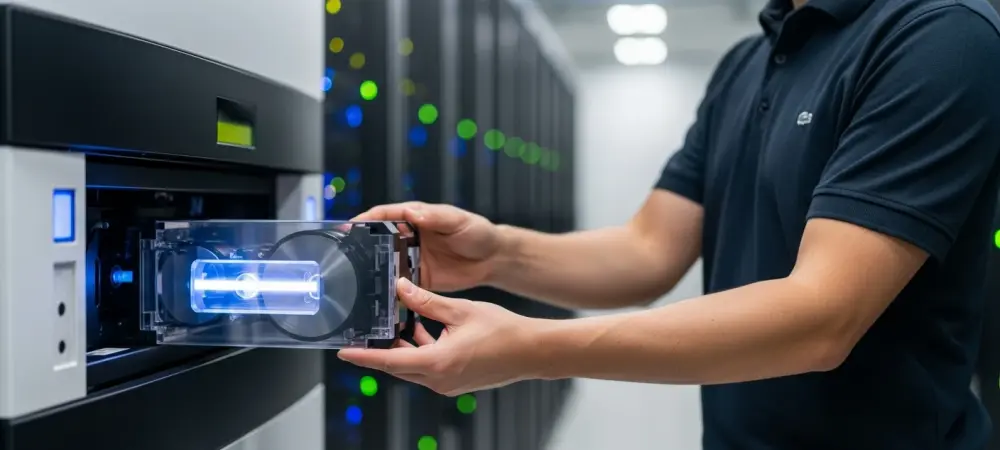
HoloMem Ltd., a UK-based startup, is pioneering a practical approach to this challenge with its HoloDrive system, which is cleverly designed for seamless integration into existing data center infrastructures. The company’s core innovation is a holographic storage cartridge that mimics the physical form factor and communication protocols of traditional LTO tape. This strategic design choice cleverly eliminates the need for a costly and disruptive “rip and replace” overhaul for adopters, allowing for a gradual and manageable transition to the new technology.
A successful trial in December 2025 at BDT Media Automation GmbH served as a crucial proof-of-concept, demonstrating that a working HoloDrive could operate flawlessly within an existing tape library. This milestone validated the system’s core value proposition of backward compatibility. Moreover, the technology offers significant advantages over its predecessors, including a 50-year media lifespan that drastically reduces migration cycles. Its ability to record data in three dimensions—a process known as volumetric storage—provides vastly superior data density, while robust encryption at the drive level ensures comprehensive data protection from the moment of creation.
Industry Voices Cautious Optimism from the Experts
Despite these promising developments, a healthy dose of skepticism persists within the industry. According to Forrester principal analyst Brent Ellis, the history of holographic storage is marked by decades of ambitious development without widespread commercial adoption. This long gestation period has created a natural and understandable caution toward new entrants, regardless of the elegance of their solutions. Experts point out that any new system must not only promise but prove it can meet or exceed the performance benchmarks of established standards like LTO-10.
Several critical hurdles must be overcome on the path to market acceptance. The write speed of holographic storage, for instance, remains a potential performance bottleneck that must be definitively addressed. Furthermore, Ellis views the goal of achieving mass production by 2027 as “highly ambitious.” Incumbent tape manufacturers have deeply entrenched, mature, and highly efficient production processes that have been refined over many years. Any new entrant will face a significant “proving period” to work out unforeseen manufacturing challenges and reliability issues at scale.
While the target market of hyperscalers is small in the number of clients, their purchasing volume is enormous, a factor that could play in a newcomer’s favor. The consensus among analysts is that securing even one or two of these major customers could be enough to ensure a new technology’s commercial success. The entire industry is therefore watching closely to see if a major cloud provider will make the first move, a decision that could trigger a wider shift in archival strategy.
Future Outlook The Road Ahead for Holographic Storage
The future success of holographic storage hinges on its ability to make the critical transition from successful demonstrations to a reliable, mass-produced product. This challenging next step involves scaling a complex manufacturing process while consistently delivering on an aggressive performance roadmap. Innovators in the space must prove that their technology is not just a laboratory marvel but a robust, enterprise-grade solution ready for the demanding environment of a modern data center.
Should it succeed, the potential benefits are transformative. Holographic media could offer a “write once, read forever” solution, drastically reducing the long-term management costs and risks associated with data migration. This durability makes it an ideal candidate for the zettabyte-scale archives of the future, where data must be preserved securely for decades or even centuries. The broader implication would be a paradigm shift in archival storage, moving the industry from two-dimensional surface media to far more capacious three-dimensional volumetric media.
However, key challenges remain in convincing a traditionally conservative market to invest capital and trust in a new technology. HoloMem and other innovators must overcome the weight of historical skepticism and prove their solutions are not just technologically superior but also operationally and financially sound. Their success would fundamentally alter the economics and capabilities of long-term data preservation for cloud providers, scientific research, and cultural heritage institutions alike, securing digital information for generations to come.
Conclusion A New Chapter in the Data Storage Saga
Holographic data storage, led by innovators like HoloMem, has re-emerged with a pragmatic, integration-focused strategy that may finally unlock its long-awaited commercial potential. By offering superior longevity, massive capacity, and a lower total cost of ownership in a backward-compatible format, it presented a compelling alternative to magnetic tape. The technology directly addressed the critical need for a sustainable long-term solution in an era of exponential data growth. While significant challenges related to performance, manufacturing scale, and market adoption remained, the coming years have become pivotal in determining whether holographic storage will move from a perennial “technology of the future” to an essential tool for the present.