

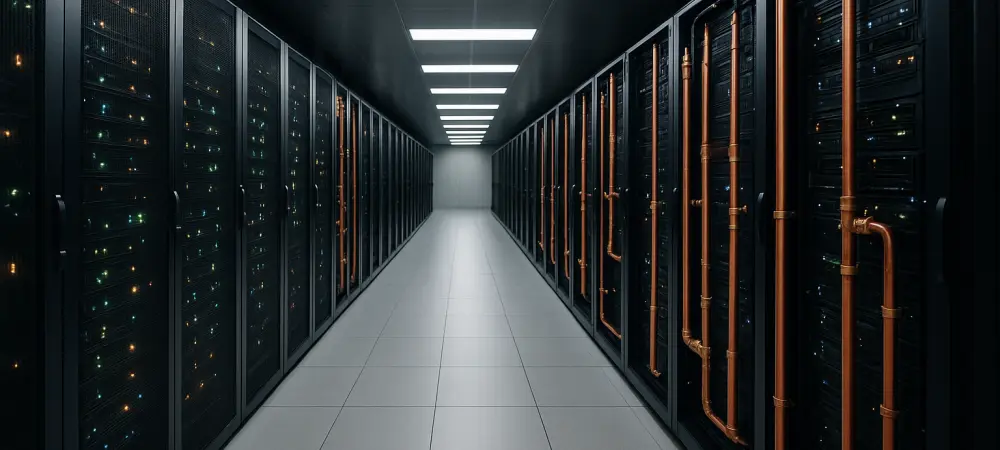
The exponential surge in artificial intelligence workloads has forced a radical rethink of the infrastructure required to prevent massive server farms from overheating during peak processing periods. As AI “factories” push power densities to unprecedented levels, the data center industry is facing a cooling paradox where saving the planet’s water may necessitate turning up the heat inside the server room. Traditional air-cooling methods are rapidly reaching their physical limits, making the adoption of high-temperature liquid cooling a vital strategy for balancing raw computational performance with increasingly strict environmental stewardship mandates.
This analysis explores the systemic transition from conservative 32°C cooling loops to more aggressive 45°C supply temperatures. This shift is not merely a technical adjustment but a fundamental change in data center philosophy that impacts Water-Usage Effectiveness (WUE), economic provisioning strategies, and the long-term reliability of high-end silicon. By analyzing current infrastructure trends from 2026 to 2030, a clear picture emerges of a sector moving toward “warm-water” designs to bypass the constraints of water scarcity and energy inefficiency.
The Rise of Warm-Water Liquid Cooling in AI Infrastructure
The move toward warm-water liquid cooling is primarily a response to the massive thermal output of next-generation GPU clusters. As these chips consume more power, the volume of heat they generate becomes too concentrated for air-cooling systems to manage effectively. Consequently, the industry has seen a rapid pivot to liquid-cooled architectures that can absorb and transport heat far more efficiently than air. This transition is essential for facilities that aim to maintain high uptime while scaling their processing capabilities to meet the demands of global AI models.
Furthermore, raising the temperature of the water used in these systems allows for a more sustainable interaction with the external environment. When cooling water is kept at higher temperatures, the difference between the internal system and the outside air increases, facilitating easier heat rejection. This approach enables operators to utilize ambient air for cooling even in warmer climates, reducing the reliance on evaporation-based systems that consume millions of gallons of water annually.
Market Adoption and Efficiency Metrics
Industry data through 2026 indicates a decisive shift toward liquid cooling for high-density racks exceeding 188 kW. Recent modeling suggests that utilizing 45°C supply temperatures can lead to transformative improvements in water conservation across diverse geographic regions. In temperate climates like Paris, this temperature threshold can reduce water consumption by as much as 82%, while even in hotter environments like Dallas, savings of 66% are achievable. These metrics demonstrate that the physics of heat rejection favor those willing to operate closer to the thermal limits of their hardware.
The primary driver behind these statistical benchmarks is the enhanced performance of dry coolers. A higher temperature delta between the liquid cooling loop and the ambient outdoor air allows these dry systems to operate without evaporative water loss for a significantly greater percentage of the year. This shift reduces the “water footprint” of the data center, a metric that has become as critical as electrical efficiency for modern operators. As the industry moves forward, these efficiency gains are becoming the standard benchmark for any new high-density facility construction.
Real-World Applications and Industry Pioneers
Strategic partnerships between infrastructure providers and chip manufacturers have already begun to demonstrate the viability of these high-temperature clusters. Recent implementations involving Nvidia’s Vera Rubin liquid-cooled clusters have shown that running at higher temperatures allows 100-MW facilities to rely almost exclusively on dry cooling in many regions. This setup virtually eliminates the need for mechanical chillers, which are both energy-intensive and expensive to maintain. By bypassing the chiller phase, operators can streamline their mechanical plants and reduce the overall complexity of the facility.
Current infrastructure configurations are evolving into “tunable” sustainability frameworks. Leading providers now offer four-tier cooling models that range from traditional air-cooling for legacy racks to overprovisioned 45°C liquid systems for AI-intensive loads. This modular approach allows global operators to customize their thermal management based on local water costs and environmental regulations. These pioneers are setting the stage for a future where data center design is dictated as much by the local watershed as it is by the proximity to fiber-optic backbones.
Expert Perspectives on Operational Challenges
While the benefits of high-temperature cooling are clear, industry experts point out that these systems introduce new complexities in resource management. The decision to prioritize water savings often involves a complex calculation of capital expenditure versus long-term operational costs. Moving to a 45°C standard is not as simple as adjusting a thermostat; it requires a specialized approach to facility design that can handle higher thermal loads without compromising the stability of the entire infrastructure.
Moreover, the focus of efficiency metrics is broadening. While Power-Usage Effectiveness (PUE) has been the dominant metric for decades, experts suggest that PUE alone is no longer sufficient to measure the true environmental impact of an AI data center. The industry is seeing a shift toward more holistic resource management that includes water consumption and hardware lifecycle costs. This broader perspective is essential for meeting aggressive corporate sustainability goals while maintaining the high availability required by AI clients.
Capital vs. Sustainability: The Economic Trade-Off
Industry specialists emphasize that monumental water savings often require a higher initial investment to overprovision the surface area of dry coolers. To achieve the best results at 45°C, a facility must install more cooling units than a traditional 32°C setup to ensure sufficient heat exchange occurs during peak summer temperatures. This creates a financial tension where the focus shifts from minimizing immediate CapEx to maximizing long-term environmental and social governance (ESG) performance.
This overprovisioning strategy essentially creates a surplus of cooling capacity that remains dormant during cooler months but becomes critical during heatwaves. Operators must justify the cost of this “idle” equipment to investors by pointing to the reduced risk of water-related outages and the lower costs associated with water procurement and treatment. As water rights become more contested in arid regions, the economic argument for high-temperature systems becomes increasingly persuasive, regardless of the higher upfront costs.
Silicon Health and Warranty Risks: Pushing the Envelope
Thought leaders from engineering bodies such as ASHRAE warn that 45°C inlet temperatures push the physical limits of silicon and power distribution components. While next-generation chips are designed for these environments, operating at the top end of the ASHRAE A4 operational envelope can lead to accelerated aging of electronic parts. This risk of hardware degradation is a major concern for operators who must manage expensive compute assets over a multi-year lifecycle.
Thermal stress can affect not only the GPUs but also the surrounding memory modules and voltage regulators, potentially increasing the failure rate of server components. Manufacturers are responding by tightening warranty requirements and developing more resilient materials, but the industry remains cautious. Maintaining a strict balance between aggressive cooling temperatures and asset longevity is a primary operational challenge that requires sophisticated monitoring and real-time adjustments to cooling flow rates.
The Future Landscape of Thermal Management
The evolution of data center cooling is moving away from the “one-size-fits-all” designs of the past decade. Engineering is becoming increasingly climate-specific, where the thermal management strategy is dictated by the specific atmospheric conditions and water availability of the site. This geographic specialization ensures that facilities are optimized for their surroundings rather than relying on a generic design that may be inefficient in certain climates.
As technology continues to evolve, the focus will likely remain on reducing the total environmental footprint of these massive facilities. This includes not only direct water and power usage but also the indirect impacts associated with the local utility grid. The industry is currently seeking ways to integrate these factors into a unified management system that can predict and respond to environmental changes in real-time.
Geographic Specialization: Designing for Local Climates
Future data center projects will likely see a divide in cooling strategies based on regional environmental pressures. In arid regions where water is a scarce and expensive resource, high-temperature liquid loops will become the default configuration to bypass water scarcity issues. In these locations, the infrastructure will be designed to maximize dry cooling capacity, even if it means operating at the very edge of hardware thermal tolerances.
Conversely, in regions where water is abundant but power costs are high, operators might choose to stick with lower-temperature liquid cooling to maximize the electrical efficiency of the servers. This regional differentiation will create a fragmented but highly optimized global network of data centers. Engineering firms are already developing specialized toolkits to help operators decide which cooling path to take based on local environmental data and regulatory forecasts.
Technological Evolution: The Move Toward Closed-Loop Systems
There is an ongoing development in “closed-loop” systems that aim to eliminate on-site water consumption entirely. By recirculating the same cooling medium and utilizing advanced heat exchangers, these systems can isolate the data center from the local water supply. However, the industry still must grapple with the indirect water consumption that occurs at the power plants providing electricity to the facility. True sustainability requires a holistic view that accounts for every drop of water used throughout the entire energy and cooling lifecycle.
Innovation in this space also includes the development of more efficient cooling fluids that can carry more heat than standard treated water. These advanced coolants could allow for even higher operating temperatures or smaller, more compact heat exchangers. As these technologies mature between 2026 and 2030, the ability to decouple compute power from local resource constraints will become a reality for the most advanced data center operators.
Broader Implications: Balancing Reliability and Environmental Targets
The divergence in cooling strategies may create a divide between different types of data center operators. On one side are those who prioritize asset longevity and reliability by operating at 32°C, often catering to legacy enterprises with traditional service-level agreements. On the other side are the AI-focused operators who must meet aggressive ESG targets by operating at 45°C, accepting the engineering challenges as a necessary trade-off for staying competitive in a resource-constrained world.
This split will influence how hardware is designed and marketed in the coming years. Server manufacturers will likely offer different tiers of equipment optimized for specific thermal environments. This evolution will force operators to become experts in granular engineering trade-offs, ensuring that their chosen cooling strategy aligns perfectly with their business model and environmental commitments.
Summary and Outlook
The transition to high-temperature liquid cooling functioned as a decisive response to the environmental challenges posed by the AI boom. By moving the industry toward 45°C cooling loops, operators successfully demonstrated that drastic water savings were possible through the intelligent use of dry-cooling technology and increased thermal differentials. The analysis showed that while the initial capital costs were higher, the long-term reduction in water reliance provided a more stable and sustainable path for the growth of massive GPU clusters.
Moving forward, the industry found that mastering these granular engineering trade-offs was essential for maintaining global compute capacity. Future designs became more localized, with cooling architectures specifically tailored to the nuances of regional climates and water availability. The shift toward warm-water systems ultimately proved that the data center industry could scale its computational power without placing an unsustainable burden on the world’s most precious natural resources. Companies that adopted these strategies early secured a significant advantage in a market where environmental impact became a primary metric of success.