

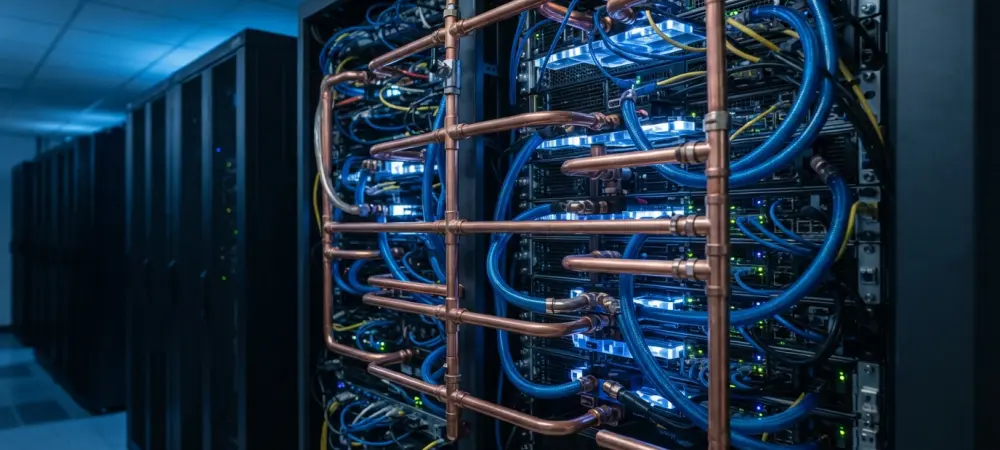
The Evolution of Thermal Management in the AI Era
The recent forty billion dollar acquisition of Aligned Data Centers by a consortium led by BlackRock and MGX serves as a clear indicator that cooling infrastructure has become the most valuable asset in the modern compute landscape. As artificial intelligence models expand, the heat generated by high-density racks has pushed traditional thermal management to its limits. This evolution represents a fundamental shift toward advanced hybrid systems that prioritize performance and waterless sustainability. The transition from legacy air cooling to high-efficiency solutions is now the backbone of global digital transformation.
Market Dynamics and the Shift Toward High-Efficiency Cooling
Statistical Growth and Adoption Trends: Infrastructure Investment
Capital influx into the sector is accelerating as providers race to support power-hungry GPUs. The Delta Cube 3.0 technology exemplifies this trend, offering a ten percent boost in cooling capacity and energy efficiency without expanding the physical footprint of the data hall.
Manufacturing strategies have also shifted toward U.S.-based production in Texas and Virginia. This move secures critical supply chains, ensuring that infrastructure remains resilient against global disruptions while meeting the 2026 benchmarks for operational uptime.
Real-World Implementation: Technological Integration
Early adopters are already leveraging these advancements to maintain a competitive edge in international markets. In regions like Brazil, firms such as Odata have successfully integrated closed-loop, waterless systems to bypass the environmental risks of traditional water-cooled towers.
Similarly, Houston-based Netrality has deployed these solutions to support extreme-density racks. These implementations prove that high-performance compute does not require the sacrifice of local ecological resources or excessive water consumption.
Expert Perspectives on Air-Side and Liquid Cooling Hybridization
Engineers argue that the most effective designs now utilize a hybrid architecture, blending air-side solutions with liquid cooling like DeltaFlow. This flexible approach allows operators to handle diverse workloads ranging from standard enterprise apps to intensive machine learning. By optimizing heat exchangers and fan impellers, facilities redirect power from cooling to revenue-generating hardware. Air cooling remains a vital, adaptable component of design even as immersion technologies gain traction across the industry.
Future Outlook: Sustainability and the Scalability of Compute
The move toward waterless environments will define the next phase of infrastructure development. Specialized cooling labs are currently testing R&D breakthroughs that aim to balance immense power requirements with global carbon neutrality mandates. These developments are essential for scaling compute resources in water-stressed regions. The goal is to maintain the reliability of the digital economy while eliminating the operational water footprint of high-density facilities.
Conclusion: Navigating the High-Density Frontier
The industry successfully navigated the high-density crisis by adopting versatile cooling platforms that bridged the gap between air and liquid technologies. These advancements provided a framework for growth while addressing the critical need for resource conservation. Investing in domestic manufacturing and specialized R&D proved to be the decisive factor in maintaining stability. Future strategies focused on optimizing waterless systems for even more intensive generative models. Success eventually depended on the ability to integrate hybrid solutions that scaled alongside the relentless growth of machine learning.