

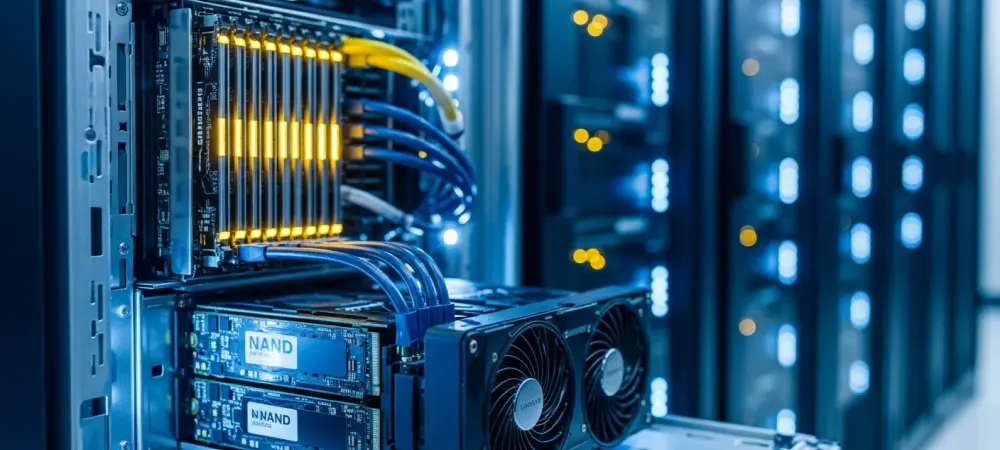
The relentless expansion of artificial intelligence has pushed conventional data center architectures to their breaking point, revealing the central processing unit as an unexpected bottleneck in an era that demands unprecedented speed. As organizations grapple with datasets of staggering size and complexity, traditional storage paradigms are proving inadequate, unable to feed the voracious appetite of modern AI workloads. This analysis explores the ascent of GPU-accelerated storage, a transformative trend that offloads intricate storage operations to massively parallel processors, unlocking new frontiers of performance and efficiency.
This emerging paradigm is not merely an incremental upgrade; it represents a fundamental rethinking of how data is stored, accessed, and processed. It addresses the critical chokepoints that emerge when vast AI models interact with their underlying data, a problem that CPUs were never designed to solve. By examining the core technologies, market trajectory, and real-world applications, a clearer picture emerges of a paradigm shift in progress. This analysis will provide a comprehensive look at why GPU-accelerated storage is not just an incremental improvement but a fundamental architectural shift, essential for powering the next generation of AI and data-intensive computing. Furthermore, it will explore the profound and often disruptive ripple effects this trend is causing across the tech industry, from creating new friction between strategic partners to triggering significant global supply chain challenges that will affect enterprises of all sizes.
The Ascent of a New Storage Architecture
Market Drivers and Adoption Statistics
The primary catalyst for this architectural revolution is the explosive demand for artificial intelligence infrastructure. As AI models grow in sophistication, their hunger for data and computational resources intensifies, creating performance bottlenecks that legacy systems cannot overcome. Nvidia’s Vera Rubin platform, for example, starkly illustrates this new reality, requiring a staggering 16 terabytes of NAND flash per GPU. This single specification signals the creation of a massive new source of demand for high-performance memory, fundamentally reshaping the supply and demand dynamics of the entire storage market.
This technological necessity is driving adoption from niche, specialized applications toward the enterprise mainstream. In a clear signal of industry-wide consensus, major vendors such as Dell, HPE, IBM, Pure Storage, and Supermicro are publicly announcing their support for new GPU-centric storage platforms. This broad backing is not speculative; it is a direct response to the urgent needs of cloud providers and frontier AI model developers who are struggling to manage performance in their large-scale inference systems. The industry is collectively acknowledging that the old way of doing things is no longer viable. The shift is therefore driven by a clear and present pain point: the inefficiency of moving massive datasets, particularly the key-value (KV) cache used during AI inference, across traditional networks. This constant data shuffling consumes valuable resources and creates latency that hampers the performance of complex, long-running AI processes. The new architecture is explicitly designed to solve this problem, indicating a market that is maturing rapidly from theoretical concepts to practical, widely supported solutions.
Pioneering Technologies and Use Cases
At the forefront of this technological wave is Nvidia’s Inference Context Memory Storage (ICMS) platform, a flagship example of the new architecture in action. This system directly targets the KV cache bottleneck by creating a pooled, extended memory system that leverages BlueField DPUs and high-speed NVMe SSDs. By centralizing the KV cache for an entire GPU cluster and managing it through a high-speed fabric, ICMS drastically reduces the network traffic that previously plagued large-scale AI inference, streamlining operations and boosting efficiency.
Nvidia is not alone in this pursuit, as both competitors and partners are developing parallel solutions to address the same fundamental challenge. Weka, for instance, has introduced its “Augmented Memory Grid,” another approach designed to deliver memory-class performance for AI workloads. In a notable strategic maneuver, Vast Data has announced a deep integration that will allow its software to run directly on Nvidia’s BlueField-4 DPUs. These different approaches, from purpose-built platforms to software integrations, highlight a vibrant and competitive ecosystem coalescing around the core principle of GPU-centric storage. The primary use case for these pioneering technologies involves next-generation AI systems that must manage enormous datasets that are actively in use. These systems perform frequent recomputations and require near-instantaneous access to petabytes of data, a task for which traditional storage architectures, with their inherent latency and CPU-bound processes, are completely ill-equipped. This is not about storing cold data; it is about creating a high-performance tier of active data that acts as an extension of GPU memory itself.
Expert Commentary on Industry Disruption
Industry analysts characterize this trend as nothing short of a “radical departure” from traditional storage design. Simon Robinson of Omdia emphasizes that these systems are engineered from the ground up for memory-class performance and latency, which fundamentally alters the architectural assumptions that have guided the storage industry for decades. The focus is no longer on simply storing bits and bytes but on delivering data at a speed and scale that matches the processing power of modern GPUs, effectively blurring the lines between storage and memory. This architectural shift is also creating significant competitive friction within long-standing technology partnerships. Experts observe that Nvidia’s direct entry into the storage solutions space forces its partners to navigate a complex and delicate relationship. These partners must now re-evaluate their own roadmaps and clearly articulate a differentiated value proposition that complements, rather than competes with, Nvidia’s offerings. The dynamic has shifted from simple collaboration to a more intricate dance of “coopetition,” where companies are simultaneously partners and potential rivals.
The conspicuous absence of key players like NetApp from initial platform support announcements has fueled intense speculation among industry watchers. Analysts like Brent Ellis of Forrester and Rob Strechay of TheCube Research suggest this may be due to direct product overlap. Ellis points to similarities between Nvidia’s ICMS and the data services layer within NetApp’s own AI Data Engine. Strechay offers a complementary view, suggesting that the underlying architecture of NetApp’s legacy OnTap file system may present technical challenges in adapting to the new, disaggregated model promoted by Nvidia. While NetApp has cited a desire to keep product plans confidential, the situation underscores the strategic dilemmas facing established vendors in this new landscape.
Future Projections Economic and Strategic Implications
Perhaps the most significant and far-reaching challenge stemming from this trend is the exacerbation of a global NAND flash memory shortage. The immense memory requirements of new GPU platforms are injecting an unprecedented level of demand into a market already under severe strain from existing AI infrastructure growth. This collision of soaring demand and constrained supply is already driving up costs for all IT buyers, from hyperscale cloud providers to mainstream enterprises.
The economic consequences are direct and unavoidable. Industry leaders are already confirming the impact on their bottom lines and pricing strategies. Dell’s COO, Jeffrey Clarke, has explicitly identified rising NAND costs as a primary driver of price increases across the company’s product portfolio. This is not a temporary blip but a sustained trend that is expected to continue, forcing organizations globally to re-evaluate their IT budgets and brace for higher hardware expenditures.
Looking ahead, the availability of flash memory may evolve from a simple supply chain issue into a critical strategic bottleneck. According to Forrester, access to sufficient flash memory could become a determining factor in “who is able to actually develop technologies and who is not.” This dynamic upends the long-held industry assumption of cheap, abundant storage, transforming it into a prized and potentially scarce resource. Consequently, organizations will be compelled to prioritize efficiency and rethink their long-term data management strategies in a new, capacity-constrained environment where performance comes at a premium.
Conclusion Redefining the Future of Data
GPU-accelerated storage is an undeniable and disruptive force, driven by the insatiable demands of artificial intelligence. It solves critical performance challenges but introduces complex market dynamics and severe supply chain pressures. This trend marks a definitive break from the past, challenging established industry leaders and creating opportunities for innovators to redefine the storage landscape. The intricate balance between technological advancement and market stability is being tested as never before.
This trend signals a pivotal moment for the storage industry. The focus is shifting from simple capacity to memory-class performance, forcing a re-evaluation of data center architecture from the ground up. The lines between memory, storage, and networking are blurring, giving rise to a more holistic, integrated approach to data management. This architectural convergence is essential for unlocking the full potential of AI and other data-intensive workloads that will define the next decade of computing. All organizations, not just those at the forefront of AI, must prepare for this new reality. The era of cheap, limitless storage is ending, and success will depend on the ability to adapt to a landscape where performance, efficiency, and strategic resource management are paramount. The choices made today about data architecture will have long-lasting implications, determining an organization’s ability to compete and innovate in an increasingly data-driven world.