

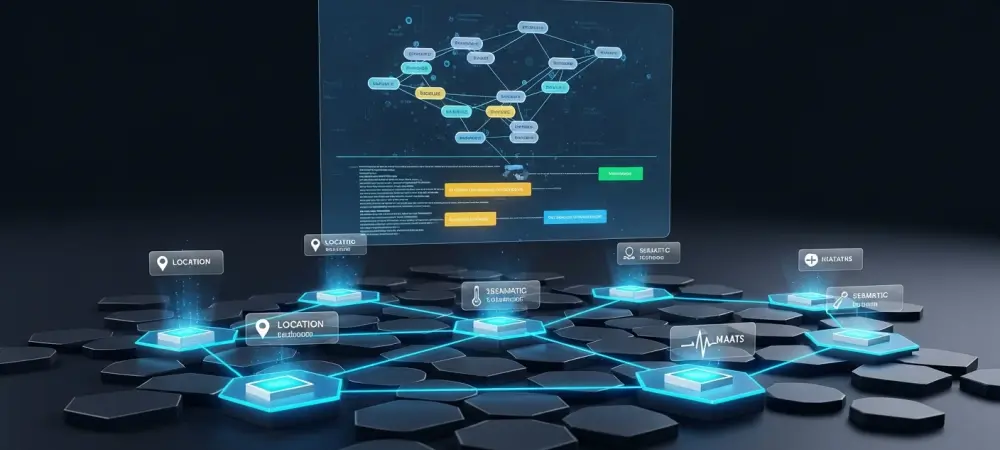
The traditional obsession with maximizing raw bitrates is finally hitting a wall as global data traffic prepares for a projected thousand-fold increase by the early 2030s. The transition from 5G to 6G marks a fundamental shift in the philosophy of telecommunications: moving from the quantitative pursuit of “more data” to the qualitative pursuit of “better meaning.” While 5G pushed the boundaries of bandwidth and latency, 6G is set to introduce Semantic Communication (SemCom), a paradigm where the network understands the context of the information it carries. At the heart of this evolution is the emergence of Explicit Semantic Bases (Sebs), a breakthrough that moves beyond “black box” AI to create interpretable, efficient, and protocol-compatible networks. This article explores how explicit semantic modeling is redefining the future of mobile connectivity and why it is considered the cornerstone of intelligence-native 6G infrastructure.
The Shift Toward Explicit Semantic Modeling in Next-Gen Networks
Statistical Growth and the Evolution of Semantic Standards
Current 6G research indicates a decisive move away from bit-level transmission toward semantic-level efficiency. This trend is driven by the realization that transmitting every single bit of an image or video is often redundant if the receiver only needs to understand the “intent” of the message. By focusing on the underlying meaning, networks can bypass the physical limitations of the radio spectrum. Adoption statistics from leading research institutions, such as the Beijing University of Posts and Telecommunications, show that semantic-based systems can achieve a 20% improvement in perceptual quality (LPIPS) compared to traditional neural network models.
Industry reports highlight a growing trend in “Intelligence-Native” designs, where the network’s primary metric shifts from bit error rate (BER) to successful “intent delivery.” This reflects a broader transition in global telecommunications standards as engineers prioritize how well a machine or human understands the received data rather than how perfectly the bits were reconstructed. As we move from 2026 toward the 2030 commercialization window, this metric will likely become the gold standard for evaluating network performance in crowded urban environments.
Real-World Applications and the Implementation of Sebs
Case studies in high-bandwidth environments, such as Extended Reality (XR) and immersive Digital Twins, demonstrate how Explicit Semantic Bases (Sebs) allow for high-fidelity rendering with reduced data overhead. In these scenarios, the network identifies the most vital “semantic units”—like the movement of a person’s hands in a virtual space—and prioritizes their transmission over less critical background details. Notable collaborations between the University of Houston and industry partners have successfully mapped multimodal data—text, image, and video—into shared feature spaces. This ensures that the meaning remains consistent even if a user switches from a video feed to a text-based summary.
Practical hardware implementations are currently utilizing “Semantic Intelligence (SI) planes” to bridge the gap between application-layer intent and physical-layer resource scheduling. This architectural addition proves that semantic models can be integrated into existing 3GPP-compliant infrastructure without requiring a total overhaul of the world’s cell towers. By layering semantic intelligence over established protocols, providers can offer “meaning-aware” services that feel faster and more responsive to the end user, even when the actual bandwidth remains unchanged.
Expert Perspectives on the Explicit Semantic Paradigm
Industry thought leaders emphasize that the “Explicit” nature of Sebs is the definitive solution to the interpretability crisis in AI-driven communications. Traditional deep learning models often act as “black boxes,” making it nearly impossible for engineers to troubleshoot why a certain message was misinterpreted. In contrast, an explicit framework allows engineers to audit and refine the “knowledge” stored within the network. This transparency is crucial for gaining regulatory approval in sensitive sectors like healthcare or autonomous transport, where the “why” behind a data failure is just as important as the failure itself.
Professionals in the field also highlight the advantage of “adjustable granularity,” which allows the network to act like a zoom lens for data. Experts can program the network to switch between fine-grained and coarse-grained data transmission based on real-time resource availability. For instance, during a peak traffic period, a 6G network might transmit a “coarse” semantic representation of a security camera feed to save power, only switching to “fine” detail when the AI detects an anomaly that requires human intervention. This flexibility ensures that the network never collapses under its own weight during high-demand events. There is a growing consensus among 6G architects that the ability to update Knowledge Bases (KBs) without retraining entire neural networks is a critical leap forward. In previous iterations of AI-based communication, adding a new concept or language required a massive computational effort to retrain the entire system. With the Seb approach, the network can simply “plug in” new semantic bases as needed. This modularity makes the infrastructure sustainable and scalable, allowing it to evolve alongside human language and technical requirements without a massive carbon footprint.
Future Implications for Global Connectivity and Infrastructure
The future of 6G will likely rely on “Intelligent Evolution,” where networks dynamically add or remove semantic information based on the “Age of Information” and specific user requirements. This means the network will become a living entity that learns which data is most valuable to its specific geographical region. A network in a rural farming community might prioritize semantic data regarding soil moisture and drone flight paths, while a network in a financial hub would focus on the sub-millisecond nuances of trading data. This hyper-localization will redefine the efficiency of global infrastructure.
The broader implication for industries like remote surgery and autonomous transportation is a massive increase in reliability. By using Unequal Error Protection (UEP), 6G networks can prioritize the most vital semantic “units” to ensure safety-critical data arrives intact even in poor conditions. For a remote surgeon, this might mean that the visual clarity of the surgical site is protected by the strongest error-correction protocols, while background room audio is allowed to degrade slightly. This specialized protection makes 6G not just faster, but fundamentally safer for mission-critical applications.
Challenges remain regarding the global synchronization of Knowledge Bases, yet the potential benefits position explicit semantic communication as the dominant 6G architecture. To achieve a truly global standard, different manufacturers and nations must agree on a shared “dictionary” of semantic bases. While the technical path is clear, the geopolitical coordination required to align these digital libraries will be the next great hurdle for the telecommunications industry. Those who master the explicit semantic framework first will likely set the rules for the global digital economy for decades to come.
Summary of the Semantic Transformation in 6G
The shift from implicit “black box” systems to explicit, interpretable semantic frameworks prioritized the utility and meaning of data over raw volume. This transition addressed the looming spectrum crisis by ensuring that every transmitted bit served a specific, understood purpose within a broader context. The integration of Explicit Semantic Bases (Sebs) provided a scalable, 3GPP-compatible path toward the intelligence-native networks required for the next decade of digital services. As the industry approached the commercialization of 6G, the adoption of explicit semantic modeling became the defining factor in creating a truly connected, context-aware global society that valued the quality of communication over the mere quantity of data.