

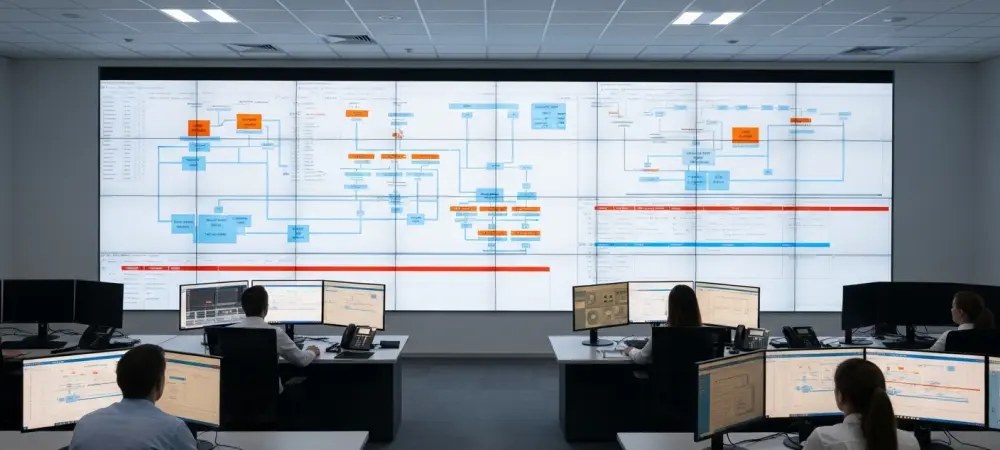
The fundamental question echoing through boardrooms and development teams is no longer about the potential power of artificial intelligence but how to reliably harness that power for mission-critical operations. While generative AI has adeptly captured the public imagination with its creative and conversational abilities, the next frontier for business is the rise of enterprise-grade AI reasoning. This evolution centers on developing systems engineered for accuracy, reliability, and verifiable logic, capable of operating flawlessly in high-stakes environments where errors are not an option.
This analysis examines the accelerating trend of structured AI reasoning, a movement from unpredictable creative models to disciplined, logical agents. Using the foundational partnership between OpenServ, an AI agent-building suite, and Neol, a network intelligence company, as a central case study, this article explores the market drivers, real-world applications, expert insights, and future trajectory of this transformative technology. It is a shift that promises to redefine how organizations deploy AI, moving it from the sandbox into the core of their operational strategy.
The Accelerating Shift Toward Production-Ready AI
From Experimental Models to Essential Business Logic
A strategic pivot is underway in AI investment, with capital and resources flowing away from general-purpose Large Language Models (LLMs) and toward specialized, production-grade systems. These systems are not designed to do everything but to perform specific business functions with unwavering consistency. Industry reports consistently identify a critical barrier to wider AI adoption in regulated sectors like finance, government, and network intelligence. The issue is not a lack of computational power but a significant deficit in reliability and predictable reasoning, which are non-negotiable requirements for these fields.
This market maturation is further evidenced by the growth in “foundational design partnerships.” Unlike traditional client-vendor relationships, these collaborations involve companies co-developing solutions to bridge the gap between AI’s theoretical potential and the practical demands of enterprise reality. This hands-on, collaborative approach signifies that the industry is moving past the initial hype cycle and is now focused on the difficult but necessary work of building AI that businesses can truly depend on.
A Case Study in Action: The OpenServ and Neol Alliance
The partnership between OpenServ and Neol exemplifies the trend of hardening AI in demanding, real-world environments. Neol, a company specializing in network intelligence, applies OpenServ’s AI framework to its platform, which is used by government and enterprise clients to reason over complex networks of people, programs, and data. This allows them to execute strategic initiatives, such as talent sourcing and innovation programs, with greater precision and insight.
At the heart of this collaboration is OpenServ’s proprietary “structured reasoning” framework, a methodology designed to instill discipline into AI processes. This framework relies on two core principles. The first, Workflow Decomposition, breaks down complex tasks into a series of smaller, verifiable steps, creating a clear and auditable trail of logic. The second, Bounded Decision-Making, constrains the AI’s actions within safe, predefined logical boundaries, preventing unpredictable behavior and ensuring that its operations remain compliant and aligned with business objectives.
Insights from the Innovators Shaping the Trend
The core challenge of modern AI implementation is articulated by Tim Hafner, CEO of OpenServ: “Enterprise AI doesn’t break because models are weak; it breaks when AI’s reasoning capabilities aren’t designed for reality.” This statement underscores the critical need for systems engineered specifically for the complexities and pressures of live production environments. It suggests that the path forward is not simply building larger models but designing smarter, more resilient frameworks that can handle the unpredictability of the real world.
Akar Sumset, CPO of Neol, reinforces the collaborative model required for this kind of innovation, stating that a “true design partnership is one where both teams are actively shaping the technology together.” This highlights the importance of creating a symbiotic feedback loop where real-world application directly informs and improves the core technology. The insights gained from Neol’s high-stakes operational environment are fed back to OpenServ, allowing for continuous refinement of the reasoning framework.
These expert perspectives converge on a single, powerful idethe future of enterprise AI lies not in the raw power of models alone but in the disciplined frameworks that govern them. It is this combination of intelligence and structure that will ultimately deliver the reliability, verifiability, and alignment with business goals that enterprises require to move AI from a promising experiment to an indispensable asset.
The Future of Autonomous Enterprise Operations
The Broader Impact Across Industries
The successful implementation of structured AI reasoning in network intelligence serves as a powerful blueprint for other complex, regulated sectors. Industries such as supply chain management, compliance monitoring, and strategic resource allocation face similar challenges, where processes are intricate and the cost of error is high. The principles of workflow decomposition and bounded decision-making validated by the OpenServ and Neol alliance are directly transferable to these domains.
A key development on the horizon is the productization of these battle-tested reasoning patterns. For instance, OpenServ is integrating the lessons learned from its partnership with Neol directly into its core platform. This strategic move democratizes access to enterprise-grade AI reliability, allowing a much wider user base to build agents with proven, production-hardened logic. The long-term benefit is the creation of truly autonomous agents capable of executing multi-step, mission-critical business processes with minimal human oversight, driving unprecedented efficiency and strategic capability across the board.
Overcoming the Hurdles to Widespread Adoption
Despite the promise, significant challenges remain. A primary hurdle is ensuring that these advanced AI systems can operate flawlessly within strict regulatory and compliance frameworks, where errors carry severe financial and reputational consequences. As AI takes on increasingly critical functions, establishing clear accountability, transparency, and traceability for its decisions will become paramount for effective risk management.
Furthermore, the successful integration of these systems requires more than just technical prowess; it demands organizational trust. The potential negative outcome of a failed implementation is not just immediate financial loss but a long-term erosion of confidence in AI systems. Such a setback could slow innovation and adoption across the entire enterprise landscape, delaying the benefits of autonomous operations for years to come. Therefore, a careful, validated, and transparent approach is essential.
Conclusion: Engineering AI for the Real World
The trend toward enterprise-grade AI reasoning marked a pivotal evolution, shifting the industry’s focus from general-purpose models to specialized, reliable systems designed for mission-critical work. This movement was not about diminishing the power of AI but about channeling it through disciplined frameworks that ensured consistency and verifiability. The OpenServ and Neol partnership demonstrated a successful model for this evolution, proving that the combination of structured reasoning and rigorous real-world validation was the key to unlocking AI’s true business potential. Their collaboration became a blueprint for hardening AI, making it resilient enough for the pressures of live, regulated environments. For business leaders, the takeaway was clear: it was time to look beyond the hype of generative models and invest in the engineering that would power the next generation of autonomous enterprise operations. The ultimate goal was achieved—moving AI “outside of demos and inside real production.”