

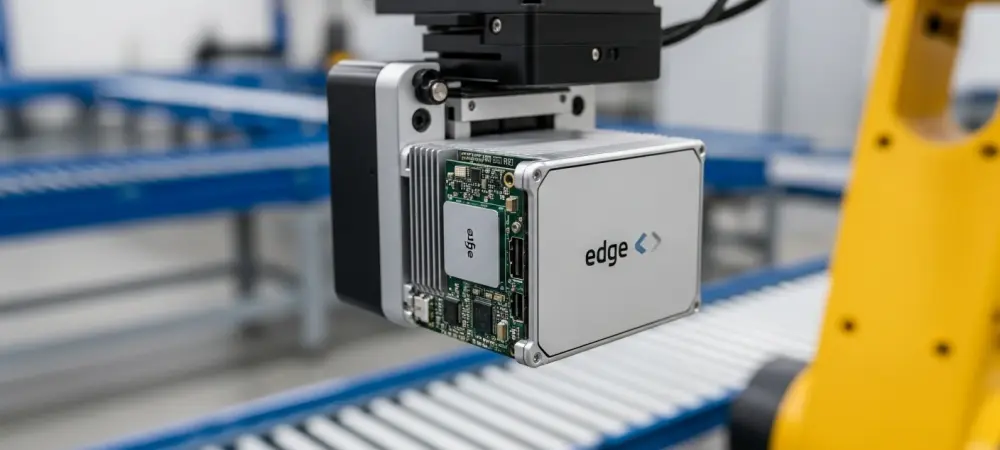
The fundamental laws of physics have quietly imposed a hard ceiling on the dream of a fully cloud-controlled smart warehouse, as the inescapable delay in sending data to a remote server and back becomes the primary bottleneck in high-speed logistics. For the kinetic, chaotic, and unforgiving environment of modern fulfillment centers, this “latency trap” is more than an inconvenience; it is an operational and safety-critical failure point. This physical limitation is now forcing a fundamental redesign of automation architecture, sparking a paradigm shift away from centralized cloud intelligence. The following analysis explores the drivers, real-world applications, future trajectory, and economic impact of migrating artificial intelligence from the distant cloud directly to the operational edge.
Market Momentum and On the Ground Application
The Latency Imperative: Data Driving the Shift to the Edge
The physical distance between a warehouse floor and a cloud data center creates a non-negotiable delay, with typical round-trip times (RTT) for data packets ranging from 50 to over 500 milliseconds. While this may seem insignificant for many enterprise applications, it represents an eternity in a dynamic robotic environment. A 200-millisecond delay in processing a sensor input can turn a 500kg Autonomous Mobile Robot (AMR) moving at speed into a significant safety liability, as its reaction time is far too slow to avoid a sudden obstacle or a human worker. This inherent lag makes cloud-based control fundamentally unsuitable for real-time navigation and collision avoidance, where decisions must be made in single-digit milliseconds.
Consequently, there is a growing industry consensus that reliance on remote servers for critical, moment-to-moment functions constitutes an unacceptable operational risk. Beyond the baseline latency, network instability and environmental interference introduce further variables that can cripple a cloud-dependent fleet. The dense metal racking common in warehouses can act as a Faraday cage, creating Wi-Fi dead zones and packet loss that would cause a robot to freeze or behave erratically. The industry is recognizing that for automation to be truly autonomous, its intelligence cannot be tethered to a connection that is, by its nature, fragile and distant.
Edge AI in Action: Real World Warehouse Implementations
The practical answer to this challenge is now being deployed at scale in warehouses globally. AMRs are increasingly equipped with powerful on-device System-on-Modules (SoMs), such as those in the NVIDIA Jetson series, which allow them to run sophisticated AI models for instantaneous inference. This embedded processing power enables them to perceive their environment through cameras and LiDAR, perform complex obstacle avoidance calculations, and adjust their path in real time, all without ever querying a remote server. This self-contained decision-making capability is the cornerstone of safe and efficient robotic navigation in shared human-robot workspaces.
Beyond navigation, computer vision has emerged as the “killer application” for edge AI in logistics, offering a path to finally supersede the 50-year-old barcode. By running object detection and recognition models directly on cameras, warehouses are implementing “passive tracking,” where items are identified and monitored continuously based on their unique visual features like logos, packaging, or text. This localized processing is what makes the technology viable; streaming high-definition video from hundreds of cameras for cloud-based analysis would be economically and technically infeasible due to the immense bandwidth requirements.
This on-device intelligence is revolutionizing quality control and error prevention. For example, smart cameras mounted over conveyor belts or sorting stations now run computer vision models locally to identify and flag misplaced items in real time. If a product destined for one shipping lane is mistakenly placed on another, the edge system can instantly trigger an alert or activate a diverter arm. This immediate intervention prevents costly supply chain errors from propagating downstream, saving significant resources that would otherwise be spent on reverse logistics and customer service resolutions.
Industry Perspective: Redefining Automation Architecture
This technological migration reflects a profound architectural inversion within the industry. The once-dominant model of a centralized “Hive Mind”—where a single, powerful cloud-based brain dictates the actions of a fleet of “dumb drones”—is rapidly being replaced by a decentralized “Swarm Intelligence” model. In this new paradigm, each robot, conveyor, or sensor is an autonomous agent with its own computational power, capable of making independent decisions based on its immediate surroundings. This distribution of intelligence creates a system that is not only faster but also more resilient, as the failure of a single unit or a network outage does not bring the entire operation to a halt.
This architectural trend is reinforced by a powerful economic argument. The cost of streaming high-definition video and sensor data from hundreds of robots to the cloud 24/7 is prohibitive. By processing this raw data at the edge, a robot can distill terabytes of information into small, essential packets of metadata. Instead of a continuous video feed, it might simply transmit a message like, “Obstacle detected at coordinates (X, Y)” or “Package ID 123 successfully sorted to Bin 7.” This dramatic reduction in bandwidth consumption makes it economically viable to scale robotic fleets from dozens to thousands of units, a critical factor for large-scale fulfillment operations.
As a result, the role of the cloud in warehouse automation is being fundamentally redefined. It is not becoming obsolete but is instead shifting to higher-level functions where latency is not a critical factor. The expert consensus confirms that the cloud’s domain is now long-term data aggregation, big-data analytics for identifying macro-level operational trends, and, crucially, the initial training of the complex AI models. Once trained, these models are deployed to the edge, which has become the undisputed domain for real-time operational execution and instantaneous decision-making.
The Road Ahead: Future Trajectories and Enabling Technologies
Looking forward, the modern warehouse is evolving into a “physical neural network.” In this vision, every component—from the AMRs and robotic arms to the conveyors and even the overhead lighting—becomes an intelligent node. Each node will possess its own processing capabilities, allowing it to analyze local data and communicate with its neighbors to self-optimize the flow of goods, people, and information across the entire facility. This interconnected system promises a level of efficiency and adaptability far beyond what centralized control could ever achieve.
A key enabling solution for this decentralized future is Federated Learning, which elegantly solves the “Data Gravity” challenge. Data gravity describes the difficulty of moving massive datasets, which tend to remain where they were generated. Instead of transferring raw data from hundreds of robots to the cloud for retraining a global AI model, federated learning allows the model updates to happen locally on each device. Only the lightweight mathematical learnings, not the private sensor data, are sent back to a central server. These insights are then aggregated to create a new, improved global model that is distributed back to the entire fleet, allowing every robot to learn from the unique experiences of its peers without overwhelming the network.
This evolving architecture clarifies the symbiotic role of private 5G networks. Far from being a replacement for edge computing, 5G serves as the high-performance “nervous system” that makes swarm intelligence possible. Its low latency and high reliability, especially in challenging radio-frequency environments like a warehouse, provide the robust communication layer necessary for intelligent edge devices to coordinate with one another. This allows for sophisticated machine-to-machine (M2M) collaboration, such as one robot broadcasting a spill location to warn others, creating a truly responsive and collaborative automated ecosystem.
Conclusion: From Physical Assets to Compute Density
The analysis revealed that Edge AI emerged as the definitive and necessary solution to the latency, safety, and economic challenges that were inherent in early, cloud-centric approaches to warehouse automation. Its adoption was not merely an incremental improvement but a fundamental pivot required to unlock the true potential of autonomous logistics in the physical world.
Ultimately, the most significant outcome of this trend was the redefinition of competitive advantage in the logistics sector. Superiority was no longer measured solely by physical assets like warehouse square footage or the number of delivery trucks. Instead, market leadership became increasingly dependent on “compute density”—the strategic capability to deploy powerful, intelligent, and autonomous decision-making at the furthest operational edge, right where goods are being moved and sorted.
It became evident that for a global economy demanding ever-faster delivery and flawless execution, the speed of light itself had imposed a final, non-negotiable constraint on remote processing. This physical reality cemented local, instantaneous computation not just as a preference, but as the only viable path forward for the future of automated fulfillment.