

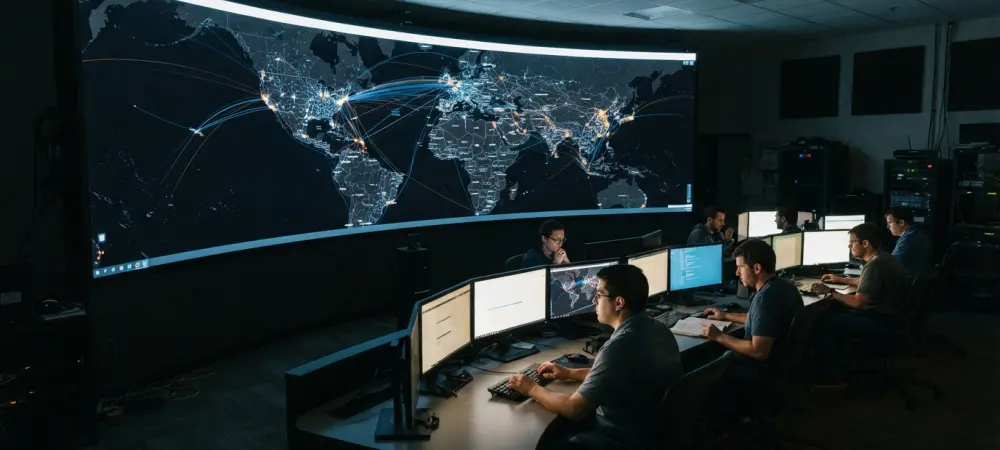
The days of managing a sprawling patchwork of forty different security vendors are rapidly coming to an end as the industry gravitates toward massive, all-encompassing platforms. This evolution is not merely a trend of convenience but a fundamental transformation in how global enterprises defend their digital perimeters. As breaches become more sophisticated, the friction caused by disparate tools has turned into a critical vulnerability. Organizations are now prioritizing seamless integration over individual feature sets, signaling the dawn of the platformization era where automated speed and unified visibility reign supreme.
The Shift Toward Unified Security Ecosystems
Market Data and Consolidation Statistics
The financial scale of recent transactions highlights a desperate race for dominance among the biggest players in the sector. Google’s staggering $32 billion bid for Wiz and Palo Alto Networks’ $25 billion acquisition of CyberArk demonstrate that cash-rich tech giants are willing to pay a massive premium to own the entire security stack. Furthermore, the market recently witnessed a dramatic 18% surge in Zscaler’s valuation following rumors of a potential merger with CrowdStrike. These fluctuations reflect a broader investor belief that the market belongs to companies that can provide a single pane of glass for identity and endpoint protection. This consolidation trend is fueled by the logistical nightmare of managing fragmented best-of-breed portfolios. Security teams are exhausted by the overhead required to maintain dozens of APIs and distinct management consoles that rarely speak the same language. By moving toward a unified ecosystem, companies can shed the technical debt associated with multi-vendor environments, redirecting their resources toward proactive threat hunting rather than mundane integration maintenance.
Practical Applications and Technical Synergy
The true value of this convergence lies in the technical marriage of endpoint intelligence and network enforcement. In a closed-loop security model, the CrowdStrike Falcon platform can identify a compromised laptop in seconds and immediately trigger Zscaler’s Zero Trust Exchange to revoke its access to internal applications. This level of automation eliminates the human bottleneck that typically occurs when a security analyst must manually pivot between different tools to contain a breach. Integrated platforms significantly lower the mean time to respond (MTTR) by synchronizing telemetry across the entire infrastructure. When identity verification and threat detection live under one roof, administrative workflows become remarkably streamlined. Operations teams no longer have to reconcile conflicting data logs from various sources, allowing them to focus on high-level strategy while the platform handles the automated isolation of suspicious traffic.
Industry Perspectives on Vendor Convergence
Cybersecurity analysts remain divided on whether this shift ultimately benefits the end user or simply enriches the dominant platform providers. While consolidation solves the integration tax that has plagued IT departments for decades, it also creates significant technical hurdles for the vendors themselves. Merging massive, distinct cloud architectures into a single interface is a Herculean task that often results in fragmented backends despite a unified front-end interface. Moreover, Chief Information Security Officers (CISOs) are growing wary of the diminishing competitive landscape. While operational simplicity is a seductive promise, the risk of reduced innovation from pure-play vendors is a legitimate concern. If a few giants control the majority of the market, the pressure to iterate quickly might fade, leaving enterprises with fewer choices and less leverage during contract renewals.
Future Outlook and Industry Implications
Looking ahead, the potential for vendor lock-in will likely dictate how enterprise security budgets are allocated from 2026 to 2028. As organizations become deeply embedded in a single ecosystem, the cost of switching becomes prohibitively high, potentially leading to aggressive pricing hikes. Procurement strategies will need to evolve to include robust exit plans and a renewed focus on ensuring that these platforms remain compatible with emerging open standards.
The long-term impact on global digital defense is equally profound as a few entities begin to manage the majority of the world’s network traffic and endpoint data. This concentration of power could either lead to a more resilient global defense through massive data sharing or create a single point of failure that state-sponsored actors could exploit. Whether platformization encourages or stifles third-party innovation remains a critical question for the next several years.
Summary of the Platformization Era
The strategic moves made by industry leaders like CrowdStrike and Zscaler set a new benchmark for how cybersecurity services are delivered and managed. Organizations must carefully navigate the delicate balance between achieving integrated efficiency and succumbing to strategic vendor dependency. These consolidation efforts shifted the focus from isolated defense mechanisms to a more holistic and automated approach that reshaped the digital landscape. Ultimately, the industry moved away from the chaos of fragmentation, favoring a structured environment where unified data became the primary weapon against sophisticated threats.